
Coldplay Drum Sheet Music — 6 Songs With Levels, BPM and Real Notation (Clocks, The Scientist, Paradise)

Coldplay songs are fairly easy on drums. Five of the six Coldplay songs in the DrumMate library sit at song-card Levels 3–7, and their average tempo is about 92 BPM — slower than the 107.6 BPM average of the library’s 434 songs in 4/4.
Below you’ll find a table of levels, BPM and main grooves for all six songs, seven notation examples copied straight from the song transcriptions, and the story of drummer Will Champion. Every example has a Listen button.
- Six Coldplay songs in the library: average Level 5.5 (library average 8.6), average about 92 BPM.
- The Scientist and My Universe use common 8-beat shapes, while Clocks (snare on 1, 2& and 4) and Something Just Like This (a main groove with no snare) are the only songs of 434 with their shapes.
- All seven examples are real bars from the song transcriptions (one groove bar, or the last two bars of the fill).
- Drummer Will Champion learned piano, violin and guitar first, and joined the band in 1998 by sitting in on drums at a demo session.
Six Coldplay Drum Songs at a Glance
Easiest first. “Main groove” is the kick and snare placement of the most common bar in each song’s four-bar groove, and the number in brackets is how many of the library’s 434 songs in 4/4 share that shape (the same method as The 10 Most Common Drum Beats — Kick and Snare Patterns Ranked From 434 Songs (Notation and Audio)). “Tricky part” is the sentence from each song page’s difficulty section.
| Song | Level | BPM | Main groove | Tricky part |
|---|---|---|---|---|
| The Scientist | 3 | 73 | Kick 1, 3, 3& + snare 2 and 4 (47 of 434 songs) | The kicks on beat 3 and its “and” are easy to confuse. |
| Everglow | 3 | 73 | Kick 1, 2& + snare 2 and 4 (11 songs) | Moving from the two sixteenth snares on 4 to the tom is tight. |
| My Universe | 3 | 101 | Kick on all four beats + snare 2 and 4 (58 songs) | On beat 3 the hi-hat stops and four sixteenth high toms follow. |
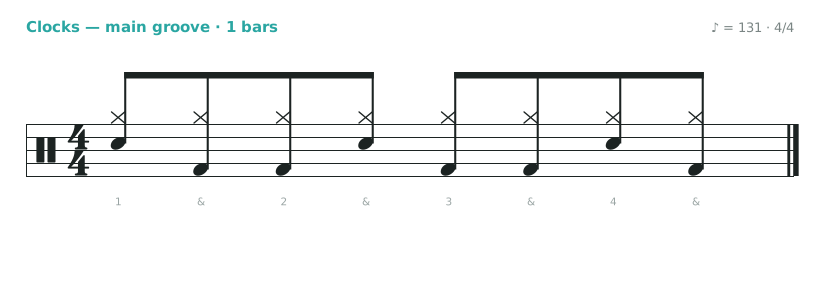
| Clocks | 4 | 131 | Snare on 1, 2& and 4 + kick on the other eighths (only this song) | The snare is off 2 and 4, so it takes time before it feels natural. |
| Something Just Like This | 7 | 103 | Kick on all four beats + crash, no snare (only this song) | With no snare, your reference point is gone — you have to count 2 and 4 internally. |
| Paradise | 13 | 70 | Sixteenth hi-hat + kick 1, 1a, 2&, 3e, 3& (2 songs) | The wrist must double its speed when moving from sixteenths to thirty-seconds. |
What the Data Says About Coldplay’s Drums
- Mostly slow and easy. Average Level 5.5 and about 92 BPM. Three songs are Level 3 (The Scientist, Everglow, My Universe); the hardest is Paradise at Level 13.
- A mix of common and one-of-a-kind grooves. My Universe’s “kick on four beats + snare on 2 and 4” appears in 58 of 434 songs, and The Scientist’s “kick 1, 3, 3&” in 47 — the second and fourth most common shapes in the library. The main grooves of Clocks and Something Just Like This, on the other hand, appear in no other song.
- A snare on beat 1 is rare. Only 6 of 434 songs have a snare on beat 1 in their main groove, and Clocks is one of them. Something Just Like This is the only song whose main groove has no snare at all.
- Short fills. The Scientist and Everglow use one-beat fills on beat 4, and two other songs — Twinkle (TaeTiSeo) and Let Her Go (Passenger) — have exactly the same snare and tom placement in their fill bar as Everglow.
Real Drum Notation, Song by Song
Each example is copied bar for bar from the song transcription. “Last two bars of the fill” means the final two bars of the four-bar fill window on the song page, which run straight on in the original track.
The Scientist (Level 3 · 73 BPM)
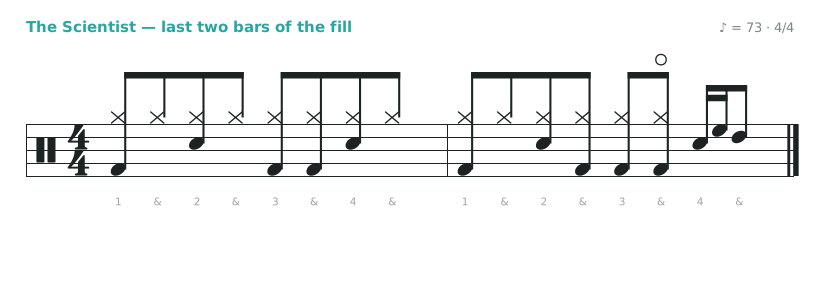
A ballad single from A Rush of Blood to the Head (2002). Kick on 1, 3 and 3& and snare on 2 and 4 over eighth-note hi-hat. In the second bar the kick moves to 2&, 3 and 3& with an open hi-hat on 3&, then a quick fill: snare on 4, high tom on 4e, mid tom on 4&.
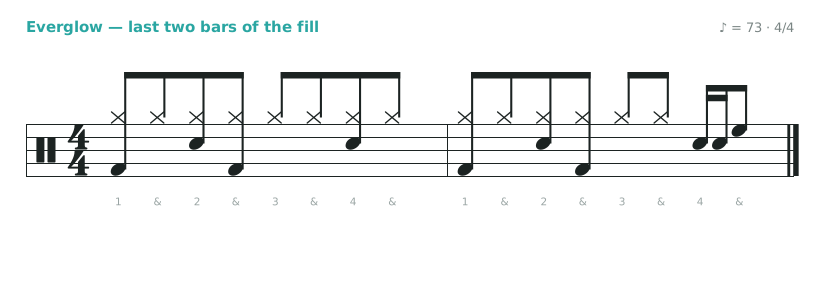
Everglow (Level 3 · 73 BPM)
A slow groove with the kick on 1 and 2&. The fill is just two sixteenth snares on 4 and 4e, then one high tom on 4&. Play it next to The Scientist at the same tempo and you’ll hear that only the kick changes.
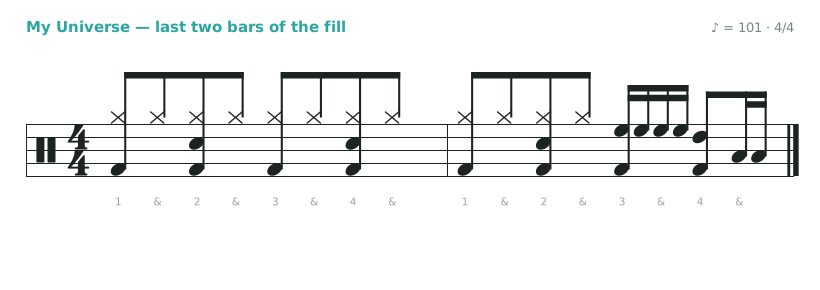
My Universe (Level 3 · 101 BPM)
Recorded with BTS, it was the first song by a British group to debut at number one on the Billboard Hot 100. The groove is kick on all four beats with snare on 2 and 4. In the fill the hi-hat stops on beat 3 for four sixteenth high toms, then the mid tom on 4 and floor tom on 4& and 4a.
Clocks (Level 4 · 131 BPM)
A single from A Rush of Blood to the Head (2002) that won the Grammy for Record of the Year. Split the bar’s eight eighth notes into 3+3+2 and the snare lands on the first note of each group (1, 2& and 4); almost every other eighth (1&, 2, 3, 3&, 4&) is a kick. It’s the 3-3-2 rhythm from The 3-3-2 Rhythm on Drums — The Tresillo Kick Pattern You Hear in Pop (Notation and Audio), played on the snare.
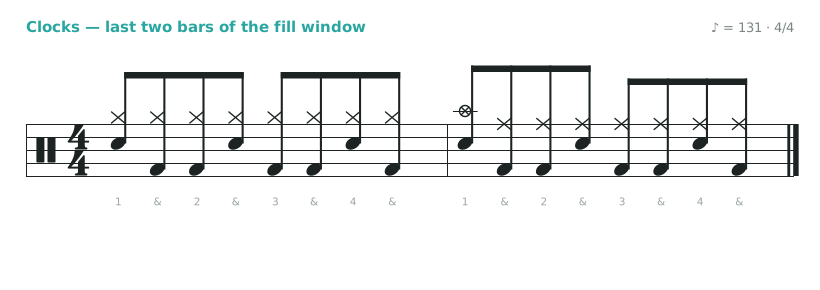
At the fill spot the rhythm stays the same — only the hands move from hi-hat to a crash on 1 and then the ride. Instead of a tom fill, the change of cymbal tells the band the next section is here.
Something Just Like This (Level 7 · 103 BPM)
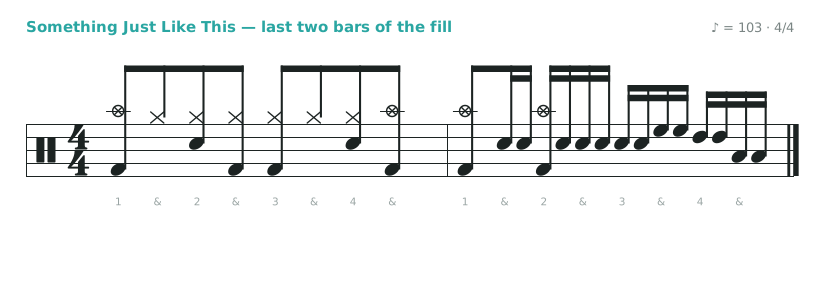
Coldplay’s song with The Chainsmokers. The main groove has no snare — just kick on all four beats with crash and hi-hat — so you have to count 2 and 4 in your head. The fill bar packs sixteenth snares between kick-and-crash hits on 1 and 2, then plays two notes each on high, mid and floor toms from 3&. That “two per tom from 3& to 4a” ending is common: 42 of 434 songs have it (see YB Drum Sheet Music — 4 Songs With Levels, BPM and Real Notation (나는 나비, 물고기와 자전거, 박하사탕)).
Paradise (Level 13 · 70 BPM)
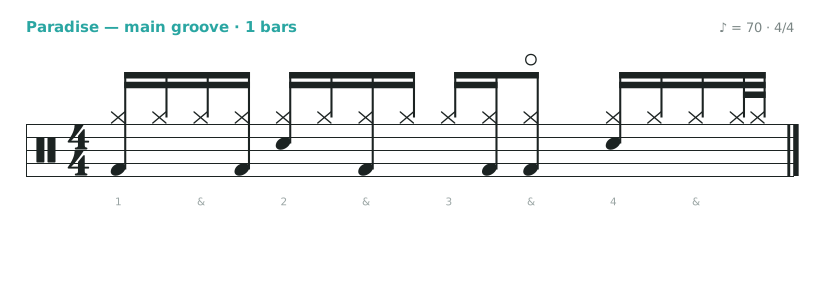
The second single from Mylo Xyloto (2011), released on 12 September 2011. It’s only 70 BPM, but the hi-hat is in sixteenths with one thirty-second at the end of beat 4, and the kick is scattered on 1, 1a, 2&, 3e and 3&, with an open hi-hat on 3&. Only Paradise and Thunder (Imagine Dragons) share this kick and snare shape in the library. The fill window on the song page also has a bar of continuous thirty-second hi-hats.
Coldplay’s Drummer, Will Champion
- Who: William Champion, born 31 July 1978 in Southampton, England. He is Coldplay’s drummer and also sings backing vocals.
- Before drums: piano and violin from age 8, guitar at 12, then bass and tin whistle. He couldn’t read music and learned by watching and copying. He was picked as his school’s drummer and played a neighbour’s kit, though he wasn’t keen on drums at the time.
- How he joined: at University College London, where he studied anthropology, he met Chris Martin, Jonny Buckland and Guy Berryman. In 1998, when a drummer roommate didn’t turn up for a demo session, he said he’d give it a go — and became the last member to join.
- Band names: Big Fat Noises in 1997, Starfish in 1998, then Coldplay. Their debut album Parachutes (10 July 2000) entered the UK Albums Chart at number one.
- Style: Wikipedia describes his drumming as energetic and focused on what each song needs. He has said he lacked the confidence to play loud at first, and that this became part of his sound; he points to “Viva la Vida” — kick drum, bell and timpani — as an example of simple, supportive playing. His favourite drummers include Ginger Baker, John Bonham and Dave Grohl.
- Also: an honorary Doctor of Music from the University of Southampton in 2023.
Lots of slow tempos make them great for counting the spaces between beats. The Scientist and Everglow share 73 BPM with different kicks, Clocks trains you to play a snare off 2 and 4, and Something Just Like This makes you keep 2 and 4 without a snare.
Practice Order by Level
- The Scientist → Everglow (73 BPM): same eighth-note hi-hat, only the kick moves. Each fill is a single beat — a great first pair.
- My Universe (101 BPM): get comfortable with four-on-the-floor, then practise the tom fill from beat 3 on its own.
- Clocks (131 BPM): first play only the snare on 1, 2& and 4 while counting “one two three, one two three, one two”, then fill in the kicks. Start around 100 BPM.
- Something Just Like This (103 BPM): set the metronome click on 2 and 4 so you don’t lose the backbeat in the snare-less groove.
- Paradise (70 BPM): get the sixteenth hi-hat even with both hands, then add the thirty-second at the end of beat 4 and the in-between kicks.
In the DrumMate library you can practise these songs along with the original recordings, and with an electronic kit connected you get timing and accuracy scores for every bar. Start with a 7-day free trial.