
Drum Rudiments for Beginners — The 5 to Learn First (Sticking and Notation)

Rudiments are the basic sticking patterns that work like an alphabet for your hands. The Percussive Arts Society lists 40 standard rudiments, but you don’t need them all at once. Work on these five and your fills and grooves will sound noticeably cleaner.
With rudiments, which hand plays (the sticking) is everything. R is right, L is left. The notes can look identical on paper while the sticking makes it a completely different exercise.
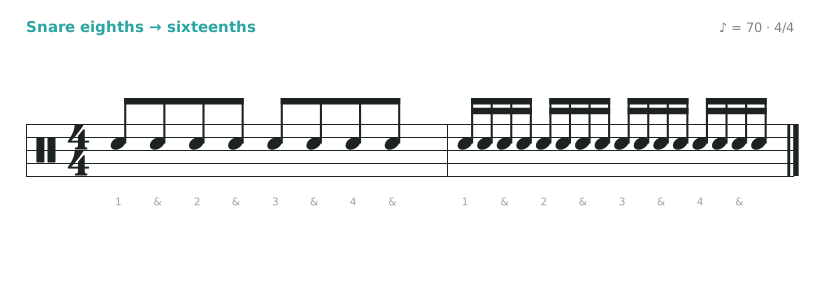
The example above is one bar of eighths and one bar of sixteenths on the snare. Practise each rudiment below over this rhythm: start slowly with eighths, then move to sixteenths once your hands feel relaxed.
1. Single stroke roll
Alternate hands, one stroke each — the most fundamental rudiment. The goal is for both hands to sound exactly the same in volume and spacing. Record yourself: the weaker hand is usually quieter.
2. Double stroke roll
Two strokes per hand. The second stroke tends to be weaker — use the stick’s rebound so both strokes match. Doubles are the foundation of fast rolls and many kick-and-snare fills.
3. Single paradiddle
Two singles plus one double. Because the leading hand switches every four notes, paradiddles keep your hands from tangling when you move between hi-hat and snare or around the toms. Try accenting the first note of each group.
4. Flam
One hand plays a very soft grace note a split second before the other plays a full stroke, making one fat “flam” sound. The sticks should not land at exactly the same time — the soft one lands just ahead. Start with the soft stick low and the loud stick high.
5. Drag
Two soft grace notes tucked right in front of a main stroke. Play the two soft notes like a small double stroke — one motion, let it bounce. You’ll hear drags in march-style snare parts and at the start of fills.
1) Start at 60 BPM. 2) Don’t speed up until both hands sound the same. 3) Five to ten minutes every day. With rudiments, often beats long.
Taking them to the kit
Once a rudiment feels natural, move it off the snare. Singles spread across snare, toms and floor tom become a fill instantly; paradiddles with the right hand on hi-hat and the left on snare become a new groove.