
Heel Down vs Heel Up — How to Play the Bass Drum Pedal (Notation and Audio)

Your right foot plays the kick — the foundation of the whole groove. Yet foot technique is often an afterthought, and few beginners are ever told how to actually press the pedal. There are two basic techniques: heel down and heel up.
- Heel down — heel on the pedal, play from the ankle. Smaller, controlled sound
- Heel up — heel raised, play with the weight of the leg. Bigger, punchier sound
- Most drummers mix both depending on the song
Heel down
Keep your heel resting on the back of the footboard and play with the front of your foot by moving only the ankle. You get less power but fine control over volume, which suits ballads, jazz and quiet songs.
- Pros — easy volume control in quiet music; less leg fatigue
- Cons — hard to play loud, harder to play fast repeated kicks
Heel up
Lift your heel and keep the ball of your foot on the pedal, using the weight of your leg. This is what most drummers use when the kick needs to cut through, as in rock and pop.
- Pros — powerful sound, better for fast repeated kicks
- Cons — balance takes practice, and it’s easy to fall into burying the beater
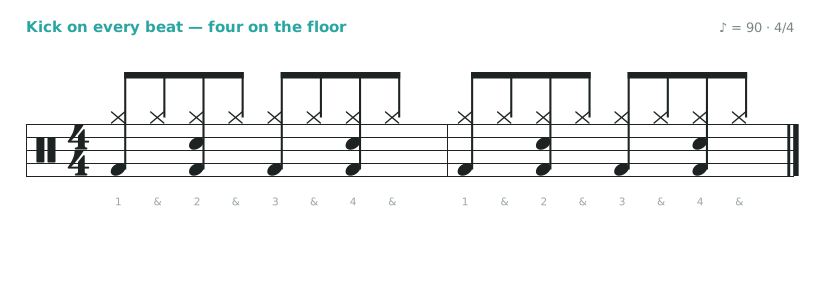
Exercise 1 — kick on every beat (four on the floor)
A staple of disco and dance music: a kick on every beat. It’s the best exercise for even volume and even spacing. Play it once heel down and once heel up, and listen to the difference.
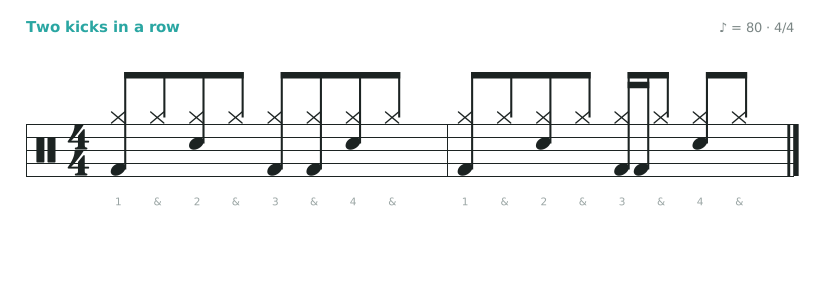
Exercise 2 — two kicks in a row
In the first bar the kick lands on 3 and the “and” of 3; in the second, there are two sixteenth-note kicks back to back on beat 3. Heel up, don’t lift the whole leg — think of two small bounces with the ball of your foot.
Leaving the beater pressed into the head after each stroke chokes the drum into a dead “thud”. Practise letting it come straight back off the head. Burying is a valid sound for some styles, but start by learning to let it bounce.
Which should you learn first?
There’s no single answer, but if you mostly play pop and rock, many people start with heel up and add heel down for quieter songs. What matters more than the technique is that every kick is the same volume and right on the beat.
Whether the kick is truly on the beat is hard to judge by ear. Connect an electronic kit to DrumMate and every bar is checked against the notation for timing and accuracy, so you can spot exactly where your kick drifts.