
How to Play the Bo Diddley Beat on Drums — The 3-2 Clave Rock and Roll Groove in 3 Steps (Notation and Audio)

The Bo Diddley beat is the rock and roll rhythm that falls in a “three… two” shape. Its roots are the Afro-Cuban 3-2 clave, and Bo Diddley made it famous with his self-titled 1955 debut single, “Bo Diddley.” On drums you move that rhythm onto the floor tom, or split it between kick and snare.
This guide gets the clave into your body first, then shrinks it into a one-bar tom groove, then puts it under an eighth-note hi-hat — three steps, each with notation you can play back with Listen, Repeat and Slow.
- The Bo Diddley beat is built on the 3-2 clave (Wikipedia calls it a variation of the clave)
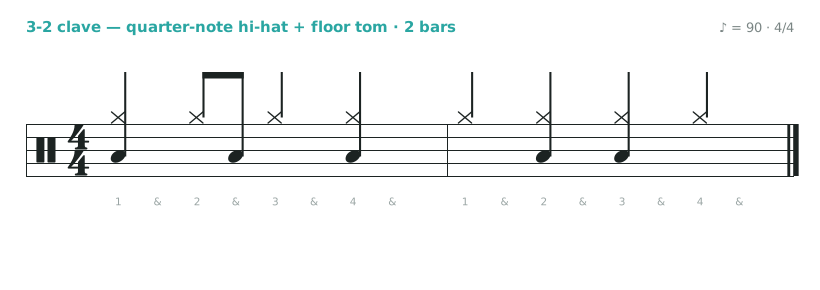
- Step 1: quarter-note hi-hat for the pulse, two-bar clave on the floor tom
- Step 2: squeeze the clave into one bar (sixteenth spots 1, 1a, 2&, 3&, 4) on floor tom, with snare on 2 and 4
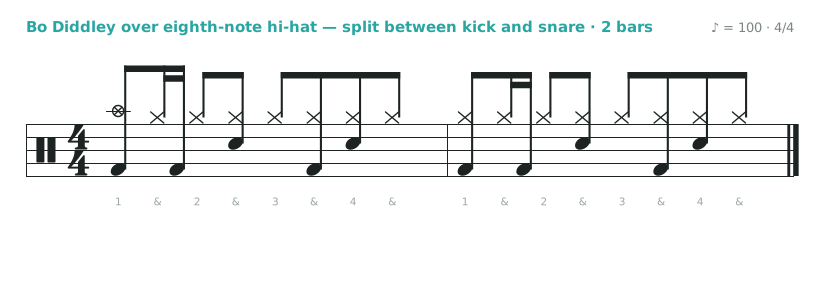
- Step 3: split it between kick and snare under an eighth-note hi-hat
- The original feel swings hard — the notation is written straight, so add a little lilt once it feels natural
What is the Bo Diddley beat?
Wikipedia describes the Bo Diddley beat as a syncopated rhythm widely used in rock and roll and pop, essentially the Afro-Cuban clave rhythm — a variation of the 3-2 clave. It is also close to the “shave and a haircut, two bits” knock.
On Bo Diddley’s early records, Jerome Green played maracas, at first as a more portable alternative to a drum set. The rhythm went on to appear in many songs; Wikipedia’s examples include Buddy Holly’s “Not Fade Away” (1957), Johnny Otis’s “Willie and the Hand Jive” (1958), the Who’s “Magic Bus” (1968), George Michael’s “Faith” (1987) and U2’s “Desire” (1988).
Step 1: the 3-2 clave on floor tom
The clave is a two-bar rhythm: three hits in the first bar (beat 1, the & of 2, beat 4) and two in the second (beats 2 and 3). Keep the pulse with quarter notes on the hi-hat in your left hand and play the floor tom with your right (open-handed, so your arms don’t cross). Count “one · two-and · four / two · three” out loud.
Step 2: the one-bar Bo Diddley beat
In rock and roll the clave is often squeezed into one bar on sixteenth-note spots: 1, 1a, 2&, 3&, 4 — still three and two. Play the floor tom with your right hand, snare on 2 and 4 with your left, and kick on 1. On beat 4 the floor tom and snare land together.
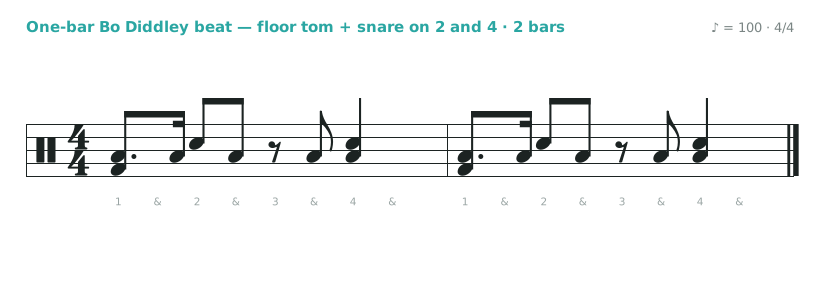
1a is the last of the four sixteenths in beat one (1 e & a). It helps to think of a dotted eighth on 1 followed by a sixteenth on 1a — that is how the notation draws it. Listen at the slow 75% setting and get the “boom… ta” spacing first.
Step 3: kick and snare under an eighth-note hi-hat
This is the version bands use most. Keep a normal eighth-note hi-hat and split the five clave spots between kick (1, 1a, 3&) and snare (2&, 4). Because the snare lands on the & of 2 instead of beat 2, it feels completely different from a regular eighth-note beat.
When it isn’t working
- The clave drifts inside the bar — put the sticks down and clap the Step 1 rhythm. Once you can clap it, you can play it.
- The 1a sticks to beat one — set the metronome subdivision to sixteenths and count “1 e & a” out loud.
- The hi-hat stops in Step 3 — play two bars of just kick and snare, add the hi-hat in quarters, then go to eighths.
As the description quoted on Wikipedia puts it, the classic Bo Diddley groove is a 3-2 clave “played with a strong swing.” The notation here is straight so the spots are easy to learn; once it sits in your hands, delay the off-beats slightly and let it bounce.
The clave connects to bossa nova and the 3-3-2 rhythm too — compare how other styles use it in the posts below. On DrumMate you can practice over 1,000 library songs along with the original tracks, and with an electronic kit connected you get timing and accuracy scores for every bar.