
How to Play a Hip-Hop Drum Beat: Boom Bap Basics and Variations (Notation and Audio)

Put on a hip-hop track and you will often hear a heavy “boom… bap!” pushing the song forward. That sound gives the style its name: boom bap. The boom is the kick drum, the bap is the snare.
Boom bap is the drum sound most associated with 1990s East Coast hip-hop, and it was often built from drum breaks sampled off old records. It sounds just as good on a real kit. In this guide we work through it in three steps: the basic beat, a kick variation and a two-bar pattern.
- Boom bap = a heavy kick (boom) plus a strong snare on 2 and 4 (bap)
- Same skeleton as an 8th-note rock beat, with kicks on 16th-note spots
- Keep the tempo relaxed and the snare solid
How is it different from a basic rock beat?
The skeleton is the same as a basic 8th-note beat: 8th-note hi-hat and snare on 2 and 4. The differences are the kick placement and the tempo. Boom bap puts kicks on 16th-note spots, which makes the groove lean and stumble a little, and many tracks sit at a relaxed 80 to 95 BPM or so. That leaves lots of space between the beats, and the rapper fills it.
The basic boom bap beat
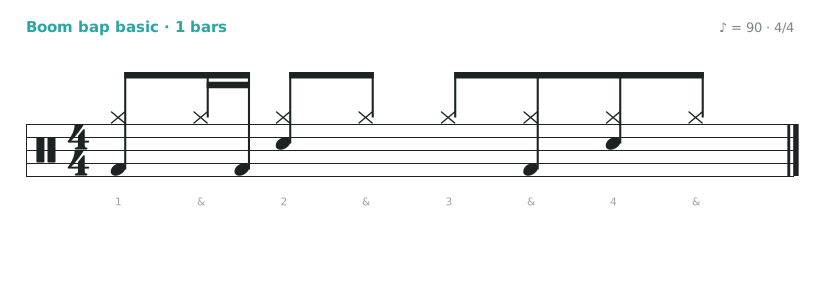
Play the kick on beat 1, on the last 16th of beat 1, and on the “and” of 3. That last 16th sits right before the snare on 2, so it pushes into it: “boom… boom-BAP”. Count “1 e & a” and drop the kick on the “a”.
Kick variation: fill the front
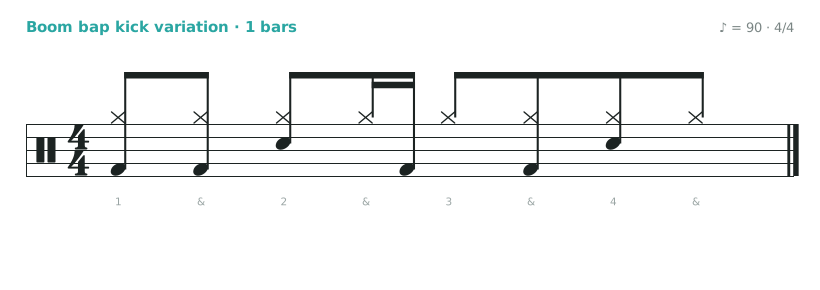
The second pattern plays two kicks in a row on 1 and the “and” of 1, then one on the last 16th of beat 2 and one on the “and” of 3. The kick right before the snare on 3 makes the second half of the bar roll forward.
Two-bar pattern: one small ornament
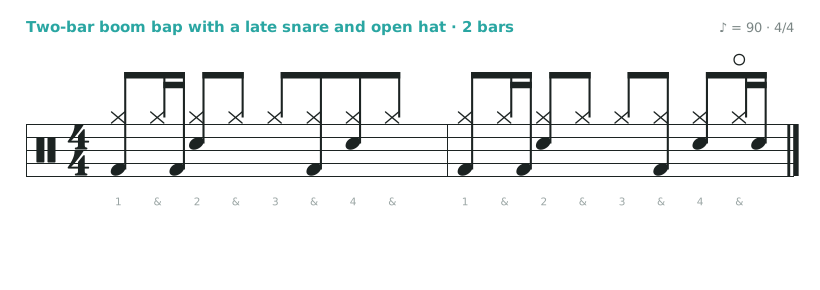
Hip-hop beats usually repeat in two- or four-bar chunks. A small ornament at the end of the second bar keeps the loop from getting stale. Here we add an open hi-hat on the “and” of 4 and one extra snare on the very last 16th. It leads into the kick on beat 1 and signals “back to the top”.
In a lot of real boom bap the 16th notes are not perfectly even; they swing a little. The notation here is straight, so once you are comfortable, try placing the 16th-note kicks just a touch late. And keep the snare on 2 and 4 strong: it should be the loudest thing in the groove.
Practice order
- Hi-hat and snare only, metronome at 70
- Add the kick on beat 1
- Add the 16th-note kicks one at a time
- Once it feels easy, move up to 80 to 90
The half-time groove also leaves a lot of space around the snare and shows up all the time in hip-hop and trap. It is worth learning alongside this one.
DrumMate has a library of more than 1,000 songs you can practice along with the original recordings, and if you connect an electronic kit it scores your timing and accuracy bar by bar. You will see right away whether those 16th-note kicks are rushing or dragging.
Keep reading
- What Is a Half-Time Groove? Same Tempo, Half the Feel — How to Play It (Notation and Audio)
- 16th-Note Drum Grooves for Beginners — One-Hand, Two-Hand and Kick Variations
- Funk Drum Beat Basics — Make the Kick Dance Over Sixteenths (Notation and Audio)
- The 3-3-2 Rhythm on Drums — The Tresillo Kick Pattern You Hear in Pop (Notation and Audio)