
How to Play the D-Beat on Drums — The Discharge Hardcore Punk Beat in 4 Steps (Notation and Audio)

The D-beat is a drum beat named after the British hardcore punk band Discharge. The snare plays every “and,” and the kick lands in pairs around the beat, so you can say it as “boom-tah-boom-boom-tah.”
This guide puts the D-beat pattern from Wikipedia into standard notation and builds it in four steps: skeleton → hi-hat → crash → fill. Every example has a Listen button.
- D-beat = a hardcore punk beat named after Discharge, developed around 1979 by drummer Terry “Tezz” Roberts.
- Kick: 1 · 1a · 2e · 3 · 3a · 4e / Snare: every “and.” Say it “boom-tah-boom-boom-tah.”
- It’s the pop-punk skank beat (kick on the beat, snare on the “and”) with the kicks on 2 and 4 split into two sixteenths around the beat.
- Four examples: skeleton, eighth-note hi-hat, crash with every kick, and D-beat → sixteenth fill → crash.
What is the D-beat? Name and history
A short summary of what Wikipedia says.
- A style and a beat — D-beat is both a style of hardcore punk developed by Discharge in the early 1980s and the drum beat that defines it. It spread in England and Sweden and is also called Discore or kängpunk.
- Who made it — Discharge formed in Stoke-on-Trent in 1977; drummer Terry “Tezz” Roberts developed the beat around 1979.
- The name — The term “D-beat” was coined in 1988 by Rich Militia, singer of Sore Throat, for the pattern Dave “Bambi” Ellesmere played on Discharge’s EP Why.
- Earlier examples — Buzzcocks’ “You Tear Me Up” is called one of the earliest examples, and Discharge may have inherited the beat from Motörhead and Buzzcocks.
- Where it went — It’s closely tied to crust punk and fed into thrash metal.
Reading the D-beat — “boom-tah-boom-boom-tah”
| Spot | 1 | 1& | 1a | 2e | 2& | 3 | 3& | 3a | 4e | 4& |
|---|---|---|---|---|---|---|---|---|---|---|
| Kick | ● | ● | ● | ● | ● | ● | ||||
| Snare | ● | ● | ● | ● |
Splitting each beat into four sixteenths (1 e & a), the kick lands on the first spot of beat 1, the last spot of beat 1 (a) and the second spot of beat 2 (e). There’s no kick on beat 2 itself. The snare plays only the “and” of each beat. The half-bar pattern repeats twice.
The skank beat in pop-punk drum beats puts the kick on all four beats and the snare on the “and” (boom-tah-boom-tah). The D-beat removes the kicks on 2 and 4 and plays two kicks on the sixteenths around them (1a·2e, 3a·4e) — hence boom-tah-boom-boom-tah.
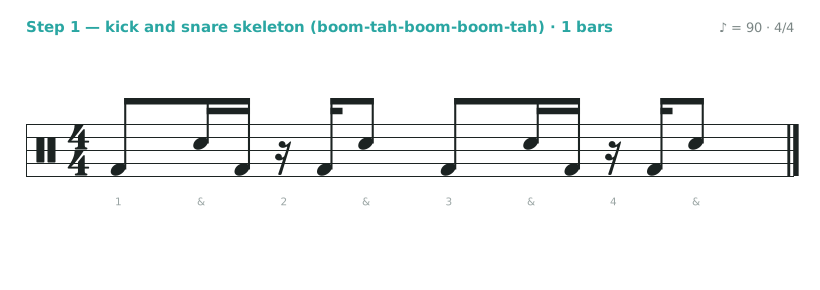
Step 1 — Kick and snare skeleton
Play just kick and snare, no cymbals. One hand plays the off-beat snare while the foot repeats “boom · boom-boom.” Say “boom-tah-boom-boom-tah” out loud at first. The key is getting the two quick kicks evenly on either side of beat 2.
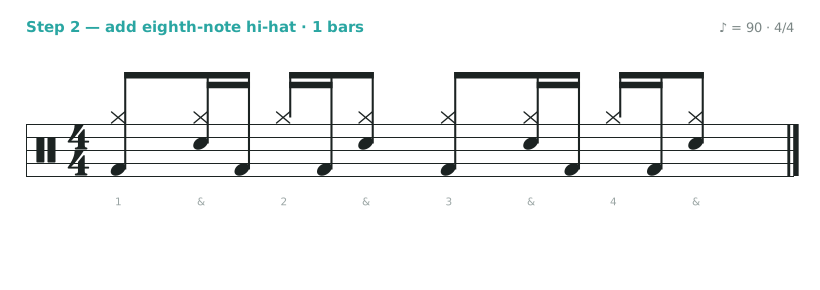
Step 2 — Add eighth-note hi-hat
The right hand keeps eighth-note hi-hat going and the left hand takes the off-beat snare, so hi-hat and snare land together on each “and.” Wikipedia also shows verse and chorus variations with hi-hat; here we use plain eighths because they’re easiest to practice.
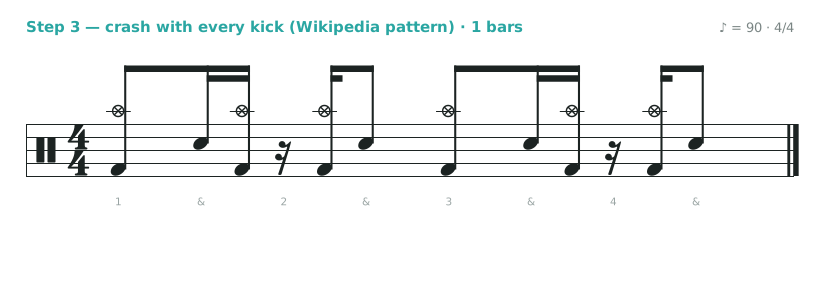
Step 3 — Crash with every kick
The first pattern on Wikipedia (in the style of early Anti Cimex and Discharge) plays a crash on every kick instead of hi-hat. Your hands alternate between crash (with the kick) and snare (on the “and”), so hands and feet move as one unit. Don’t let the crash bury the snare — balance the volumes.
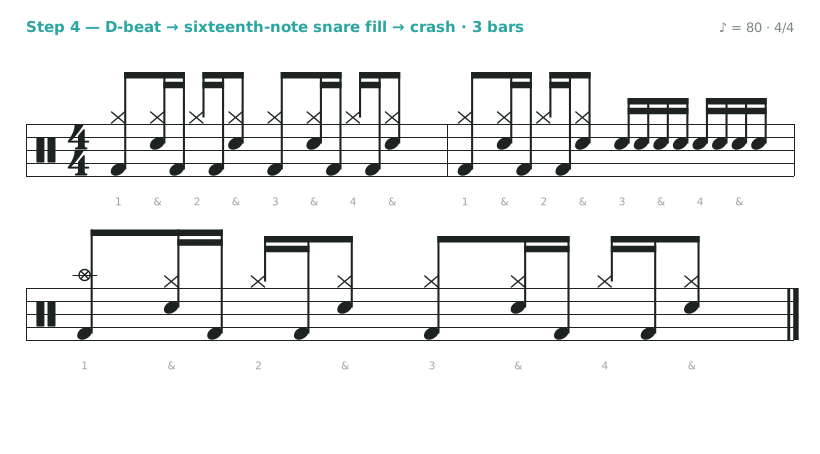
Step 4 — D-beat → sixteenth fill → crash
Play a bar of D-beat, fill beats 3–4 of the second bar with eight sixteenth-note snares, then come back to the D-beat with a crash on beat 1 of the third bar. Check that “boom-tah-boom-boom-tah” starts right after the fill.
Practice tips
- Start slow — it’s fine to go below the notated ♪ = 90. Start where the two quick kicks don’t smear together.
- Feet first — with a quarter-note click, play only the kick: “boom · boom-boom.” Feel that there’s no kick on the beat-2 click.
- BPM steps — clean, +4; shaky, −8. Use the step table from How to Play Drums Faster — 6 Steps: Relax, Rebound and Raise Your BPM (Notation and Audio).
- Stay loose — fast punk beats come from rebound, not arm strength. Stop if your wrists or ankles hurt.
In the DrumMate library you can practice all kinds of rhythms along with original recordings, and with an electronic kit connected you get timing and accuracy scored bar by bar. Use the Listen, Repeat and Slow buttons on the examples above to hear them at a lower tempo.