
How to Play the Ride Cymbal — When and How to Move Off the Hi-Hat


The largest cymbal on your right is the ride. It isn’t for big crashes — it’s for steady time-keeping, like the hi-hat. Just switching from hi-hat to ride in a chorus or bridge changes the whole mood of a song.
- Play the bow lightly with the tip of the stick
- The raised bell gives a bright “ping” — use it for accents
- Simply move your hi-hat pattern to the ride
Different spots, different sounds
- Bow — between the edge and the centre. Played with the stick tip it gives a clean “ting”. This is home base
- Bell — the raised centre. A cutting, bright “ping”
- Edge with the shoulder of the stick — a wash that spreads like a crash
The basic ride beat
Take the basic rock beat and move the hi-hat part to the ride. Snare on 2 and 4, kick on 1 and 3 stay the same. In notation the ride is an ✕ on the top line.
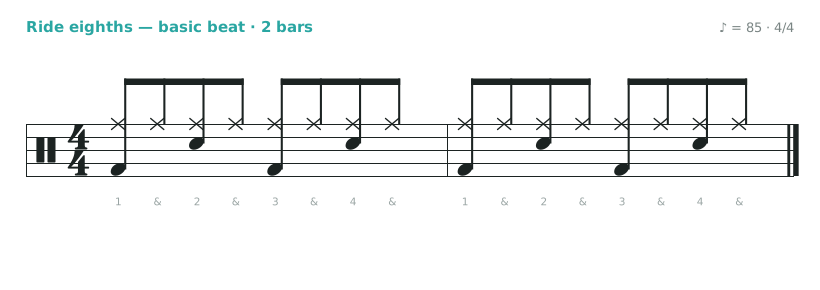
The ride rings much longer than the hi-hat, so don’t hit it hard. Relax your wrist and let the tip bounce lightly. Hit it hard and the wash builds up and smears the groove.
Change the kick
Keep the ride steady and add a kick on the “and” of 2. With the ride underneath, a moving kick makes the song sound wider.
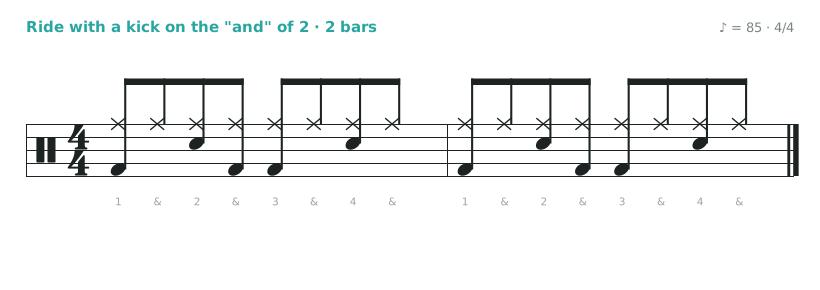
A common approach: hi-hat for the verse, ride for the chorus. Moving to the ride as the song lifts tells the listener instantly that something has changed.
Want to practise ride grooves with real songs? Pick a song at your level in the DrumMate library and play along with the original track.