
Muse’s Drummer Dominic Howard — Who He Is, Plus 4 Muse Songs to Play on Drums (Levels, BPM and Notation)

Muse’s drummer is Dominic Howard. Born on 7 December 1977 in Stockport, England, he moved to Teignmouth, Devon, at around eight and started drumming at about twelve, inspired by a jazz band performing at his school. He has played drums in Muse since 1994 and is known for playing a left-handed drum kit (Wikipedia).
Below is a short profile of Dominic Howard and Muse, a level and BPM table for the four Muse songs in the DrumMate library, and five bars of real notation from those song pages. We’ll also compare Muse’s grooves with 434 songs in the library to see what makes them stand out.
- Muse’s drummer is Dominic Howard (born 1977). He formed Muse with Matt Bellamy and Chris Wolstenholme in Teignmouth in 1994
- Four Muse songs in the library: Starlight Level 5 · Plug In Baby Level 7 · Panic Station Level 12 · Time Is Running Out Level 14
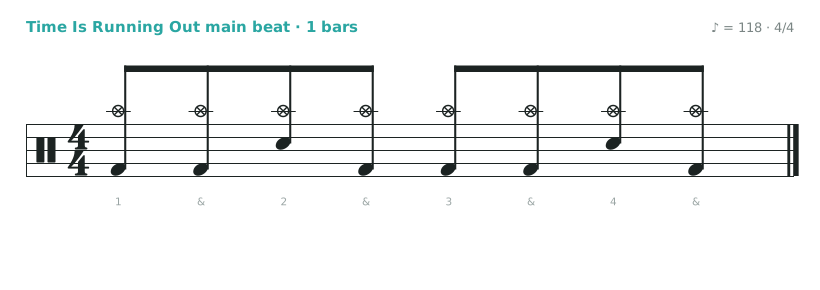
- Time Is Running Out keeps time on eighth-note crashes instead of hi-hat — only 5 of 434 songs do that
- Five bars of real notation and a practice order by level
Who is Dominic Howard?
| Details | |
|---|---|
| Full name | Dominic James Howard |
| Born | 7 December 1977, Stockport, England (moved to Teignmouth, Devon, at around eight) |
| Instruments | Drums, percussion |
| Started drumming | At about twelve, after seeing a jazz band perform at school |
| Band | Muse (1994–) |
| Notable | Plays a left-handed drum kit |
| Also | Honorary Doctorate of Arts from the University of Plymouth in 2008, with Matt Bellamy and Chris Wolstenholme |
According to Wikipedia, drummer Mike Portnoy has named Howard as an influence, comparing his playing to the “groove and power” of Dave Grohl.
How Muse started
Muse formed in 1994 in Teignmouth, Devon. Matt Bellamy and Dominic Howard met because their bands rehearsed in the same building, and Bellamy joined Howard’s band (Carnage Mayhem, later Gothic Plague). Chris Wolstenholme — then the drummer of another local band — agreed to switch to bass. After going by Rocket Baby Dolls, they won a 1994 battle of the bands and became Muse, a name chosen because it was short and looked good on a poster.
| Member | Instruments |
|---|---|
| Matt Bellamy | Lead vocals, guitar, keyboards |
| Chris Wolstenholme | Bass, backing vocals |
| Dominic Howard | Drums, percussion |
Their debut album was Showbiz (1999), followed by Origin of Symmetry (2001), Absolution (2003), Black Holes and Revelations (2006), The Resistance (2009), The 2nd Law (2012) and Drones (2015), among others. The Resistance and Drones both won the Grammy for Best Rock Album.
4 Muse songs to play on drums — levels and BPM
Levels and BPM come from the DrumMate song cards; the “tricky part” is the first line from each song page. All are in 4/4.
| Song | Album (year) | Level | BPM | Tricky part |
|---|---|---|---|---|
| Starlight | Black Holes and Revelations (2006) | 5 | 122 | Quarter-note kick at 122 BPM — the foot goes first. |
| Plug In Baby | Origin of Symmetry (2001) | 7 | 136 | The ghost snare on the last sixteenth of beat 2 has to be placed exactly. |
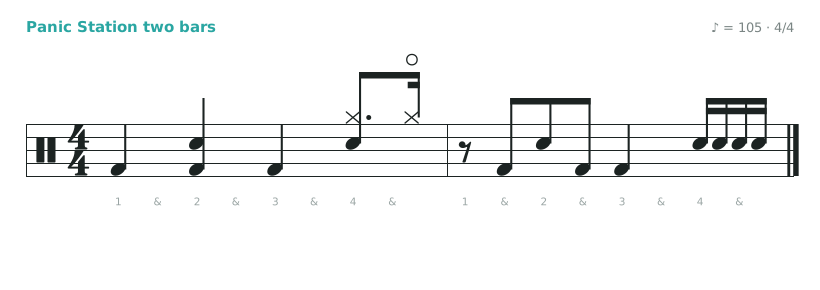
| Panic Station | The 2nd Law (2012) | 12 | 105 | Many kicks fall between beats, so the foot is easy to confuse. |
| Time Is Running Out | Absolution (2003) | 14 | 118 | Playing eighth-note crashes and kicks for 116 bars takes stamina. |
Starlight — snares on top of a four-on-the-floor kick (Level 5)
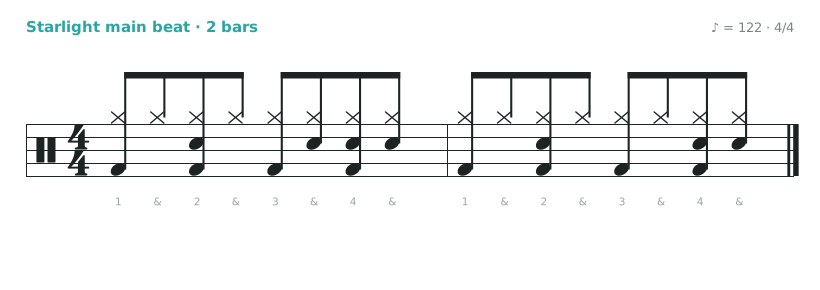
The second single from Black Holes and Revelations (September 2006). The kick plays all four beats, the hi-hat plays eighth notes, and the snare adds the “and” of 4 (and, every other bar, the “and” of 3) to the backbeat. Counting the most common bar of each of the library’s 434 songs, “kick on all four + snare on 2 and 4” appears in 58 songs — but a version with those extra off-beat snares shows up only in Starlight.
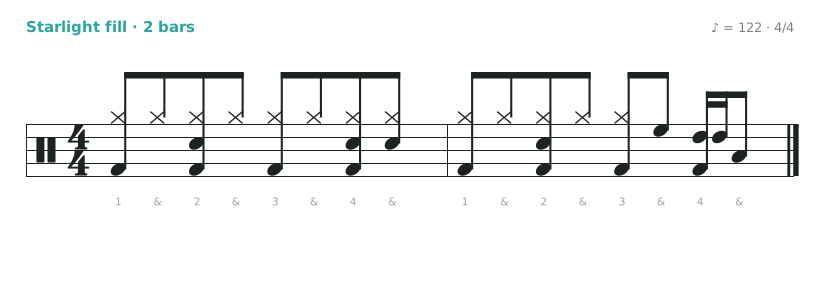
The fill is short: high tom on the “and” of 3 in bar two, two sixteenth-note mid toms on 4, floor tom on the “and” of 4 — while the kick keeps all four beats.
Plug In Baby — the sixteenth-note snare at the end of beat 2 (Level 7)
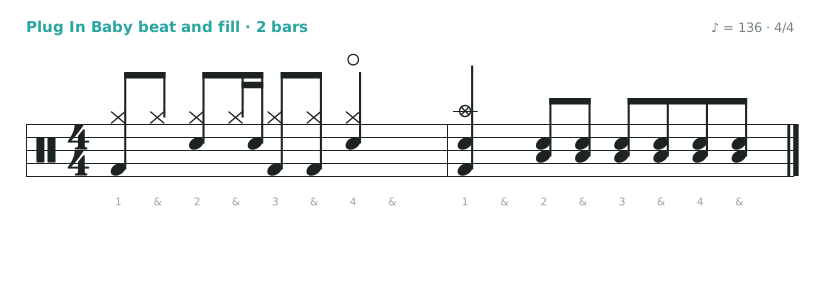
The lead single from Origin of Symmetry, released in March 2001, reached number 11 on the UK Singles Chart. The kick plays 1, 3 and the “and” of 3; the key is the extra snare on the last sixteenth of beat 2 (the “a” of 2). Only 3 of 434 songs share this kick-and-snare shape (Plug In Baby, Avril Lavigne’s “When You’re Gone” and John Park’s “Falling”). In the second bar below, a crash on 1 leads into snare and floor tom played together in eighth notes from beat 2.
Panic Station — kicks between the beats (Level 12)
From The 2nd Law, released as a single in 2013. The snare holds 2 and 4, but the kick keeps landing between beats (the “and” of 1 and 2), which is what trips the foot up. These are the last two bars of the fill example on the song page: an open hi-hat on the last sixteenth of beat 4 in bar one, then four sixteenth-note snares on beat 4 of bar two.
Time Is Running Out — keeping time on the crash (Level 14)
From Absolution, this was Muse’s first UK top-ten single (number 8). The main groove is played on eighth-note crashes instead of hi-hat. Only 5 of the library’s 434 songs keep the main beat on crash eighths like this (힐링이 필요해, Time Is Running Out, New Divide, Hey Jude and Wake Me Up When September Ends). The kick plays 1, 1&, 2&, 3, 3&, 4& — a kick-and-snare shape shared only with Afterlife (Avenged Sevenfold).
Practice order by level
- Starlight (Level 5) — keep the four-on-the-floor kick even all the way at 122 BPM. If your foot tires, start at 90.
- Plug In Baby (Level 7) — slow down (around 100 BPM) to place the “a” of 2 snare, then build to 136.
- Panic Station (Level 12) — play only the 2 and 4 snares with your hands and learn the kick spots by counting them out loud first.
- Time Is Running Out (Level 14) — crash eighths plus kick for the whole song. Start at 75% (about 89 BPM) and pace your stamina.
If you’re a lefty wondering how to set up, read Left-Handed Drumming — 3 Options and How to Choose. Notation shows drums, not hands, so the bars above read the same on any kit.
You can practice all four Muse songs with the original recordings in the DrumMate library. Connect an electronic kit and DrumMate scores your timing and accuracy bar by bar.
Keep reading
- Queen’s Drummer Roger Taylor — Who He Is, the Songs He Wrote, and 4 Queen Songs to Play on Drums (Levels and BPM)
- Green Day’s Drummer Tré Cool — Who He Is, Plus 4 Green Day Songs to Play on Drums (Levels, BPM and Notation)
- The 10 Most Common Drum Beats — Kick and Snare Patterns Ranked From 434 Songs (Notation and Audio)