
How to Read Drum Notation — A 10-Minute Guide for Complete Beginners

Drum notation looks dense at first, but there are fewer than ten rules to learn. You are not reading pitch the way a pianist does — you are only reading which drum to hit.
This one page covers the basics.
The staff is a map of your kit, not pitch
The five lines do not mean high and low notes. Each position is assigned to a specific drum. Higher up the staff means cymbals, lower down means the bigger drums — that is the easiest way to remember it.
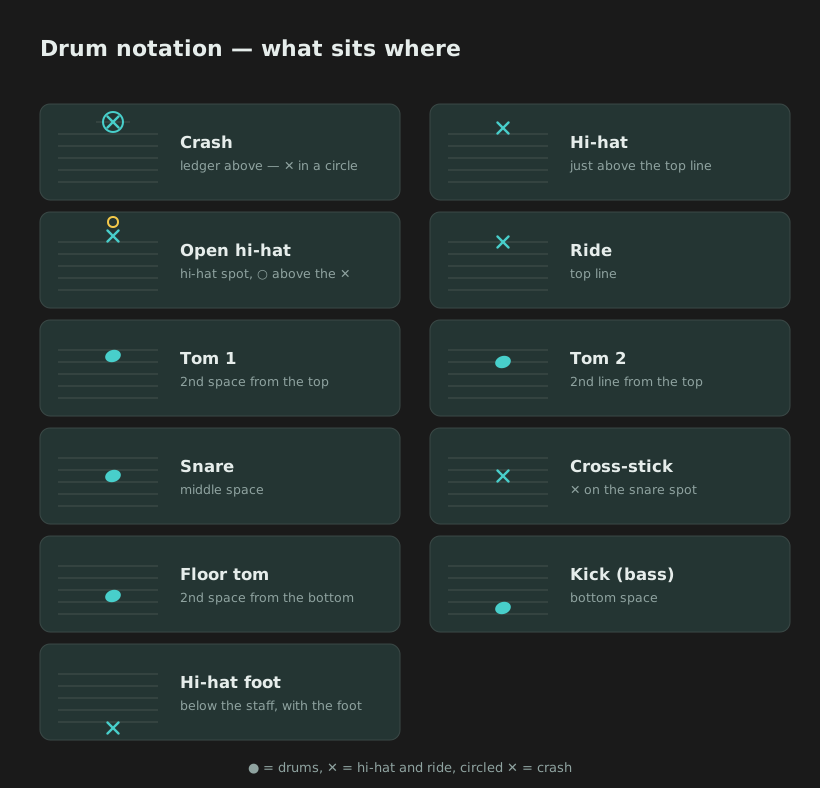
To start, you only need three: hi-hat, snare and kick. Around 90% of beginner songs use nothing else. Toms and cymbals show up in fills, and you can learn those later.
There are two notehead shapes
- ● round head — a drum. Snare, toms, kick
- ✕ cross head — metal. Hi-hat and ride
- Circled ✕ — the crash. The circle is what tells it apart from the hi-hat
So when you open a chart, a row of ✕ along the top is almost always the hi-hat. In an eight-beat song you will see eight of them per bar.
A ✕ on the snare spot (the middle space) is not a hi-hat — it is a cross-stick, where you lay the stick across the rim. Common in ballads. Tell them apart by position: ✕ at the top is hi-hat, ✕ in the middle is cross-stick.
Length is read from the tails
| Shape | Name | Per bar |
|---|---|---|
| Stem only | Quarter note | 4 |
| One tail (joined by one beam) | Eighth note | 8 |
| Two tails (joined by two beams) | Sixteenth note | 16 |
One beam means eighths, two beams means sixteenths. A glance at the beams tells you whether a song is an eight-beat or a sixteen-beat feel.
Reading a basic eight-beat
This is the most common beginner pattern. Split the bar into eight counts: “one and two and three and four and”.
- Hi-hat — all eight. It never stops
- Snare — beats 2 and 4, on “two” and “four”
- Kick — beats 1 and 3, on “one” and “three”
Stack those three and you get the sound you already know. Most pop and rock starts here, and what changes from song to song is mainly where the kick goes.
A few marks you will see often
- ○ above a hi-hat — open hi-hat. Lift the foot so it rings
- ✕ below the staff — hi-hat foot. Close the pedal with your left foot, no stick
- Double bar with two dots — repeat that section once more
- Numbers above the bars — bar numbers, for naming the section you want to practise
Drum notation is something you count out loud while playing. Say “one and two and” as you go, very slowly. Ten slow repetitions beat a hundred readings.
What comes next
That is the ruleset. What you need now is practice on real songs — and the problem with practising alone is that you cannot tell whether you actually played it right.
On DrumMate the notation scrolls as the song plays, and with an electronic kit connected it scores whether you hit the right drum at the right moment, bar by bar. Seeing the wrong notes marked makes reading click much faster.
Over 1,000 songs with drum notation, plus a level course that starts from Lv.1.