
How to Play a Reggaeton Drum Beat — The Dembow Rhythm in 3 Steps, With Real Notation From “Despacito” (Notation and Audio)

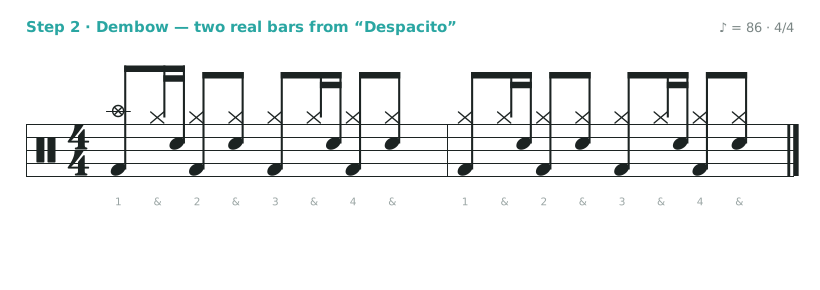
The heart of a reggaeton drum beat is the “dembow.” The kick plays all four beats, and the snare is pushed off the beat in a 3+3+2 pattern in each half bar — on 1a, 2&, 3a and 4&. The main groove in our “Despacito” transcription is exactly this shape.
Below is a short look at reggaeton and dembow as Wikipedia describes them, then three steps: counting 3+3+2, a real two-bar excerpt from the song, and a four-bar phrase with an ending.
- Dembow = a 4/4 bass drum plus the 3+3+2 (tresillo) rhythm. On a drum kit: kick on all four beats, snare on 1a, 2&, 3a, 4&
- Step 1: 3+3+2 on the kick only → Step 2: two real bars from “Despacito” → Step 3: four bars with a sixteenth-note snare ending
- Songs in our 441-song library whose main groove uses this shape: “Despacito” (Level 15, 86 BPM) and “Friends” (Level 12, 95 BPM)
- The biggest hurdle: not letting the snare slide back to 2 and 4
Reggaeton and Dembow — A Short History
- Reggaeton grew out of the Spanish-language reggae of Panama in the late 1980s, and from the early 1990s it was popularized and dominated by artists from Puerto Rico, where the name was coined.
- The name dembow comes from the dancehall song “Dem Bow” by Shabba Ranks (early 1990s). Jamaican duo Steely & Clevie, who made the “Poco Man Jam” (“Fish Market”) riddim in 1989, are usually credited with creating dembow.
- Wikipedia describes dembow as having a “bounce,” with the 3+3+2 (tresillo) rhythm over a bass drum in 4/4 time, usually used as a loop. It drew on dancehall, soca, calypso and cadence.
- Landmark songs: Daddy Yankee’s “Gasolina” is credited with opening the door for reggaeton worldwide, and the video for Luis Fonsi’s “Despacito” featuring Daddy Yankee passed one billion views in under three months in 2017.
Dembow was built from drum-machine and sampled sounds (kick, snare, timbales and more), so on a drum kit you simply move the kick and snare into those spots.
How to Count 3+3+2
Split two beats (half a bar) into eight sixteenth notes and group them 3, 3, 2. The first slot of each group is 1, 1a and 2&. The on-beat slot (1) goes to the kick, and the two off-beat slots (1a and 2&) go to the snare. Beats 3 and 4 repeat the same thing.
| Slot | 1 | e | & | a | 2 | e | & | a |
|---|---|---|---|---|---|---|---|---|
| 3+3+2 | ● | ● | ● | |||||
| Kick (4/4) | ● | ● | ||||||
| Snare | ● | ● |
Say it as “boom – ka boom ka –.” The eighth-note version of 3-3-2 (1, 2&, 4) is covered in The 3-3-2 Rhythm on Drums — The Tresillo Kick Pattern You Hear in Pop (Notation and Audio); this lesson squeezes it into sixteenths so it fits in half a bar.
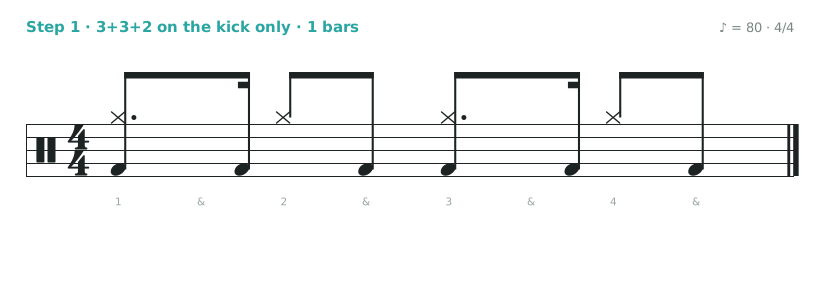
Step 1 — 3+3+2 on the Kick Only
First get 3+3+2 into your body. The hi-hat just marks quarter notes, and the kick plays 1, 1a, 2&, 3, 3a and 4&. Hi-hat and kick only line up on beats 1 and 3; the other kicks fall between the beats on their own.
Step 2 — Dembow: Two Real Bars From “Despacito”
Now split the jobs. The kick plays all four beats (the 4/4 bass drum), and the snare takes the two off-beat slots of 3+3+2. These are two bars straight from the main groove in our “Despacito” post. Keep the eighth-note hi-hat even — note that the snare on 1a and 3a sounds alone, between hi-hat notes.
Step 3 — Four Bars With a Sixteenth-Note Snare Ending
Dembow is meant to loop, so changing the end of every four bars makes it sound like a song. On beats 3 and 4 of bar 4, the hands play eight sixteenth notes on the snare while the foot keeps all four beats. Come back into the dembow with a crash on the next downbeat.
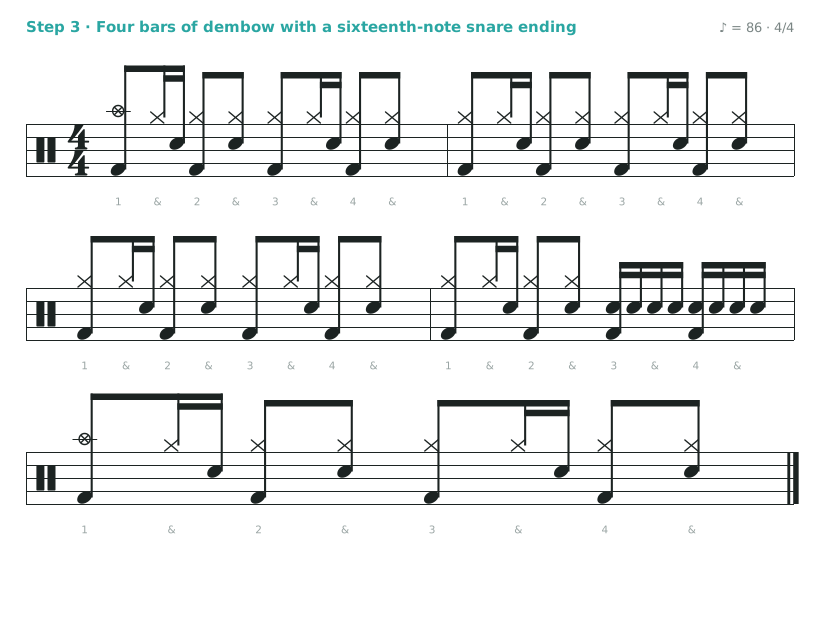
Steps 1 and 3 are practice patterns that put Wikipedia’s description (4/4 kick + 3+3+2) onto a drum kit. The real song transcription is the two bars from “Despacito” in Step 2.
3 Common Mistakes
- The snare drifts back to 2 and 4 — your hands pull toward the familiar backbeat. Go back to Step 1 and count 3+3+2 again.
- The kick wobbles with the snare — the kick stays on all four beats. Play kick and hi-hat first, then add the snare.
- Starting too fast — play at 70 BPM, below the song’s 86 BPM, for at least a minute without wobbling before you speed up.
Practice With Songs From the Library
Out of 441 song posts in the DrumMate library, two songs have a main groove with the snare on 1a, 2&, 3a and 4&.
| Song | Level | BPM | Main groove |
|---|---|---|---|
| Despacito — Luis Fonsi ft. Daddy Yankee | 15 | 86 | Kick on all four beats + snare on 1a, 2&, 3a, 4& + eighth-note hi-hat |
| Friends — Marshmello & Anne-Marie | 12 | 95 | Same kick and snare spots (the dembow shape) |
Kick on all four beats — “four on the floor” — was the second most common kick shape across 434 songs (The 10 Most Common Drum Beats). Dembow is that same kick with the snare moved into 3+3+2.
DrumMate lets you practice a library of more than 1,000 songs along with the original recordings, and if you connect an electronic kit it scores your timing and accuracy bar by bar — a good way to check that those off-beat snare hits land exactly between the beats.
Keep reading
- The 3-3-2 Rhythm on Drums — The Tresillo Kick Pattern You Hear in Pop (Notation and Audio)
- The 10 Most Common Drum Beats — Kick and Snare Patterns Ranked From 434 Songs (Notation and Audio)
- Reggae Drum Beats — The One Drop and Steppers Grooves (Notation and Audio)
- How to Play a Disco Drum Beat — Four-on-the-Floor Kick and Offbeat Open Hi-Hat (Notation and Audio)