
Sing, Sing, Sing Drums — Gene Krupa’s Tom-Tom Solo Story and a 4-Step Swing Tom Groove (Notation and Audio)

“Sing, Sing, Sing” is often named as the song that brought the drums to the front of the band. On the Benny Goodman orchestra’s 1937 recording, Gene Krupa’s tom-tom interludes were the first extended drum solos released on a commercial record, and they are credited with lifting the drummer from accompanist to an important solo voice in the band.
This guide sums up the story of the song and of Krupa (facts as stated on Wikipedia), then gives you a swing tom groove in four steps so you can practise that booming tom-tom feel on a drum kit.
- Louis Prima wrote and first recorded the song in 1936; the Benny Goodman orchestra recorded it on July 6, 1937 with Gene Krupa on drums (8:43).
- Krupa’s tom-tom interludes were the first extended drum solos recorded commercially. At Carnegie Hall in January 1938 the piece ran 12:30.
- Krupa’s name is also tied to toms with tunable top and bottom heads, the modern hi-hat, and the names ride, crash and splash.
- The notation below is a practice swing tom groove, not a transcription of the record.
The story of the song
| Details | |
|---|---|
| Written by | Louis Prima, 1936. First recorded by his New Orleans Gang (Brunswick, February 28, 1936) |
| Benny Goodman recording | July 6, 1937, Hollywood. Goodman on clarinet, Gene Krupa on drums. At 8:43 it filled both sides of a 12-inch 78 |
| Arrangement | Jimmy Mundy. It works in a piece called “Christopher Columbus” — Goodman’s releases are titled “Sing, Sing, Sing (introducing Christopher Columbus)” |
| Carnegie Hall | The January 1938 concert version, with improvised solos, ran 12:30 |
| Honors | The 1937 Goodman recording entered the Grammy Hall of Fame in 1982 |
Singer Helen Ward later recalled a night when Krupa simply would not stop drumming at the end of the third chorus. That kind of on-stage improvising is part of how the piece grew longer and the drum solo grew bigger.
Who was Gene Krupa?
- Born January 15, 1909 in Chicago; died October 16, 1973 in Yonkers, New York.
- Joined Benny Goodman’s band in December 1934 and left shortly after the Carnegie Hall concert in January 1938 to lead his own band.
- One of the first jazz drummers to use a bass drum in a recording session, in December 1927.
- The first endorser of Slingerland drums; at his urging, Slingerland developed toms with tunable top and bottom heads.
- Working with Avedis Zildjian, he helped develop the modern hi-hat and standardize the names and uses of the ride, crash and splash cymbals (Types of Drum Cymbals — Names and Sounds of the Hi-Hat, Crash, Ride, Splash and China).
- In 1978 he became the first drummer in the Modern Drummer Hall of Fame, and in the 1959 film The Gene Krupa Story he was played by Sal Mineo.
A swing tom groove in four steps
Wikipedia does not write out the song’s drum part in notes, so the scores below are not a copy of the record. They are a groove for practising the tom-tom feel: kick on all four beats with the toms rolling in a swing. The swing is written on shuffle spots — each beat split into triplets, playing the first and third (Shuffle Drum Beat for Beginners — Understanding the Swing Feel Through Triplets).
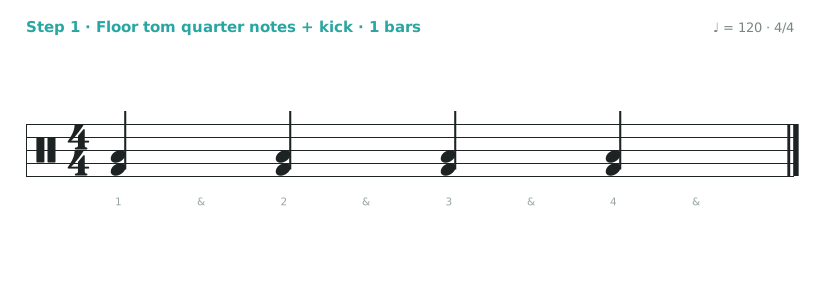
Step 1 — Floor tom and kick on four
Play the floor tom with your right hand together with the kick on beats 1, 2, 3 and 4. Aim for the same deep, ringing sound on every beat.
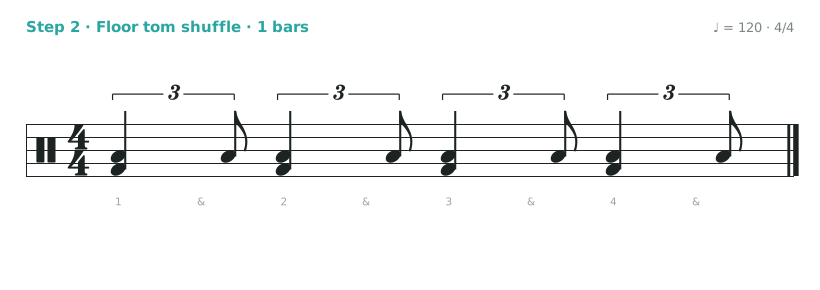
Step 2 — Floor tom shuffle
Add one more floor-tom note on the last triplet partial of each beat (the “let”). Play the beats with your right hand and the “let” with your left. Count “1 (trip) let, 2 (trip) let” and let it swing.
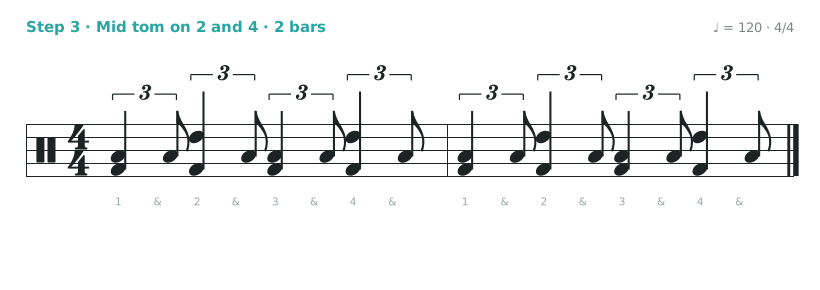
Step 3 — Mid tom on 2 and 4
Move just your right hand to the mid tom on beats 2 and 4. The low floor tom and the slightly higher mid tom now answer each other. The kick stays on all four beats.
Step 4 — Triplet tom fill → crash
After one bar of the step 3 groove, fill beat 3 of the second bar with three triplets on the high tom and beat 4 with two on the mid tom and one on the floor tom, then come back with a crash on beat 1 of the third bar. Alternate your hands: R L R · L R L.
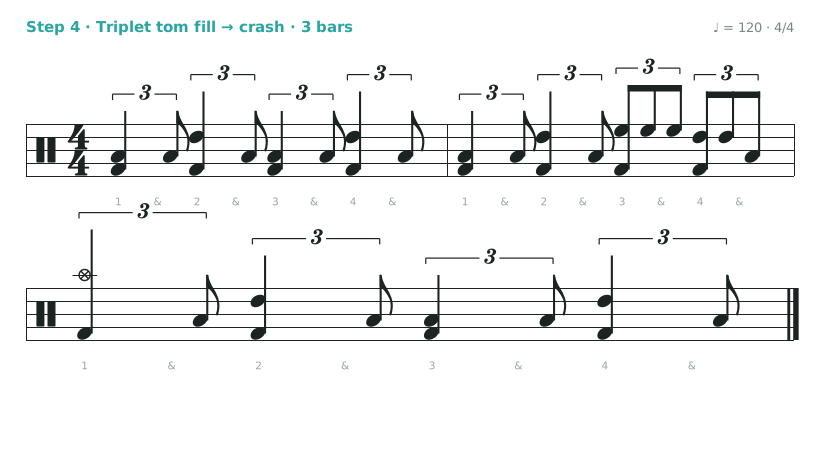
The notation on this blog has no loud and soft markings. When you play it, lean a little harder on the beats — especially the mid tom on 2 and 4 — and a little softer on the “let,” and the swing comes alive. If ♩ = 120 feels too fast, start at 90.
What this song teaches
- Hold the time with the kick — the toms can swing, but the foot stays even. Playing the kick lightly on all four beats in jazz is called feathering (Jazz Swing Ride Pattern for Beginners — Feathering and Comping Explained (Notation and Audio)).
- Build a groove on toms — you can make a beat with no hi-hat or snare at all (Tribal Tom Groove — How to Play a Big Drum Beat on the Toms (Notation and Audio)).
- A solo starts from the groove — Krupa’s long solo grew out of stretching the same rhythm. For a four-bar solo recipe, see How to Build a Drum Solo — A Simple 4-Bar Formula for Beginners (Notation and Audio).
DrumMate has a 20-level course and a library of more than 1,000 songs to play along with the original tracks, and with an electronic kit connected every bar is scored for timing and accuracy. Try it free for 7 days.