
Song Structure for Drummers — What to Play in the Verse, Chorus and Bridge (Notation and Audio)

Plenty of new drummers can play the groove but get lost halfway through a song — “wait, where are we?” The fix is not more groove practice. It is knowing the song structure.
Most pop and rock songs repeat a handful of sections in a set order. The drummer’s job is to change the sound a little in each section, so everyone can hear where the song is going.
- Songs are built from sections: intro, verse, chorus, bridge, outro
- Verse: smaller and tight. Chorus: bigger and wider
- Fill just before a new section, crash on its first beat
- Sections usually come in 4- or 8-bar blocks — count bars and you will not get lost
The parts of a song
- Intro — the opening. It may start without drums, with a simple groove, or with the drummer counting the band in.
- Verse — where the story is told. The lyrics change each time.
- Pre-chorus — a short build-up before the chorus. Many songs do not have one.
- Chorus — the biggest, most memorable part, usually with repeated lyrics.
- Bridge — a section with a different feel, often once near the end.
- Outro — the ending. It may fade down or stop on a hit.
How the drums change from section to section
There are no fixed rules, but these approaches are common:
- Verse — closed hi-hat, a little quieter. Leave room so the vocal comes through.
- Chorus — move to the ride or a slightly open hi-hat, with a crash on the first beat. The sound opens up.
- Bridge — switch to a half-time feel, play mostly on the toms, or even drop out.
Moving from the verse into the chorus
The notation below is a 4-bar example. Bars 1–2 are the verse on the hi-hat, there is a short fill on the last beat of bar 2, and bar 3 enters the chorus with a crash and a switch to the ride.
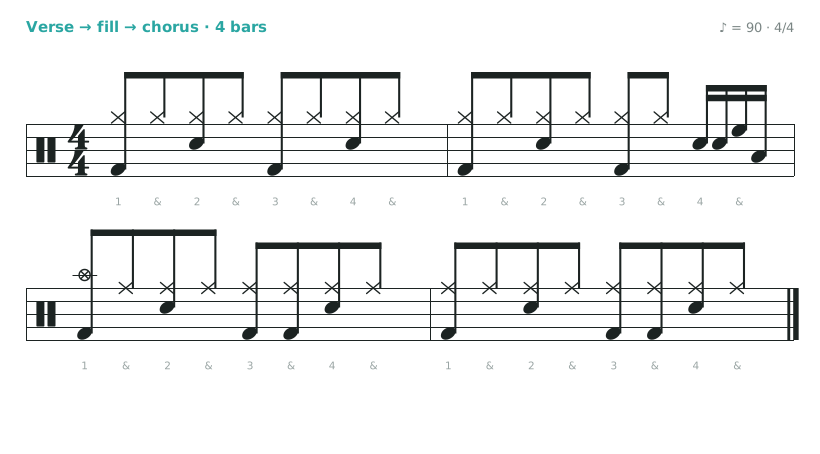
The fill does not need to be long. A one-beat fill is enough to say “here comes the change”. What really matters is landing the first beat after it right on time.
Listen to a song you like and write down each section and its length, such as “Intro 4 / Verse 8 / Chorus 8…”. Once it is on paper you will get lost far less often, and the same notes are a big help at band rehearsals.
Get into the habit of counting bars
Most sections end after 4 or 8 bars. While you play, count “1, 2, 3, 4…” in your head on the first beat of every bar and you will know when the next section is coming. It feels hard at first, but after a few songs it becomes second nature.
Practise real songs from start to finish along with the original tracks in DrumMate’s library of more than 1,000 songs. Connect an electronic drum kit and DrumMate scores your timing and accuracy bar by bar, so you can also see whether your time slips at the section changes.