
10 Basic Drum Beats for Beginners — Sheet Music and Audio for Every Groove

Learn a handful of basic drum beats and you can play along with most songs. This is a collection of 10 essential beats for beginners, ordered from easiest to hardest. Each one comes with notation, a Listen button and a tempo to start practising at.
New to drum notation? Read How to Read Drum Notation — A 10-Minute Guide for Complete Beginners first. The bottom line is the kick, the middle is the snare, and the × on top is the hi-hat.
- Beats 1–4 (quarter-note hi-hat → 8th-note beat → kick variations → open hi-hat) are the absolute basics
- Beats 5–8 change the mood of a song: ballad, half-time, 16ths and disco
- Beats 9–10 split the beat into three: shuffle and 6/8
- Listen at “Slow 75%” first, then practise with a metronome at the starting BPM in the table
At a glance
| # | Beat | Starting BPM | Where you’ll hear it |
|---|---|---|---|
| 1 | Quarter-note hi-hat beat | 70–80 | Your very first groove, slow songs |
| 2 | Basic 8th-note beat | 70–90 | Most rock and pop |
| 3 | 8th-note beat, kick variations | 70–90 | Verses and choruses of 8th-note songs |
| 4 | 8th-note beat with open hi-hat | 70–90 | Choruses, a lift without a fill |
| 5 | Ballad beat | 60–70 | Slow ballad verses |
| 6 | Half-time beat | 70–80 | Big, heavy choruses |
| 7 | 16th-note beat | 60–80 | Mid-tempo pop and R&B |
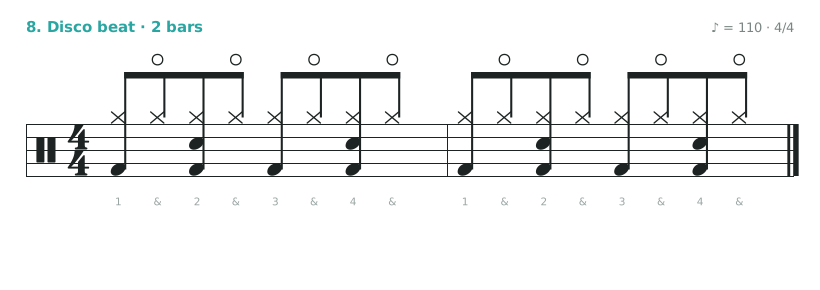
| 8 | Disco beat | 90–110 | Disco and dance pop |
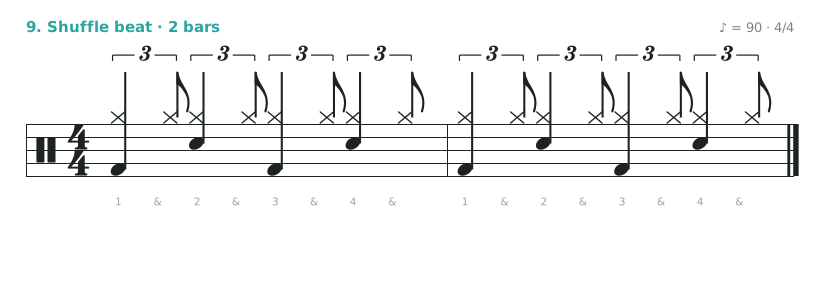
| 9 | Shuffle beat | 70–90 | Blues and shuffle rock |
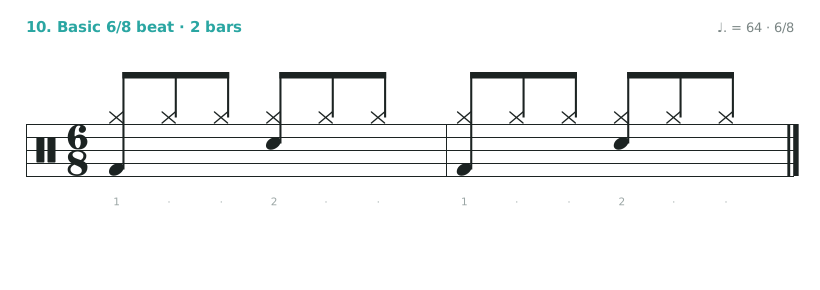
| 10 | Basic 6/8 beat | 80–100 (in 8ths) | 6/8 ballads and rock |
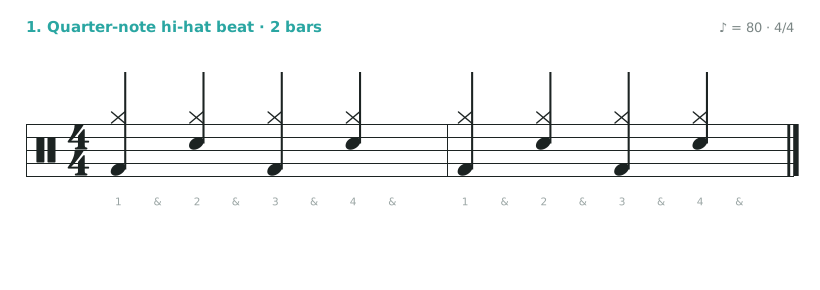
1. Quarter-note hi-hat beat
The hi-hat plays only once per beat, so your hands have time to spare and you can focus on where the kick and snare land. Just check that hi-hat and kick (1 and 3) and hi-hat and snare (2 and 4) sound exactly together. More: Quarter-Note Hi-Hat Beat — The Easiest First Drum Groove (Notation and Audio)
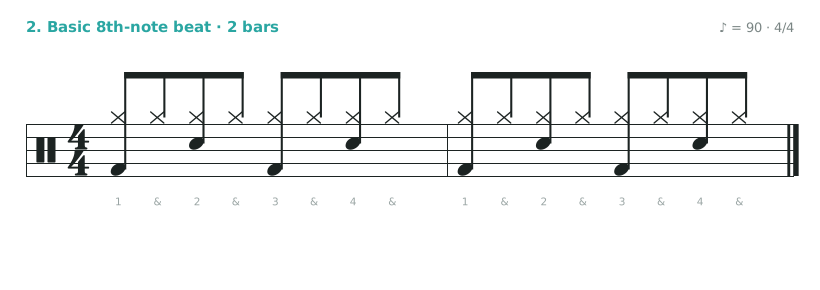
2. Basic 8th-note beat
The foundation of almost every drum beat. Count “1 and 2 and…” while the hi-hat plays eight 8th notes, then add the kick on 1 and 3 and the snare on 2 and 4. When you can hold it steady with a metronome for a full minute, move on. More: The Basic Rock Beat — Your First 8th-Note Drum Groove and Two Variations
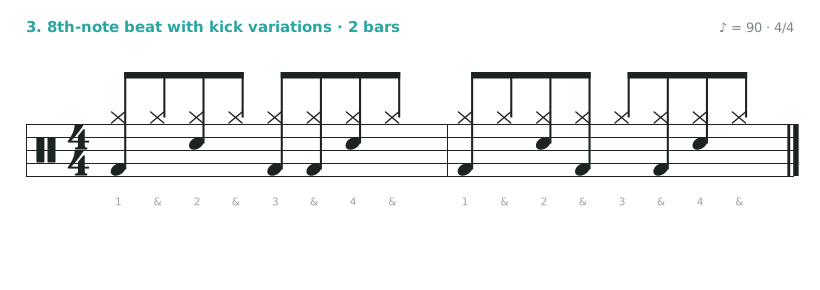
3. 8th-note beat, kick variations
The 8th-note beat with one more kick. Bar 1 adds the and of 3; bar 2 has kicks on the and of 2 and the and of 3. Keep your hands exactly the same and only add the foot, so the hi-hat doesn’t wobble on the off-beat kicks. More: The Basic Rock Beat — Your First 8th-Note Drum Groove and Two Variations
4. 8th-note beat with open hi-hat
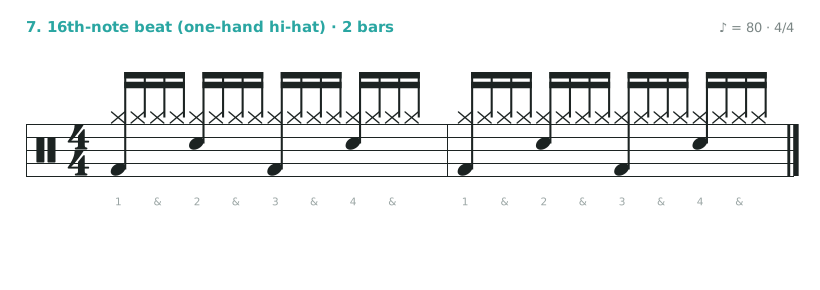
On the and of 4, lift the hi-hat pedal a little so it hisses open, then close it with your foot on the next beat 1. Sheet music marks the open note with a small circle. More: Open vs Closed Hi-Hat — How to Play It, How It’s Notated, and Two Exercises
5. Ballad beat
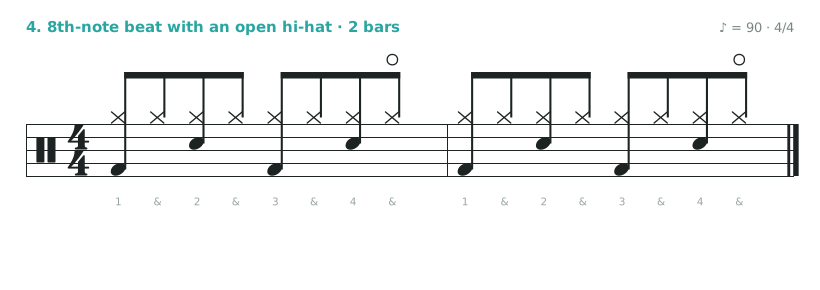
Play beats 2 and 4 with a cross-stick (the stick laid across the snare, clicking on the rim). Slow tempos leave long gaps between notes, which actually makes it easier to drift. In the chorus, switch the cross-stick to a full snare to make the song bigger. More: Ballad Drum Beats for Beginners — Why Slow Songs Are Harder, and How to Play Them
6. Half-time beat
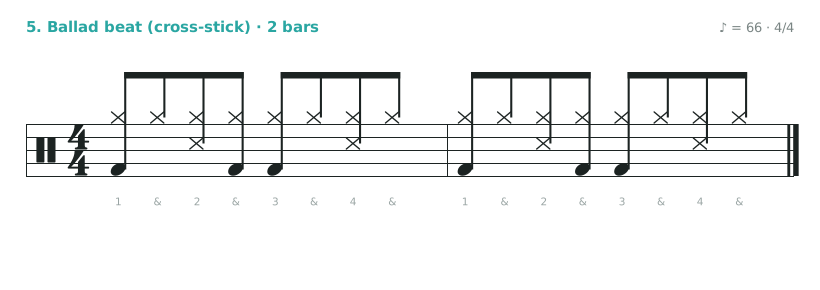
The snare plays once, on beat 3, instead of on 2 and 4. Same tempo, but it sounds half as fast and much heavier. With fewer snares, the key is keeping the hi-hat 8ths perfectly even all the way through. More: What Is a Half-Time Groove? Same Tempo, Half the Feel — How to Play It (Notation and Audio)
7. 16th-note beat
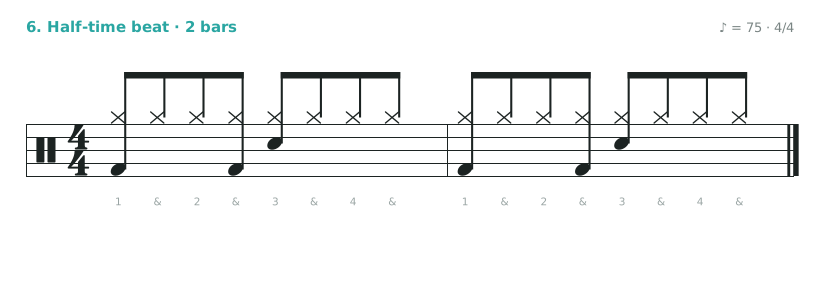
One hand plays 16th notes on the hi-hat. That tires your wrist quickly at speed, so start at 60. At faster tempos you can split the 16ths between both hands (see the 16th-note beat guide). More: 16th-Note Drum Grooves for Beginners — One-Hand, Two-Hand and Kick Variations
8. Disco beat
Kick on all four beats; hi-hat closed on the beat and open on the off-beat — “boom tsss boom tsss”. Your left foot opens and closes the pedal every beat, so start slowly and get the two feet together first. More: How to Play a Disco Drum Beat — Four-on-the-Floor Kick and Offbeat Open Hi-Hat (Notation and Audio)
9. Shuffle beat
The hi-hat sits on the first and third notes of each triplet for a bouncy “daa-da daa-da”. It’s not just late 8th notes — count each beat in three (“1-trip-let”) and it lines up. More: Shuffle Drum Beat for Beginners — Understanding the Swing Feel Through Triplets
10. Basic 6/8 beat
Six 8th notes per bar, grouped into two big beats. Kick on the 1st 8th, snare on the 4th. Count “1 2 3 4 5 6” and the snare lands on 4. More: 6/8 Drum Grooves — Ballad, Rock and Fill Variations (Notation and Audio)
How to practise them
- One or two a day. When you can hold a beat steady with a metronome for one minute, move on to the next number.
- Start each beat at the BPM in the table, and after three clean run-throughs in a row, go up by 5. (What Does BPM Mean?)
- Alternate two beats, four bars each — for example, 8th-note beat for four bars, then half-time for four. That’s exactly how songs switch between verse and chorus.
- Add a fill at the end of the last bar and it starts to sound like a real song. (Easy Drum Fills for Beginners — Your First Three Fills (Notation and Audio))
At first, only listen for whether the notes your hands and feet play together (hi-hat + kick, hi-hat + snare) sound as one. Playing slowly and accurately gets you there much faster than playing fast with mistakes. You can also turn on “Slow 75%” under each example and play along.
Once you’ve got a few basic beats, it’s time to play real songs. DrumMate has a 20-level course and a library of 1,000+ songs you practise along with the original recording, and if you connect an electronic drum kit it scores your timing and accuracy for every bar.