
Ravel’s Boléro Snare Drum Rhythm — How to Play the 3/4 Pattern That Runs for 15 Minutes, in 3 Steps (Notation and Audio)

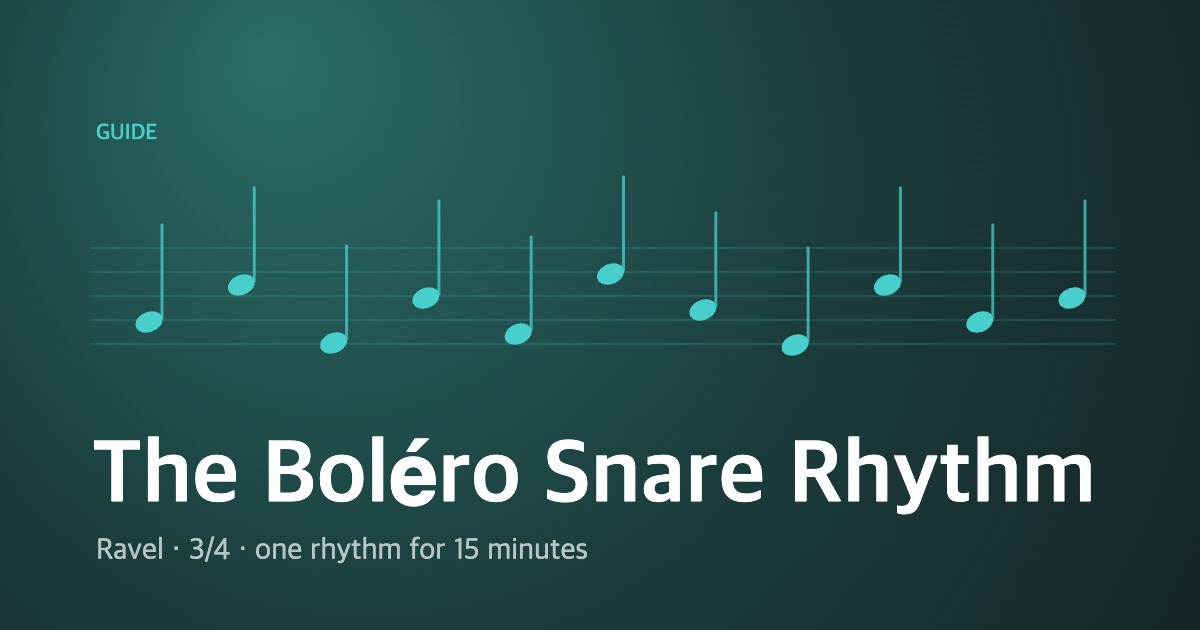
Boléro is an orchestral piece Maurice Ravel wrote in 1928. From start to finish the snare drum plays the same two-bar rhythm, while two melodies repeat on top, passed from instrument to instrument, and the whole piece slowly grows from very quiet to very loud. A performance usually lasts about 15 minutes.
For drummers, Boléro is a timekeeping workout: one rhythm for 15 minutes without speeding up, only slowly getting louder. This guide shows the Boléro snare rhythm in notation with audio, a three-step way to learn it, and a sticking. The background facts come from Wikipedia.
- The Boléro snare rhythm is two bars of 3/4: each beat is “an eighth note + three sixteenth-note triplets,” bar 1 ends with two eighths, bar 2 ends with six sixteenth-note triplets.
- The notation here is written at double length (eighth → quarter, sixteenth triplet → eighth triplet), so ♩ = 144 equals ♩ = 72 in the original.
- Three steps: feel the triplets → the two-bar rhythm → mark the original beat with the kick.
- The keys are not speeding up and starting very quietly.
What Is Boléro?
| Item | Details |
|---|---|
| Composer | Maurice Ravel, 1928 (published 1929) |
| How it started | Commissioned by the dancer Ida Rubinstein — she first asked for an orchestration of Albéniz pieces, but Ravel wrote a new piece on the bolero rhythm instead |
| Premiere | 22 November 1928, Paris Opéra |
| Key and meter | C major, triple time (3/4) |
| Tempo | Marked Tempo di Bolero, moderato assai. Ravel crossed out 76 in his own copy and wrote 66; later editions suggest 72 |
| Length | About 15 minutes on average. Ravel’s own 1930 recording runs 15:50 |
| Form | Two 18-bar melodies alternate and repeat; near the end the music shifts briefly to E major, then returns to C major |
| Snare | The score calls for two snare drums. The rhythm is there from the first bar, and a second snare joins near the end |
Ravel himself described the piece as one very long, gradual crescendo.
The Boléro Snare Rhythm — Two Bars
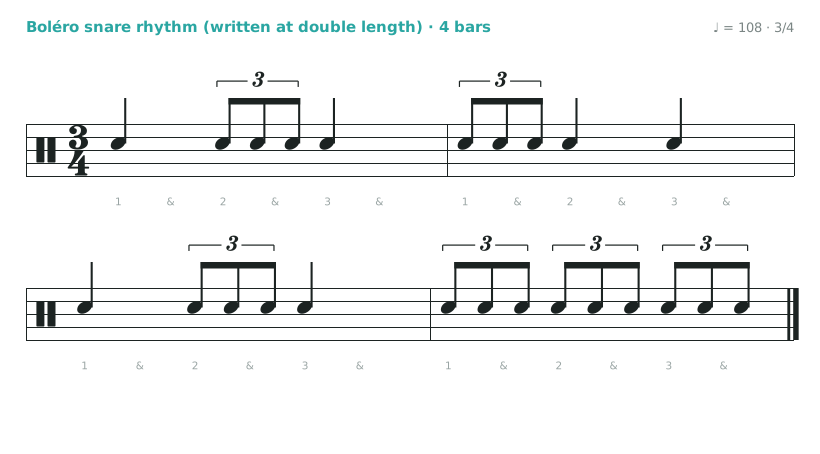
One cycle is two bars of 3/4.
- Bar 1 — beat 1: eighth + three sixteenth-note triplets / beat 2: the same / beat 3: two eighth notes
- Bar 2 — beats 1 and 2: same as bar 1 / beat 3: six sixteenth-note triplets
Say it as “tah da-da-da tah da-da-da tah tah | tah da-da-da tah da-da-da da-da-da-da-da-da.” Three triplets squeezed into half a beat makes it quite dense.
This site’s notation engine draws an eighth note and sixteenth-note triplets inside one beat in a hard-to-read way. So the scores below double every note value: eighth → quarter, sixteenth triplet → eighth triplet, and one original bar → two bars. The tempo number doubles too, so ♩ = 144 sounds the same as ♩ = 72 in the original. When you read the real score, use the description above.
Step 1 — Feel the Triplets
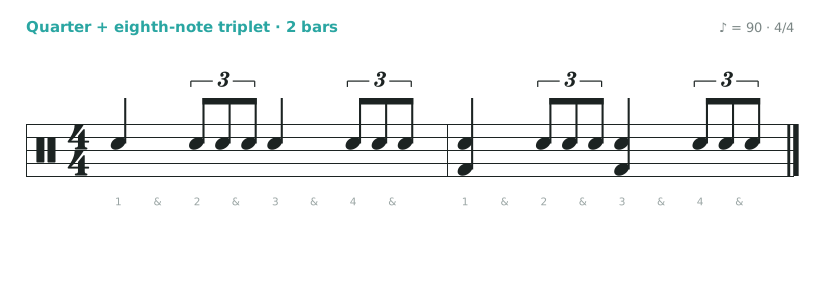
First, loop just the basic cell — “one long note + three triplets” — in 4/4. Listen for the eighth-note triplets to fall evenly on the beat after the quarter note. In bar 2 the kick joins on beats 1 and 3 so you feel the pulse in your foot.
Step 2 — The Two-Bar Boléro Rhythm (Slowly)
The four written bars are the original two bars. ♩ = 108 equals ♩ = 54 in the original — well below the real tempo. The nine triplets in the last bar are the three triplets at the end of beat 2 plus the six triplets of beat 3 in the original bar 2. Hands tend to bunch up here, so keep them even.
Step 3 — Mark the Original Beat With the Kick
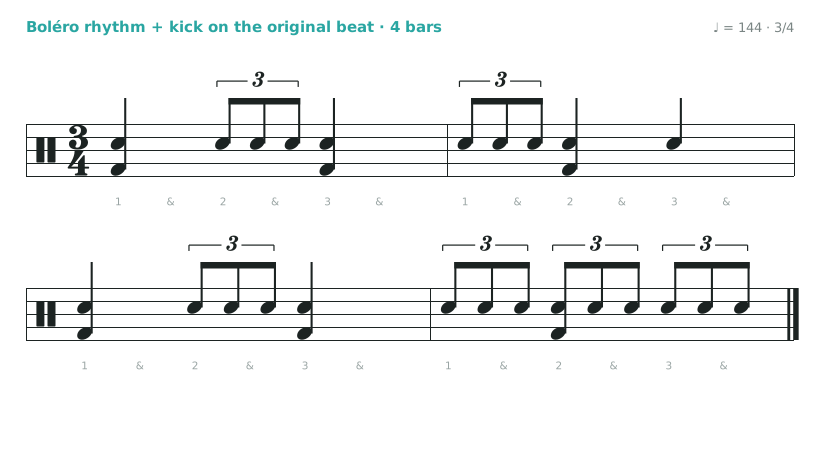
Now go up to ♩ = 144, the same as the original ♩ = 72, and press the kick on every original beat — every two beats as written. Your foot holds the pulse while your hands fill in the rhythm, so you can hear right away if the beat drifts. The real orchestral snare part has no kick; this is just for practice.
Sticking
Alternating single strokes make every beat start on the same hand (in original note values):
- Bar 1: R LRL R LRL R L
- Bar 2: R LRL R LRL RLR LRL
How to Stay Steady for 15 Minutes
- Metronome in 3/4 at 72 (or 66). The free DrumMate metronome has a 3/4 setting. The Triplet subdivision clicks eighth-note triplets, which do not line up with Boléro’s sixteenth-note triplets, so Quarter note or Eighth notes is less confusing.
- Start very quietly. The whole piece keeps growing, so if you start loud there is nowhere to go. Begin with low sticks and raise them little by little (Drum Dynamics — Dynamic Marks, Playing a Soft Verse and Loud Chorus, and 4 Exercises (Notation and Audio)).
- Do not speed up. Getting louder tends to make you faster. Record yourself on your phone and compare the first minute with the last.
- Build up the time. 3 minutes → 5 → 10 → 15. If your hands tense up, stop and rest.
At a 1930 performance at the Paris Opéra, Arturo Toscanini conducted Boléro much faster than Ravel wanted, and Ravel told him backstage that it was too fast. Recordings range from close to 12 minutes to almost 18, mostly because of tempo. In practice, the goal is to pick one tempo and hold it to the end.
Where You Have Heard Boléro
- Torvill and Dean won ice-dance gold at the 1984 Winter Olympics to Boléro, with perfect artistic scores from every judge.
- It is also in the 1979 film 10 and the 1976 animated film Allegro Non Troppo.
- Its copyright ended in France in 2016; in the US it ran until the end of 2024.
Practice with DrumMate
The stamina to play one rhythm evenly for a long time pays off in band songs too. The DrumMate library has more than 1,000 songs, and with an electronic drum kit connected every bar is scored for timing and accuracy, so you can see whether the beat slips late in a song. Start your tempo work with the free metronome.