
Drum Dynamics — Dynamic Marks, Playing a Soft Verse and Loud Chorus, and 4 Exercises (Notation and Audio)

Drum dynamics means how loud or soft you play. A drum kit has no volume knob, so you change the level with how high you lift the stick, which instrument you hit, and how many notes you play. Just playing the same rock beat softly in the verse and louder in the chorus makes a song come alive.
This guide covers the dynamic marks you’ll see in sheet music, three ways to change volume on the drums, a verse and chorus beat in notation, and four exercises for loud and soft playing.
- Dynamics = loud and soft. Written from pp (very soft) to ff (very loud).
- On drums you change volume with ① stick height, ② which instrument you play, ③ how many notes you play.
- In a song: verse soft (closed hi-hat, cross-stick), chorus loud (crash, ride, snare).
- Use a metronome so you don’t slow down when soft or rush when loud.
Dynamic marks in sheet music
Dynamics are written with Italian abbreviations. p means soft and f means loud; an m in front means “moderately”, and a doubled letter means “very”.
| Mark | Name | Meaning |
|---|---|---|
| pp | pianissimo | very soft |
| p | piano | soft |
| mp | mezzo-piano | moderately soft |
| mf | mezzo-forte | moderately loud |
| f | forte | loud |
| ff | fortissimo | very loud |
| cresc. or < | crescendo | gradually louder |
| decresc. / dim. or > | decrescendo / diminuendo | gradually softer |
An accent (a > above a note) is a dynamic mark too—it means play that one note louder. Moving accents around is covered in The 4 Basic Drum Strokes — Full, Down, Up and Tap Strokes for Clean Accents.
Three ways to change volume on the drums
1. Stick height
This is the foundation. A low stick plays soft; a high stick plays loud. Control volume with height, not by forcing the stroke, and your sound stays clean and your tempo stays steady.
2. Which instrument, and how you hit it
With the same hand height, a different instrument gives a different level and feel. A closed hi-hat sounds smaller than an open one, a ride smaller than a crash, a cross-stick smaller and drier than a full snare. That’s why quiet sections often use closed hi-hat and cross-stick, and big sections move to crash, ride and snare.
3. Number of notes
Fewer notes feel softer; more notes feel bigger. Dropping the hi-hat from eighths to quarters, or adding one extra kick, already changes how loud the groove feels.
Dynamics in a song — soft verse, loud chorus
In most songs the verse tells the story and the chorus opens up. The drums follow that shape. The two beats below have the same tempo and pulse—only the instruments change.
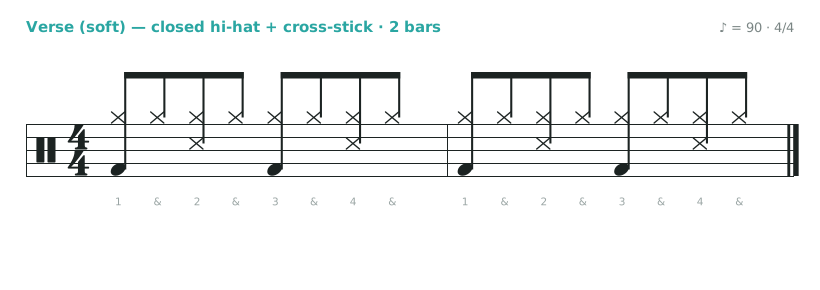
Verse: low closed hi-hat, and cross-stick instead of snare on 2 and 4. It stays out of the singer’s way.
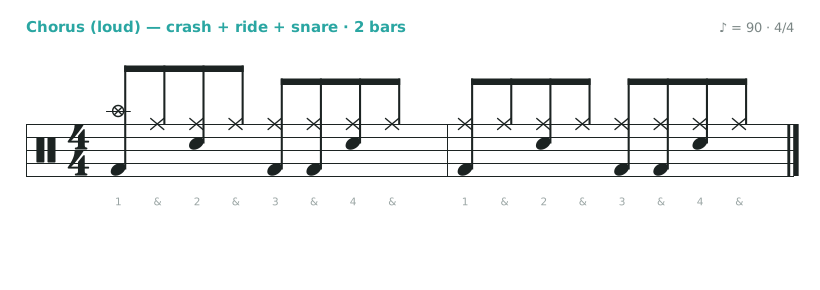
Chorus: crash on beat 1, ride eighth notes, snare on 2 and 4, and one extra kick on the “and” of 3. Only the instruments changed and one note was added, yet it sounds much bigger.
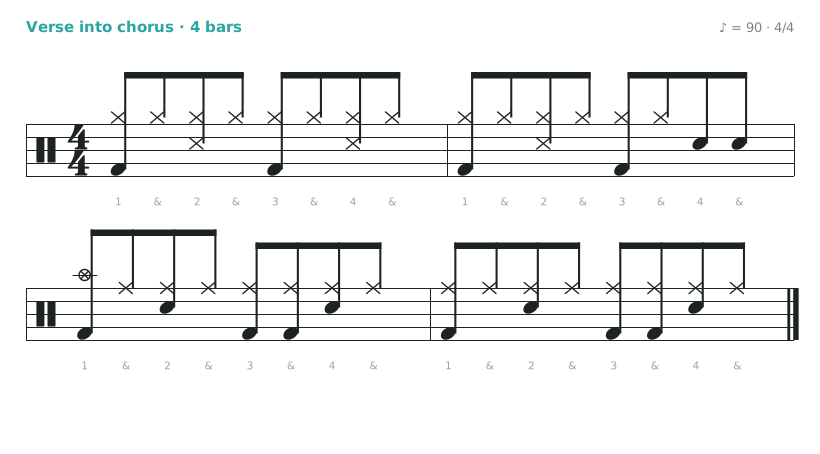
Put them together and you get this. The two snare eighth notes on beat 4 of bar 2 are the signal that the song is about to get louder.
For more on what the drummer does in each part of a song, see Song Structure for Drummers — What to Play in the Verse, Chorus and Bridge (Notation and Audio).
Four exercises for dynamics
- Four-level rock beat. Play the same rock beat at p → mp → mf → f, four bars each. Change only your hand height; keep the tempo.
- Eight-bar crescendo. Start very soft and grow a little each bar so the last bar is the loudest. Then try a decrescendo. If it jumps up all at once in one bar, start again.
- Different level per hand. Hi-hat at p, snare at f. Your two hands learn to move at different heights, and the backbeat on 2 and 4 pops out.
- Check the tempo with a metronome. Most people rush when they play loud and drag when they play soft. Do exercises 1–3 with a metronome.
The notation and Listen buttons in this post don’t show dynamic marks. Ghost notes—very soft notes usually written in parentheses—aren’t drawn here either. The verse/chorus difference is shown through the instruments; add the volume yourself when you play.
On DrumMate you can practise more than 1,000 library songs along with the original track, which makes it easy to hear how loud the verse and chorus are and match them. Connect an electronic drum kit and every bar is scored for timing and accuracy.
Keep reading
- The 4 Basic Drum Strokes — Full, Down, Up and Tap Strokes for Clean Accents
- Song Structure for Drummers — What to Play in the Verse, Chorus and Bridge (Notation and Audio)
- How to Play Cross-Stick (Side Stick) — The Ballad “Click” Sound (Notation and Audio)
- Drum Build-Ups — Three Ways to Raise the Energy Before a Chorus (Notation and Audio)