
When to Hit the Crash Cymbal — Timing, Technique and Chokes (Notation and Audio)

The crash cymbal is the flashiest sound on the drum kit, so beginners want to hit it all the time. But a crash is a signal that says “a new section starts here.” Hit it everywhere and the song just gets louder while losing its punch.
This guide covers when and how to play the crash, with two short examples.
- A crash usually goes on beat 1 of a new section, right after a fill
- Play the kick together with the crash to give it weight
- A “push” moves the crash early, onto the and of 4
- Strike the edge with a glancing blow, and grab it to stop the sound (choke)
The basic spot: beat 1 after a fill
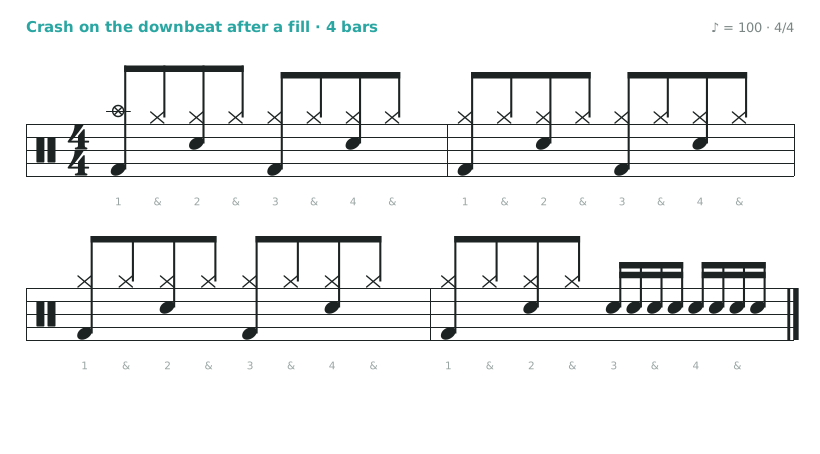
This is the most common place. Play a snare fill in the second half of bar four, then hit the crash and kick together on beat 1 of the next bar. On that beat the hi-hat rests and the crash takes its place. Loop the example and you get a crash every four bars. In real songs, too, most crashes land on beat 1 where a new section like a verse or chorus begins.
Good places for a crash
- The start of a section — beat 1 where the verse turns into the chorus
- Right after a fill — where the fill “lands”
- The last note of the song — crash and kick together, then let it ring
- Accents inside a chorus — once every four or eight bars
On the other hand, avoid crashing every bar in a quiet verse or dropping one randomly in the middle of a vocal line.
The pushed crash
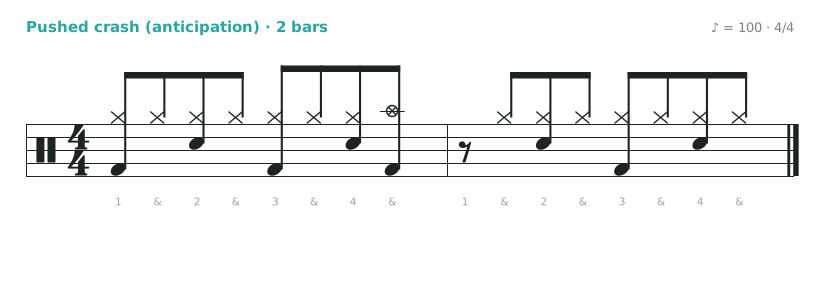
Instead of beat 1 of the next bar, the crash comes half a beat early, on the “and” of 4. When the whole band hits that spot together it is called a push, and it adds tension and drive. Beat 1 of bar two is left empty so the crash can ring. If you hear the bass or guitar come in half a beat early in a song, try matching it here.
How to hit it
- A glancing blow — strike the edge with the shoulder of the stick at an angle. Hitting straight down sounds choked and puts stress on the cymbal.
- Pull away — let the stick bounce off instead of leaving it on the cymbal so the sound rings longer.
- Angle — tilting the cymbal slightly toward you makes the edge easier to reach.
Right after hitting the crash, grab its edge with your other hand and the sound stops at once. That is a choke. It is used for band stops and for songs that end abruptly. Charts often do not mark chokes, so listen to the original song and find where the sound suddenly cuts off.
DrumMate has a library of more than 1,000 songs you can practice along with, and when you connect an electronic drum kit it scores your timing and accuracy bar by bar. Check that the crash at the end of each fill lands exactly on beat 1.