
How to Play Afrobeat Drums — A 3-Step Practice Groove Inspired by Tony Allen, Plus Afrobeat vs Afrobeats (Notation and Audio)

An Afrobeat drum groove holds back on the 2-and-4 backbeat, anchors beat 1 with the kick, and hints at the clave with the snare. The style grew up in Nigeria in the late 1960s, led by Fela Kuti and his drummer Tony Allen — Fela once said that “without Tony Allen, there would be no Afrobeat.”
Based on how Wikipedia describes Tony Allen’s playing, here is a three-step Afrobeat practice groove with notation and audio. It isn’t a transcription of any real song — it’s an exercise to get those features into your hands.
- Afrobeat: late-1960s Nigeria, Fela Kuti and drummer Tony Allen — highlife mixed with funk, jazz and soul
- Tony Allen’s traits: sparing 2-and-4 backbeat, swung triplet hi-hat, snare implying the clave, double kick on 1
- Three steps: sixteenth hi-hat + kick → add the snare → two-bar phrase
- Afrobeat and Afrobeats are different genres
What is Afrobeat? (And how it differs from Afrobeats)
| Afrobeat | Afrobeats | |
|---|---|---|
| Began | Late 1960s, Nigeria | 21st century, West Africa |
| Key figures | Fela Kuti, drummer Tony Allen | — |
| Ingredients | Yoruba and Ghanaian highlife + American funk, jazz and soul | Hip hop, house, dancehall and more |
| Traits | Chanted vocals, complex interlocking rhythms and percussion, Fela Kuti’s songs often run 10–15 minutes or longer | — |
The names are often mixed up, but Wikipedia is clear that the two genres are not the same. This lesson is about 1970s-style Afrobeat drumming.
How did Tony Allen play?
Tony Allen (1940–2020) was the drummer and musical director of Fela Kuti’s band Africa ’70 from 1968 to 1979, and is counted among the founders of Afrobeat. Wikipedia describes four features of his playing.
| Part | Tony Allen’s approach | In this practice groove |
|---|---|---|
| Snare | Sparing use of the 2-and-4 backbeat; implies the clave without stating it | Snare on 1a, 2& and 4 instead of 2 and 4 |
| Hi-hat | Tightly swung, aggressive triplet patterns | Written as straight sixteenths — swing them once they’re comfortable |
| Kick | A strong downbeat, often a double kick on 1 | Kick on 1 and 1e, plus 3& |
| Four limbs | Said a good drummer’s four limbs play different things | Go slowly so hands and feet land in their own spots |
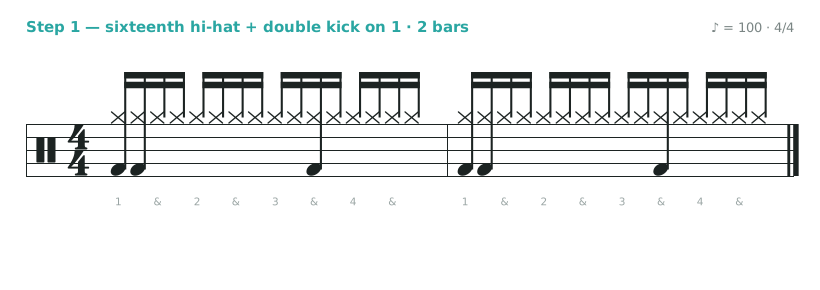
Step 1 — sixteenth hi-hat + double kick on 1
Play even sixteenths on the hi-hat with your right hand, kick twice on beat 1 and the very next sixteenth (1e), and once on the “and” of 3. No snare yet. When the double kick on 1 comes out the same size every bar, move on.
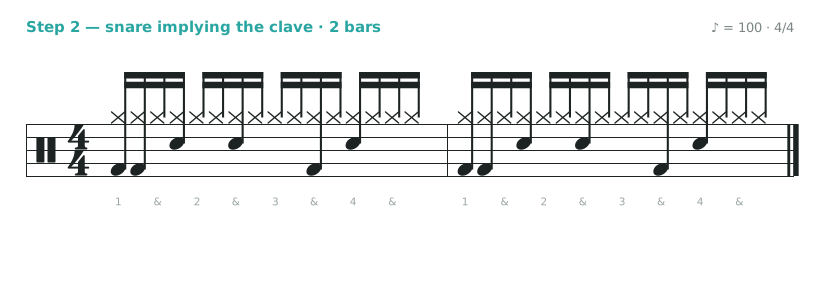
Step 2 — let the snare imply the clave
Put the snare on 1a, 2& and 4 instead of 2 and 4. Now kick on 1, snare on 1a, snare on 2&, kick on 3& and snare on 4 trace a 3-2 clave (1, 1a, 2&, 3&, 4). Kick and snare share the clave between them, so it sounds like a rolling groove rather than a backbeat. You can practice those clave spots in How to Play the Bo Diddley Beat on Drums — The 3-2 Clave Rock and Roll Groove in 3 Steps (Notation and Audio) too.
Step 3 — two-bar phrase
In bar two, add a kick on 2a and open the hi-hat on the “and” of 4. The two bars should sound like one unit. Afrobeat songs run long, so loop these two bars with a metronome for five minutes without letting them drift.
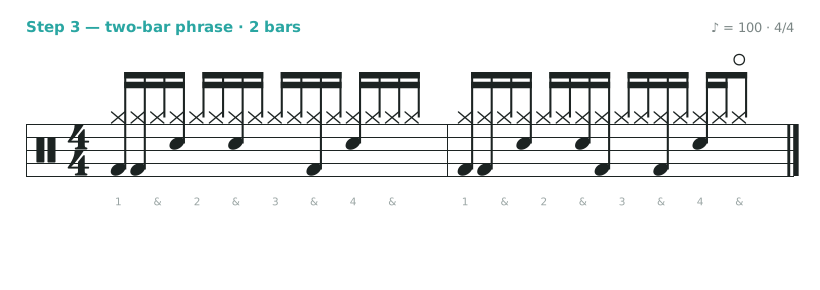
The notation has no swing marking, so the sixteenths are drawn evenly. Once the groove is comfortable, play each pair of hi-hat sixteenths slightly long–short. That moves you toward Tony Allen’s swung triplet feel. New to swing? Start with Shuffle Drum Beat for Beginners — Understanding the Swing Feel Through Triplets.
Practice tips
- Start slow: if the audio tempo (♪ = 100) is too fast, begin at 70–80 and add 4 BPM at a time.
- Count sixteenths: say “1 e & a 2 e & a …” out loud to place the kick and snare. If sixteenth-note hi-hat is new, see 16th-Note Drum Grooves for Beginners — One-Hand, Two-Hand and Kick Variations first.
- Separate the limbs: for drills that keep the hi-hat steady while the kick and snare move, see Drum Limb Independence for Beginners — Keep the Hands, Change the Feet.
With DrumMate you can practice library songs along with the original recordings, and if you connect an electronic kit, every bar is scored for timing and accuracy. More genre grooves are collected in Drum Beats by Genre — A Quick Guide from Rock to Funk, Reggae and Bossa Nova.