
12-Bar Blues Drums — How to Count the Form, Play a Shuffle and Fill Back to the Top (Notation and Audio)

A 12-bar blues is a song form where one time around is twelve bars, with chords moving I (four bars) → IV (two bars) → I (two bars) → V, IV, I, I. As the drummer, count those twelve bars as three lines of four, mark the first beat of bars 1, 5 and 9 with a crash, and play a short fill at the end of bar 12 to send the band back to the top. This post walks through one full chorus with three shuffle excerpts (twelve bars plus the return to bar 1).
- 12-bar blues = I I I I / IV IV I I / V IV I I (the most common form, per Wikipedia)
- Count three lines of four bars — crash on bars 1, 5 and 9
- A snare pickup at the end of bars 4 and 8; a triplet fill on beats 3–4 of bar 12 back to bar 1
- Groove: shuffle (first and third triplet partials); second chorus: ride plus kick on all four
- All four excerpts have Listen, Repeat and Slow playback
What is a 12-bar blues? The chord chart
Wikipedia’s twelve-bar blues article gives the simplest form below. The Roman numerals are the I, IV and V chords of the key. Some versions keep V in bar 12 to turn back to bar 1, and the quick change visits IV early, in bar 2. The article says the blues was passed down orally from work songs and spirituals before W. C. Handy first wrote it down and codified the form.
| Bars | Chords | What the drums do |
|---|---|---|
| Bars 1–4 | I – I – I – I | bar 1 (crash), bar 4 (one pickup snare) |
| Bars 5–8 | IV – IV – I – I | bar 5 (crash), bar 8 (snare triplet on 4) |
| Bars 9–12 | V – IV – I – I | bar 9 (crash), bar 12 (fill on 3–4) |
Wikipedia also notes that the lyrics often follow an AA’B shape: a line, the same line again with a small change, then an answer. So the song changes line every four bars, and drums that move in four-bar units feel natural.
The blues shuffle — first and third triplet partials
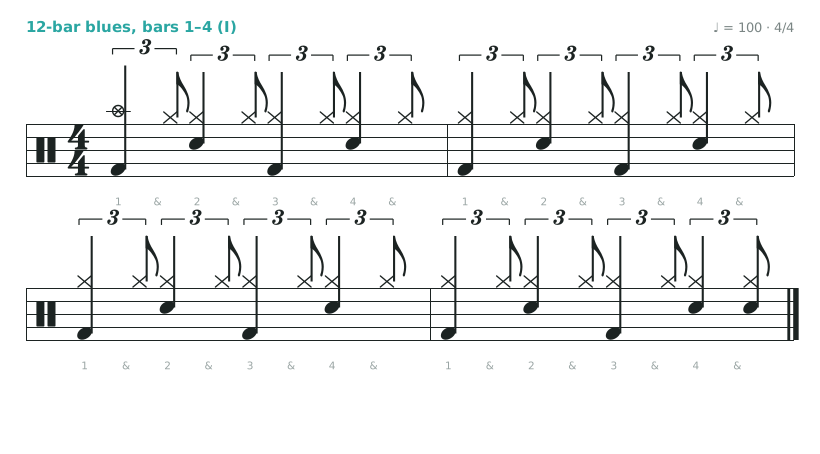
Blues is very often played with a shuffle. Wikipedia’s swing article explains that in a shuffle the first note of each pair sounds about twice as long as the second, giving a triplet feel. On drums, play the hi-hat on the first and third partials of each triplet, kick on 1 and 3 and snare on 2 and 4. If the shuffle itself is new to you, start with shuffle basics.
Bars 1–4 — the I chord, a crash and a pickup
Crash on beat 1 of bar 1 to mark the top of the form. Bars 2 and 3 are plain shuffle. In bar 4, add one snare on the last triplet partial to signal that the next line is coming.
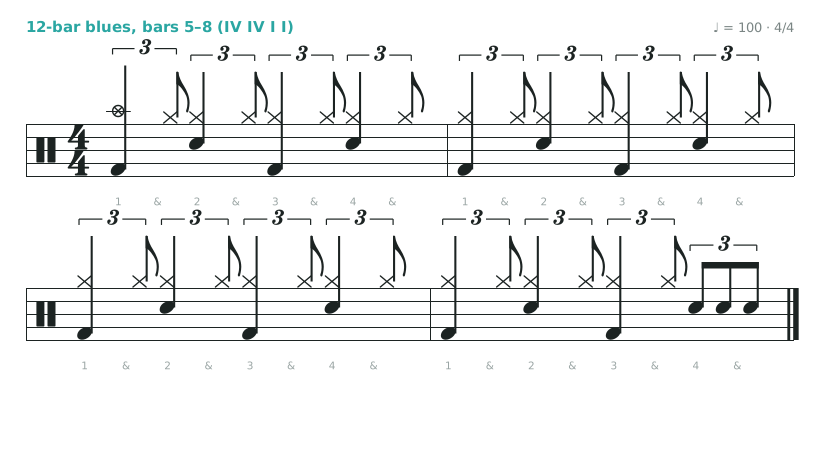
Bars 5–8 — crash where the chord moves to IV
Bar 5 is where the chord changes to IV, so a crash on beat 1 fits well. On beat 4 of bar 8, play three snare triplets — a slightly bigger pickup that sets up bar 9, the V chord and the most tense point of the form.
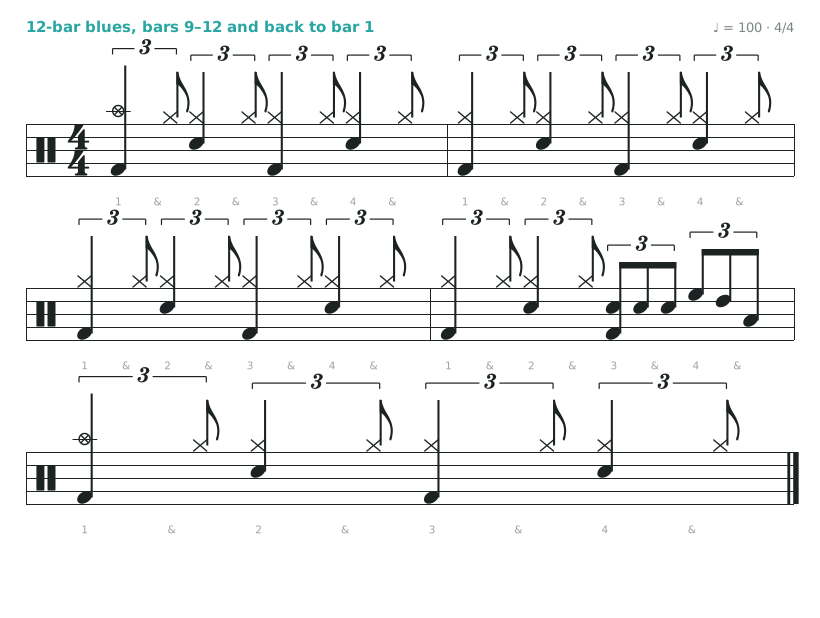
Bars 9–12 — V, IV, I, I and the fill back to the top
Crash on bar 9 (V). In bar 12, play three snare triplets on beat 3 and high tom, mid tom and floor tom triplets on beat 4, then land on the crash at bar 1 of the next chorus. This end-of-form spot that wraps the chorus and sends it back to the top is commonly called the turnaround. To end the song, play the ending you agreed on with the band instead of this fill.
Twelve bars is longer than it feels. Count the line (1, 2, 3) on the fingers of your left hand, or just count “four from here” starting at each crash bar (1, 5, 9). Practice hearing the bass and guitar move to IV and V too, so you rely less on counting.
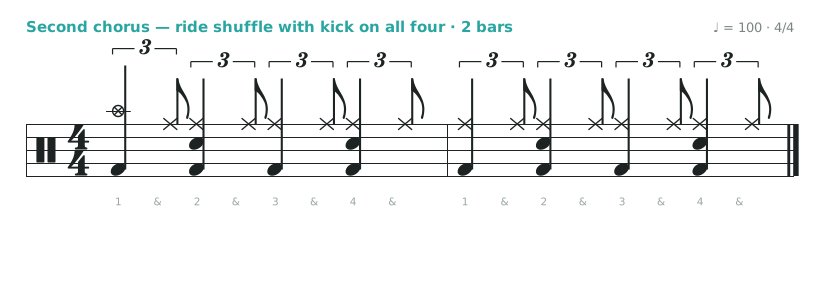
Second chorus — ride shuffle with kick on all four
Because the same twelve bars repeat, changing the drum sound each time around makes the song grow. Play the first chorus on the hi-hat, then move to the ride and put the kick on all four beats for the second. It is a common move when a solo starts.
Practice order
- Metronome at 80–100 BPM with the subdivision on triplets; play one shuffle bar evenly for a minute.
- Crash only on bars 1, 5 and 9 and play twelve bars without stopping.
- Add the pickups in bars 4 and 8 and the bar-12 fill; play three choruses in a row.
- Switch to ride plus four-on-the-floor kick from the second chorus.
- Play with a blues backing track or a band and crash where you hear the chords change.
In blues the drums mostly support the singer and the solos. One or two beats at the end of bar 12 is plenty, and the bar 4 and 8 pickups can be a single snare or two. For more shuffle fills see shuffle fills; for slow, rolling songs see 12/8 slow rock.
Practice with DrumMate
Every excerpt above has Listen, Repeat and Slow (75%) buttons. The free DrumMate metronome can switch its subdivision to triplets or an eighth-note shuffle, which helps you lock into the shuffle feel while you count the twelve bars.