
Afro-Cuban 6/8 Drum Groove — How to Play the Standard Bell Pattern on the Ride in 3 Steps (Notation and Audio)

The standard bell pattern is a seven-stroke rhythm that strikes pulses 1, 3, 5, 6, 8, 10 and 12 of a 12-pulse bar in 12/8 (6/8). Counted out, it’s “1, 1a, 2&, 2a, 3&, 4, 4a.” It is the most commonly used key pattern in sub-Saharan Africa and the most widely used bell pattern in Cuba, and many North American musicians simply call it the “6/8 bell.” On a drum kit, playing it on the ride is the starting point of the so-called Afro-Cuban 6/8 groove.
This guide builds it in three steps: the bell over the four main beats, the 6/8 clave hidden inside it, then a drum-set practice groove with a tom fill. Every score is at ♩. = 60 (metronome in 12/8 at 90 BPM) and has a Listen button.
- Standard bell pattern = pulses 1, 3, 5, 6, 8, 10, 12 of 12 (spacing 2-2-1-2-2-2-1).
- Other names: standard pattern, bembé, 6/8 bell.
- The seven strokes contain both the 6/8 son clave and the 6/8 rumba clave.
- Count it against four dotted-quarter main beats — start with the kick on those beats.
- Four scores: kick + bell → clave check → kick/cross-stick groove → half-bar tom fill → crash.
What is the standard bell pattern?
Wikipedia’s “Bell pattern” article describes it as the most common key pattern in sub-Saharan Africa. It appears as the 12-pulse standard pattern in Ewe music from Ghana and in Afro-Cuban rhythms such as bembé, palo, iyesá and rumba columbia, and it is the most widely used bell pattern in Cuba. Godfried Toussaint writes it as the interval sequence 2-2-1-2-2-2-1. Bell patterns are also played on the shell of the timbales and on drum kit cymbals.
Count       1 & a 2 & a 3 & a 4 & a
Bell (7)    X . X . X X . X . X . X
Son clave   X . X . X . . X . X . .
Rumba clave X . X . . X . X . X . .
Main beats  X . . X . . X . . X . .
As the grid shows, the seven strokes include every stroke of the 6/8 son clave (1, 3, 5, 8, 10) and the 6/8 rumba clave (1, 3, 6, 8, 10), which is why A. M. Jones considered the three “basically the same pattern.” The same sources stress that every key pattern is built on four main beats — feel those first instead of chasing the bell.
On the DrumMate metronome, choosing 12/8 gives four main-beat lights, and the BPM number counts quarter notes. For ♩. = 60, set 90 BPM (60 × 1.5). Start slower at 60–75 BPM (♩. = 40–50).
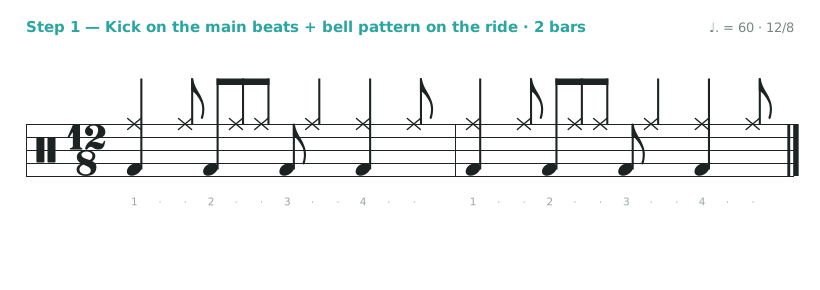
Step 1 — Bell pattern over kick on the main beats
Kick on the four main beats only; right hand plays the seven bell strokes on the ride. Kick and ride land together only on beats 1 and 4 — on main beats 2 and 3 the kick sounds alone. Get used to the ride slipping in around those kick-only spots on 2a and 3&. Saying “1 · a 2& a · 3& · 4 · a” out loud helps.
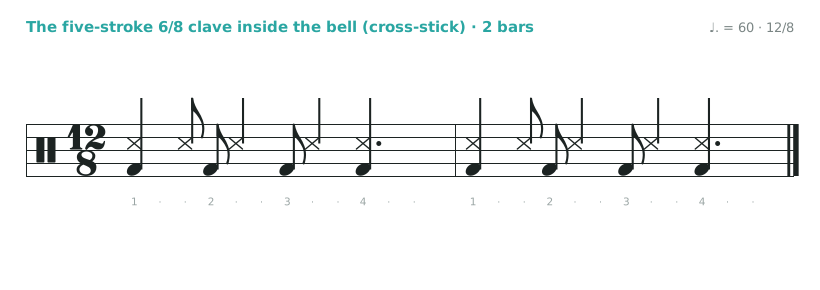
Find the 6/8 clave inside the bell
Play only five of the seven strokes (the son clave) on cross-stick and you’ll hear that the bell is just the clave plus two extra pulses, 2a and 4a. Alternate this with Step 1 and the “clave + two” structure sticks. Note that Wikipedia says the clave instrument itself usually isn’t played in Afro-Cuban 6/8 feels — this is purely a practice step to learn the structure.
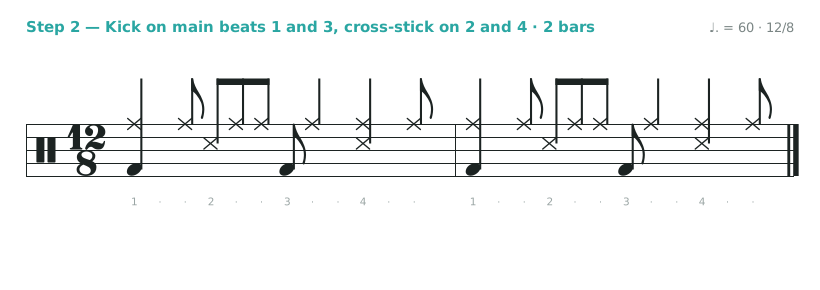
Step 2 — Kick on main beats 1 and 3, cross-stick on 2 and 4
Now turn it into a kit groove: right hand stays on the bell, kick on main beats 1 and 3, left-hand cross-stick on main beats 2 and 4. It’s the familiar “kick 1 and 3, snare 2 and 4” moved onto dotted-quarter beats, so it feels natural to rock and pop drummers. On main beat 4 the ride and cross-stick land together — make both hands hit exactly at once. This is a drum-set practice groove, not a transcription of a traditional rhythm.
Step 3 — Groove → half-bar tom fill → crash
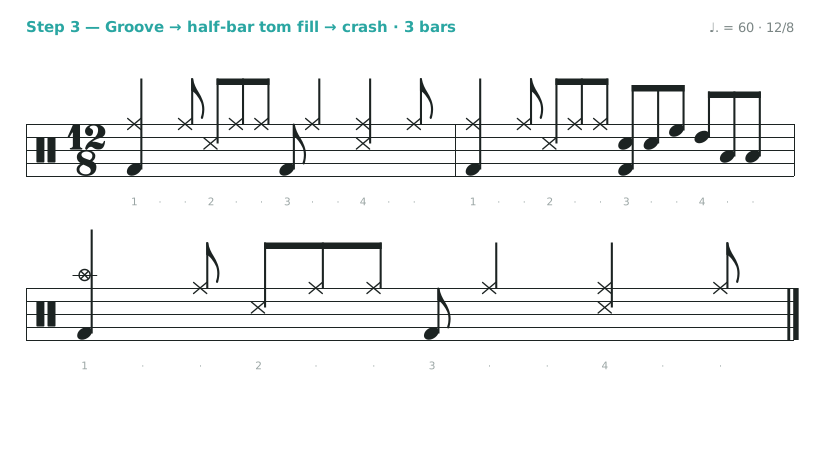
From main beat 3 of the second bar, stop the bell and come down in six eighth notes: two snares → high tom → mid tom → two floor toms (kick on main beat 3). Bar three opens with crash + kick, then the bell picks straight back up — remember that the next bell stroke after the crash is on 1a.
Three common mistakes
- The bell turns into 4/4: if the back-to-back 2& and 2a aren’t evenly spaced, it starts to sound like straight eighths. Count the pulses against the main-beat kick.
- Losing the main beats: if the bell no longer feels like it starts on 1, go back to Step 1 and listen to the four kicks.
- Losing the bell after the fill: the bell resumes on 1a after the crash. Loop just “fill → crash → 1a.”
New to 6/8? Learn to count main beats with three 6/8 grooves and the 12/8 slow rock beat first. Clave in 4/4 is covered in our Bo Diddley beat guide.
DrumMate lets you practice over 1,000 songs along with the original recordings, and with an electronic kit connected it scores your timing and accuracy bar by bar. The free metronome supports 12/8 time and triplet subdivisions.