
Drum and Bass Beat for Beginners — Learning the Fast Two-Step Breakbeat (Notation and Audio)

Drum and bass (DnB) is an electronic music genre known for fast, rolling drums and heavy bass. Tempos usually sit around 160–180 BPM, but the drum pattern itself is surprisingly simple — which makes it a great rhythm to bring to a real kit.
The genre grew out of chopping drum breaks (the drums-only sections) from old funk and soul records and speeding them up, which is why it goes hand in hand with the word “breakbeat.” In this guide you’ll learn the core rhythm, the two-step, then add variations and a fill.
- Drum and bass is a fast breakbeat style, usually around 160–180 BPM
- The core two-step = kick on 1 and the “and” of 3, snare on 2 and 4
- Build variations by adding just one kick or snare at a time
- Start slow — the audio examples are written at 120
What is the two-step?
In a basic 8-beat the kick lands on beats 1 and 3. The two-step pushes that second kick to the “and” of 3. That one-slot shift makes the groove roll forward: “boom, tsk, —boom, tsk.” At a fast tempo it sounds like two quick steps per bar, hence the name.
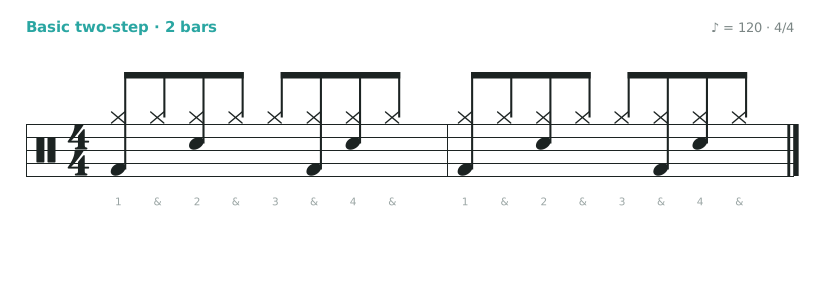
Basic two-step
Eighth-note hi-hat, snare on 2 and 4, kick on beat 1 and the “and” of 3. The hands and feet are almost the same as an 8-beat, so it comes quickly. The example below is written at 120 for practice.
Adding one kick and one snare
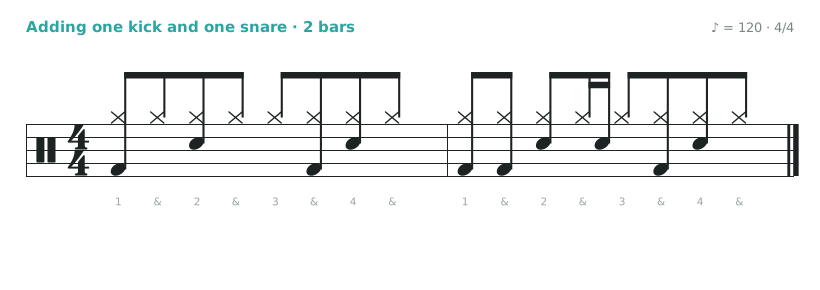
Once the two-step feels comfortable, add a kick on the “and” of 1 and a snare on the last sixteenth of beat 2 in the second bar. That breakbeat flavor comes from small additions like these. Rather than adding lots at once, try them one at a time and find the combinations you like.
Beat-4 snare fill into a crash
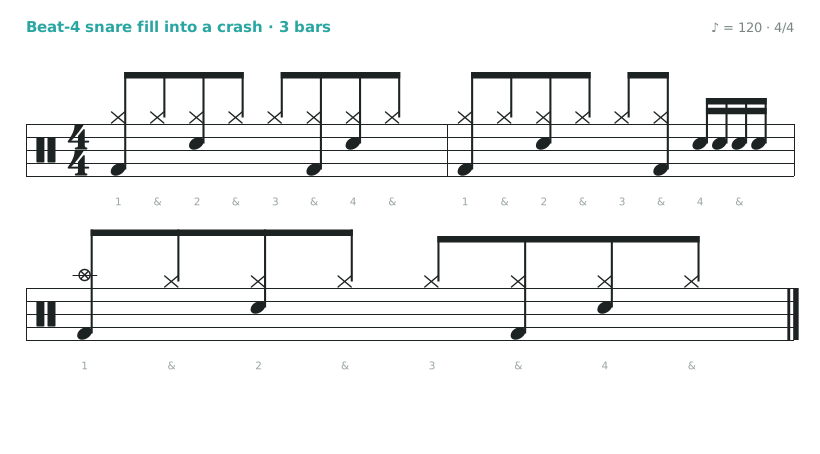
At the end of four or eight bars, fill beat 4 with four sixteenth-note snares and land on a crash on beat 1 of the next bar. Because the tempo is fast, even a one-beat fill sounds big.
How to practice fast tempos
Played slowly, the two-step sounds like a simple 8-beat variation; the genre comes alive as it speeds up. Raise the metronome gradually — 120 → 140 → 160 — and only move on when you can play two minutes at each tempo without wobbling. As it gets faster, play the hi-hat softer and keep the sticks low to save energy. If tempo numbers are new to you, read what BPM means first.
If eighth-note hi-hat is too much at a fast tempo, drop it to quarter notes. As long as the kick stays on 1 and the “and” of 3 and the snare on 2 and 4, the two-step shape is still there. Moving the hi-hat part to the ride gives another flavor, too.
Practice with DrumMate
DrumMate has a library of over 1,000 songs to practice along with the original recordings, and with an electronic kit connected it scores your timing and accuracy bar by bar. When you’re pushing the tempo up step by step, it’s an easy way to see exactly where the time starts to slip.