
Drum Build-Ups — Three Ways to Raise the Energy Before a Chorus (Notation and Audio)

You have heard it right before a chorus: the snare goes “ta, ta, ta, ta… ta-da-da-da-da-da” and keeps getting faster until the song explodes. That is a build-up. Unlike a one-bar fill, a build-up raises the tension bit by bit over two, three or even four bars.
The idea is simple: fit more and more notes into the same amount of time. Here are three build-ups a beginner can use right away, with notation you can listen to.
- A build-up is a multi-bar link that adds tension by splitting notes smaller and smaller.
- Quarter notes → eighth notes → sixteenth notes is the basic recipe.
- Keeping the kick on all four beats stops you from losing the beat.
- Leaving one beat empty at the end makes the first beat of the chorus hit harder.
Build-up vs. fill
A fill usually lives in the last beat or two of a bar. A build-up is a rising wave across several bars, so the listener can feel that something big is coming. That is why a build-up almost always ends with a crash and a new section. You will hear them before choruses in pop and electronic dance music, and before the last chorus of many rock songs.
Pattern 1 — Split the snare: quarters, 8ths, 16ths
This is the classic. The kick plays all four beats while the snare plays quarter notes in bar 1, eighth notes in bar 2, and sixteenth notes in bars 3 and 4. Bar 5 starts the new section with a crash on beat 1.
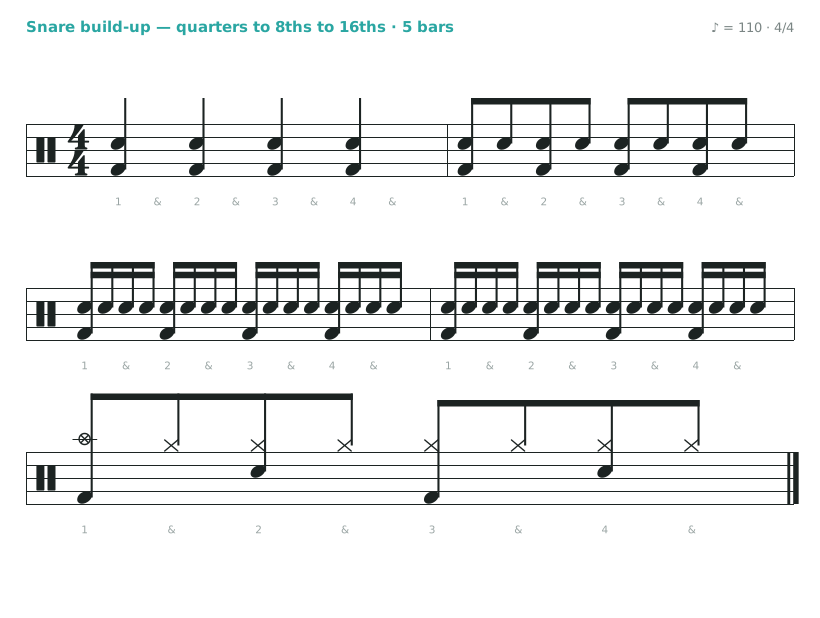
The notation has no dynamics, but when you play it, start soft and get louder towards the last bar (a crescendo). More notes plus more volume is what makes it sound like a build-up.
Pattern 2 — Build on the floor tom
Swapping the hi-hat for the floor tom makes the sound darker and heavier. Play eighth notes on the floor tom in bar 1 and sixteenth notes in bar 2. Keep the kick on all four beats and the snare on 2 and 4 so the backbone of the groove stays solid.
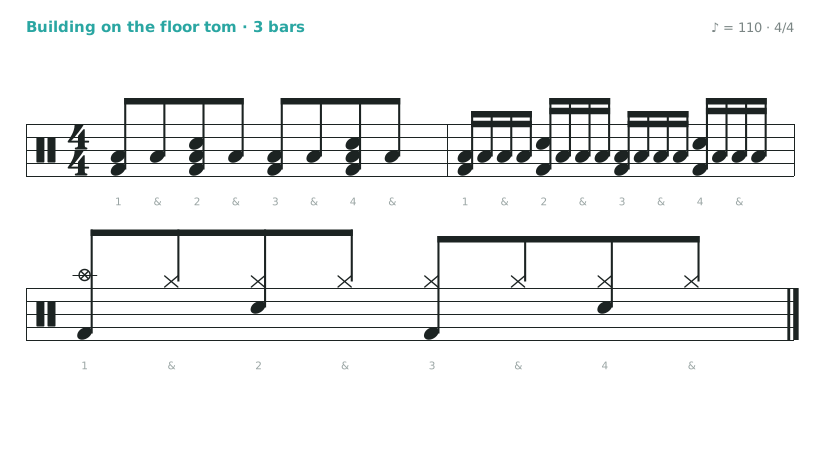
Play the sixteenth-note floor tom hand to hand (right, left); on 2 and 4, whichever hand is due plays the snare instead of the floor tom. If your hands tangle, practise the floor tom sixteenths alone first, then slot the snare in.
Pattern 3 — Leave one beat empty
If you leave a beat silent on purpose at the end of a build-up, the next downbeat sounds much bigger. Play snare sixteenths through beat 3, play nothing on beat 4, and come in with crash and kick on beat 1 of the next bar.
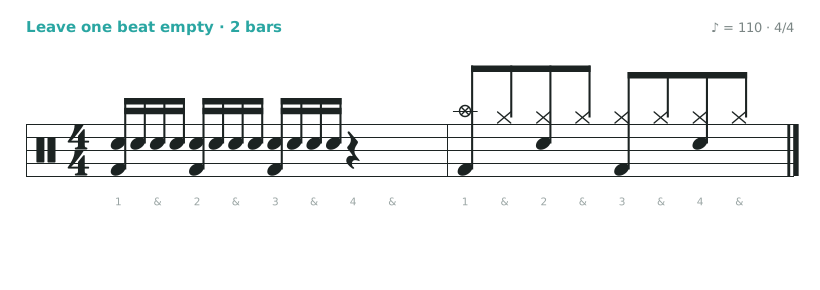
It is easy to rush the empty beat, so count “four” in your head before you come back in. If the whole band stops together there, the effect is even stronger.
Turn on a metronome and check that the tempo does not speed up when Pattern 1 moves from quarter notes to sixteenths. The most common build-up mistake is pushing ahead as the notes get busier. Practise slowly while counting bars, then bring it up to the song tempo.
Practise it in a song
Olivia Rodrigo’s Stupid Song has a section where the snare fills two whole bars with sixteenth notes over a four-on-the-floor kick — a great place to hear Pattern 1 in a real song.
The DrumMate library has more than 1,000 songs you can play along with the original track, so you can try build-ups like these inside real songs. Connect an electronic kit and every bar is scored for timing and accuracy, so you will see right away if your build-up starts to rush.