
Hi-Hat Patterns for Drums — 7 Types With Notation, Plus How Often Each Appears in 434 Songs

A hi-hat pattern is how many times, and where, you hit the hi-hat in one bar. Keep the kick and snare the same and just switch the hi-hat from quarter notes to eighths or sixteenths, and the same beat can sound relaxed or busy.
This guide draws seven hi-hat patterns over the same kick and snare (kick on 1, 3 and the “and” of 4; snare on 2 and 4) so you can compare them, and counts how often each one appears in the main-groove notation of 434 song guides (4/4) in the DrumMate library.
- Of 434 library songs, 338 (78%) use eighth notes on the hi-hat (or ride).
- Sixteenth-note hi-hats show up in 30 songs averaging 89 BPM — slow songs; quarter notes show up in 16 songs averaging 154 BPM — fast songs.
- 93 songs (21%) have an open hi-hat in the main groove, most often on the “and” of 4 (65 songs).
- All seven patterns have notation and a Listen button so you can compare them.
Hi-hat patterns at a glance
| Pattern | Hits per bar | Library songs | Avg BPM | Avg level | Example songs |
|---|---|---|---|---|---|
| 1. Quarter notes | 4 | 16 | 154 | 16.0 | 항해, The Final Countdown |
| 2. Eighth notes | 8 | 338 | 106 | 7.2 | REDRED |
| 3. Sixteenth notes | 16 | 30 | 89 | 13.8 | Old Town Road, See You Again |
| 4. Eighths + sixteenths | 9–12 | 27 | 109 | 12.2 | Stupid Song, Dynamite |
| 5. Upbeat (offbeat) | 4 | 9 | 130 | 11.0 | 찐이야, Heart of Glass |
| 6. With an open hi-hat | 8 (one open) | 93* | — | — | Soda Pop, Stand By Me |
| 7. Shuffle | 8 (triplet spots) | 2 | 116 | 18.0 | Isn’t She Lovely |
Songs are counted by the hand pattern in each song guide’s “main groove” notation. Songs played on the ride instead of the hi-hat are counted in the same row when the hand pattern matches (57 of the 434 use the ride), and 12 songs whose main groove has no cymbal at all — just kick, snare and toms — are left out. *Open hi-hats overlap the other patterns, so they are counted separately.
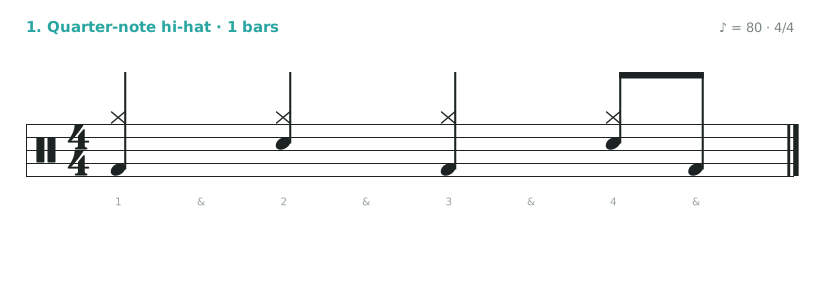
1. Quarter-note hi-hat — one hit per beat
The hi-hat plays only on the beats: “1, 2, 3, 4.” Your hand has the least to do, which makes it a good first beat (Quarter-Note Hi-Hat Beat — The Easiest First Drum Groove (Notation and Audio)). But the 16 library songs with a quarter-note main groove average 154 BPM, and 13 of the 16 are Level 16. That is not because they are easy — it is usually because the song is too fast for full eighth notes, so the hi-hat is cut in half. 항해 (185 BPM) is a good example.
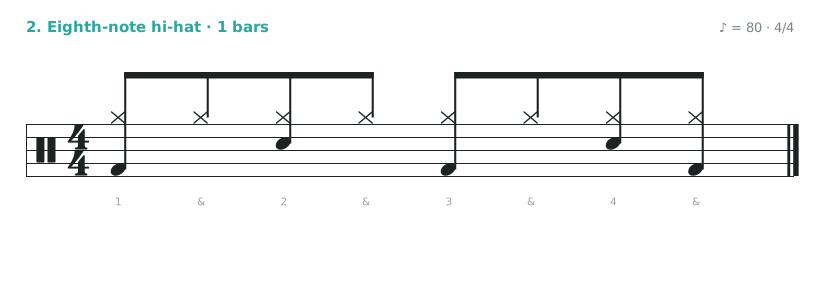
2. Eighth-note hi-hat — the default
“1 and 2 and 3 and 4 and,” two hits per beat. 338 of the 434 songs use it, and at an average of Level 7.2 it is the easiest of the seven. The newest song in the library, REDRED (Level 3, 121 BPM), plays eighth notes on the hi-hat over a four-on-the-floor kick. At 120 BPM that is four hi-hat hits per second.
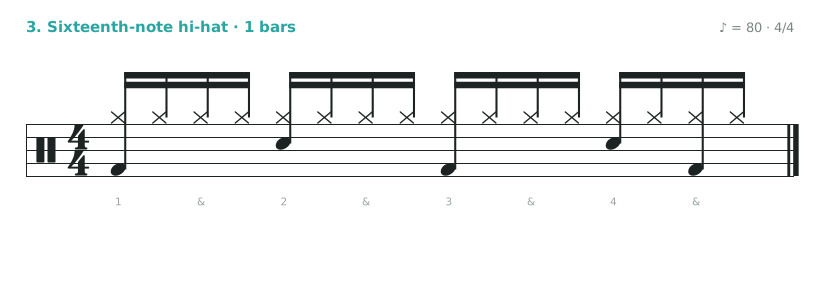
3. Sixteenth-note hi-hat — busy hands in slow songs
“1 e and a,” four hits per beat. It is usually split between both hands (R L R L), or played with one hand when the song is slow. The 30 library songs average 89 BPM — the slowest of the seven — yet their average level is 13.8. Sixteenths at 89 BPM are almost six hits per second, so the beat is slow but the hands are busiest. Examples: Old Town Road (68 BPM), See You Again (80 BPM). Hand speed for each song is in Song BPM List, Part 4 — 50 More Songs With Tempo and Hi-Hat Hand Speed (Hits per Second).
4. Eighths plus sixteenths — “1 and a”
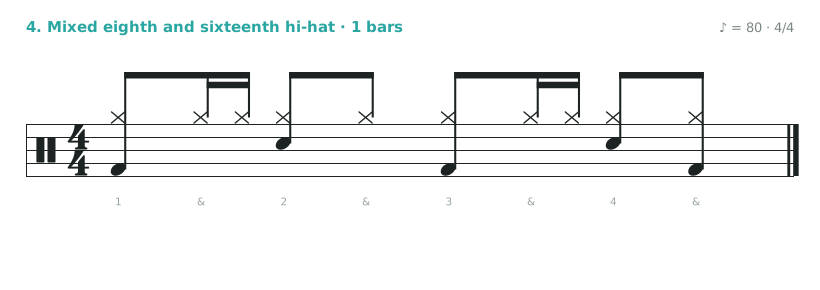
An eighth-note hi-hat with one extra sixteenth tucked in, so a beat sounds like “1 and a.” The notation above adds the “a” only on beats 1 and 3. 27 songs use it, averaging 109 BPM and Level 12.2, mostly pop and K-pop: Stupid Song, Dynamite, Never Gonna Give You Up. Play the quick “and a” with your right hand, or if it will not keep up, slip just the “a” in with your left hand — it never lands on a snare note.
5. Upbeat hi-hat — leave the beats empty
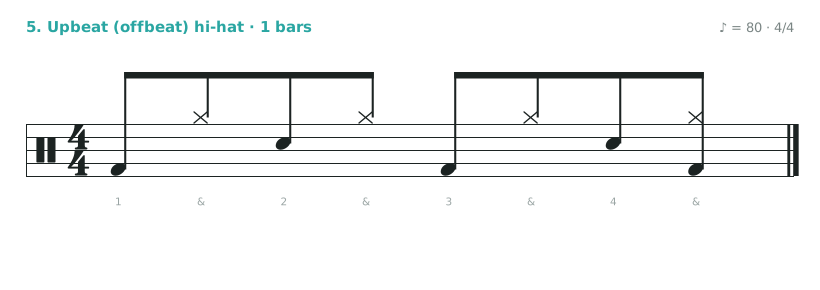
The hi-hat skips the beats and plays only the “ands.” The kick is on the beat and the hi-hat answers in between, so the groove sounds like a back-and-forth. 9 songs use it, averaging 130 BPM, and 8 of them open and close that offbeat hi-hat disco-style (How to Play a Disco Drum Beat — Four-on-the-Floor Kick and Offbeat Open Hi-Hat (Notation and Audio)). The Korean trot songs 찐이야 and 우연히 and Blondie’s Heart of Glass all use it. The notation above shows it closed.
6. Open hi-hat — one long “tsss”
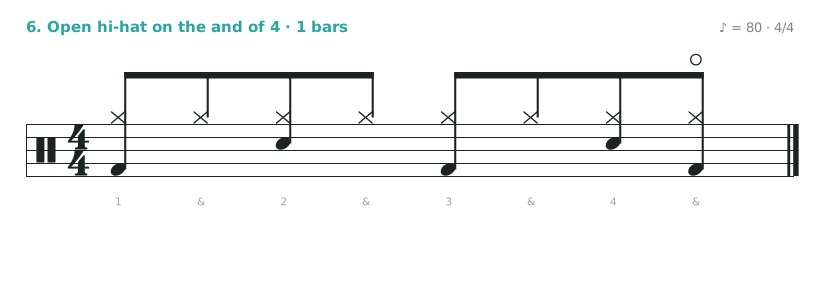
On one eighth note, lift your left foot slightly so the hi-hat rings open, then close it with the pedal on the next beat (Open vs Closed Hi-Hat — How to Play It, How It’s Notated, and Two Exercises). 93 songs (21%) have an open hi-hat in the main groove. By position: the “and” of 4 in 65 songs, the “and” of 3 in 41, the “and” of 2 in 26 and the “and” of 1 in 20 (one song can use more than one). Examples: Soda Pop, Stand By Me, Really Really, TiK ToK.
7. Shuffle hi-hat — first and third triplet
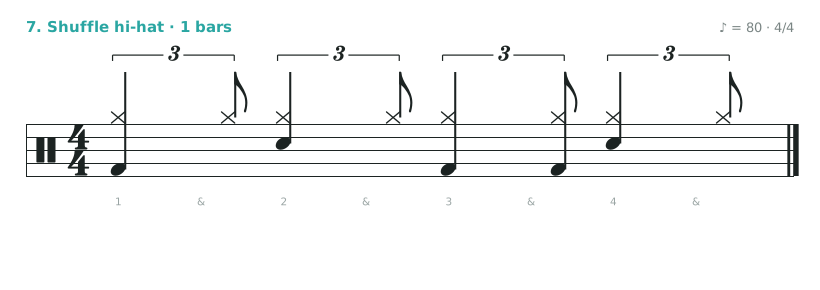
Split each beat into three triplet partials and play only the first and third. Count it “1 (trip) let, 2 (trip) let” and it starts to swing (Shuffle Drum Beat for Beginners — Understanding the Swing Feel Through Triplets). Only two library songs have a shuffle main groove — Isn’t She Lovely and Everybody Wants to Rule the World — and both are Level 18. The notation above also puts one kick on a shuffle spot (the last partial of beat 3).
Practice: switching hi-hat patterns
- Play pattern 2 (eighth notes) for four bars at 80 BPM with a metronome.
- Keep the kick and snare and switch to pattern 1 (quarter notes) for four bars, then back to 2.
- When that is easy, go 2 → 3 (sixteenths, both hands) → 2.
- Finally, drop one open hi-hat (pattern 6) or one “and a” (pattern 4) into pattern 2 every few bars.
The thing to watch is whether the kick and snare rush or drag when the hi-hat gets busier. Record yourself and you will hear it straight away.
The hi-hat is the ✕ in the space above the top line of the staff. An open hi-hat has a small ○ above the ✕, and the ride is an ✕ on the top line. All the positions are in How to Read Drum Notation — A 10-Minute Guide for Complete Beginners.
The DrumMate library has more than 1,000 songs to play along with the original tracks, so you can try the songs in the table and hear the patterns for yourself. Connect an electronic kit and every bar is scored for timing and accuracy.