
How to Do a Drum Roll — Single, Double and Buzz Rolls, and How to Make Them Even (Notation and Audio)

A drum roll is a run of fast strokes that blends into one continuous sound. There are three main kinds: the single stroke roll, alternating one hit per hand (RLRL); the double stroke roll, two hits per hand (RRLL); and the buzz roll (press roll), where each stick is pressed into the head so it bounces several times.
This guide covers how the three differ, how to make a roll sound smooth instead of lumpy, and how to fit a roll into a song so it starts and ends on the beat — with notation you can play back.
- Three rolls: single (RLRL), double (RRLL), buzz (press and bounce)
- Same hand speed: a 16th-note single roll becomes a 32nd-note double roll — twice the sound (notation and audio)
- Uneven rolls usually come from mismatched stick heights or a weak second stroke
- In a song, a roll is not “as fast as possible” — it starts on a set beat and ends on the next beat 1
The 3 Drum Rolls at a Glance
| Type | Sticking | Sound | Where it’s used |
|---|---|---|---|
| Single stroke roll | R L R L | Every stroke clearly separate | Tom fills, fast 16th-note fills |
| Double stroke roll | R R L L | Twice as dense at the same hand speed | Long snare rolls, fast fills |
| Buzz roll (press roll) | R L R L, each pressed to bounce several times | A smooth “zzzz” sustain | Song intros and endings, crescendo rolls |
Singles and doubles are also core rudiments — for rudiment practice see Drum Rudiments for Beginners — The 5 to Learn First (Sticking and Notation), and the full list is in The 40 Drum Rudiments List — Rolls, Diddles, Flams and Drags Explained. This guide focuses on turning them into a roll sound.
From Single to Double — Same Hand Speed, Twice the Notes
The secret to a fast-sounding roll isn’t moving your hands faster — it’s getting two sounds out of each motion. In the notation below, bar 1 is 16th-note singles (RLRL) and bar 2 is 32nd-note doubles (RRLL). Your hands move the same number of times in both bars; only the number of notes doubles.
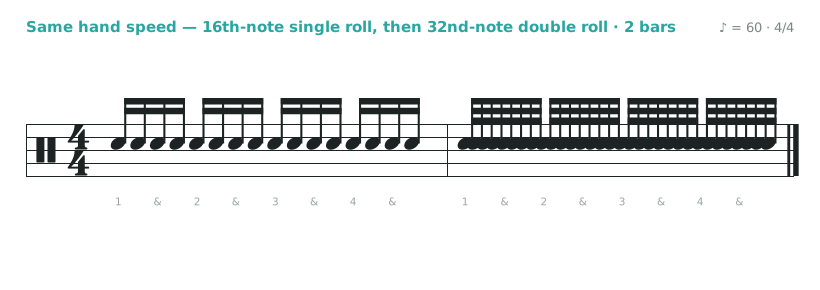
Alternate the two bars at 60 BPM, and when bar 2 sounds as even as bar 1, go up by 4. The second stroke of a double isn’t a second wrist motion — as the stick bounces up from the first stroke, your fingers push it back down.
4 Ways to Make Your Roll Sound Even
1. Match your stick heights
If your roll sounds like “da-dak da-dak” instead of “da-da-da-da”, one hand is usually higher or heavier. Use a mirror or film yourself and match the stick heights of both hands.
2. Bring out the second stroke of the double
When the second stroke of each double is weaker, the roll gets bumpy. At slow tempos, practice deliberately playing the second stroke a little louder; when you speed up, the two strokes even out.
3. Keep the buzz pressure steady
For a buzz roll, press the stick lightly into the head so it bounces several times, then join the buzzes by alternating hands. First get each hand to make a “zzz” of the same length, then alternate them in 8ths and then 16ths. Our notation has no buzz marking, so this one is explained in words only (standard notation marks it with a Z through the note stem).
4. Count the roll
Play a roll “as fast as I can” and it will be a different length every time and end in a different place. Decide on 16ths or 32nds and count them, and the start and end of the roll become clear.
Using a Roll in a Song — Two Beats Into a Crash
The roll you’ll use most in songs is a short snare roll just before the chorus. Below, one bar of rock beat is followed by 32nd-note rolls filling beats 3 and 4, landing with a crash on beat 1 of the next bar. At faster tempos, play the same spot as a double or buzz roll.
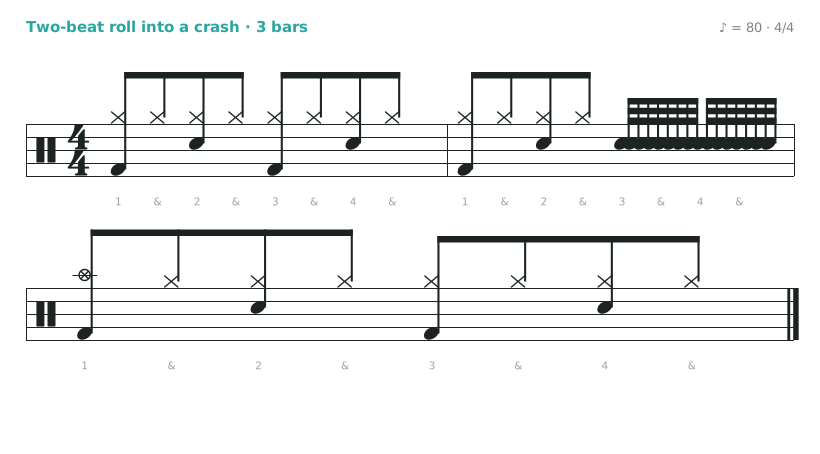
The notation doesn’t show dynamics, but when you play it, start the roll quiet and grow louder (a crescendo) before the crash — it sounds far more dramatic. More on crash timing in When to Hit the Crash Cymbal — Timing, Technique and Chokes (Notation and Audio).
① 16th-note single roll at 60 BPM → ② 32nd-note double roll at the same tempo → ③ the two-beat roll into a crash → ④ buzz roll one hand at a time. If your wrists hurt, stop and lower your stick height first.
To move doubles onto the toms, see Double-Stroke Fills — How to Take RRLL from the Pad to the Drum Kit (Notation and Audio). In DrumMate you can practice real song fills along with the original recording, and with an electronic kit connected it scores your timing and accuracy for every bar — so you can tell straight away whether your roll lands on the next beat 1.
Keep reading
- Drum Rudiments for Beginners — The 5 to Learn First (Sticking and Notation)
- The 40 Drum Rudiments List — Rolls, Diddles, Flams and Drags Explained
- How to Play Drums Faster — 6 Steps: Relax, Rebound and Raise Your BPM (Notation and Audio)
- Double-Stroke Fills — How to Take RRLL from the Pad to the Drum Kit (Notation and Audio)