
Tempo Markings Explained — Largo, Andante, Allegro and Presto in BPM, and How to Read ♩ = 120 (Notation and Audio)

Tempo is the speed of a piece of music. The word is Italian for “time”, and when we write it as a number we use BPM (beats per minute). On sheet music you’ll see it either as a number like “♩ = 120” or as an Italian tempo marking like “Allegro”.
This guide puts the common markings into a BPM chart and explains, from a drummer’s point of view, how to read the tempo signs you’ll meet on a chart. For BPM itself (60 BPM is one beat per second and so on), see What Does BPM Mean?
- Tempo = speed. It’s written as a BPM number or as a marking such as Largo, Andante or Allegro
- Markings are rough ranges and differ a little from book to book. When there’s a number (♩ = 120), follow the number
- ♩ = 120 means 120 quarter notes per minute; ♩. = 60 means 60 dotted quarters per minute
- rit. means gradually slower, accel. gradually faster, a tempo back to the original speed
Tempo markings and their BPM
Tempo markings come from classical music and were never fixed numbers, so the ranges vary a little between books and metronomes. These are the ranges DrumMate’s free metronome uses for the name it shows next to the BPM.
| Marking | BPM (approx.) | Meaning |
|---|---|---|
| Largo | under 60 | very slow and broad |
| Adagio | 60–75 | slow, at ease |
| Andante | 76–107 | at a walking pace |
| Moderato | 108–119 | moderate |
| Allegro | 120–155 | fast and bright |
| Vivace | 156–175 | lively and fast |
| Presto | 176 and up | very fast |
You’ll also see Lento (slow), Larghetto (a little faster than Largo), Allegretto (a little slower than Allegro) and Prestissimo (as fast as possible). Pop and rock charts usually skip the Italian and write just a number like “♩ = 120”, often with a style word such as “Slow Ballad” or “Medium Rock”.
Same beat, different tempo — have a listen
The same 8th-note beat feels completely different at different tempos. The two examples below have identical notes; only the speed changes. Use the Listen button to compare.
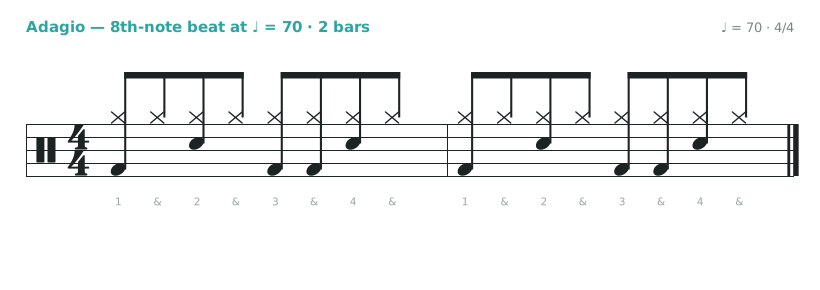
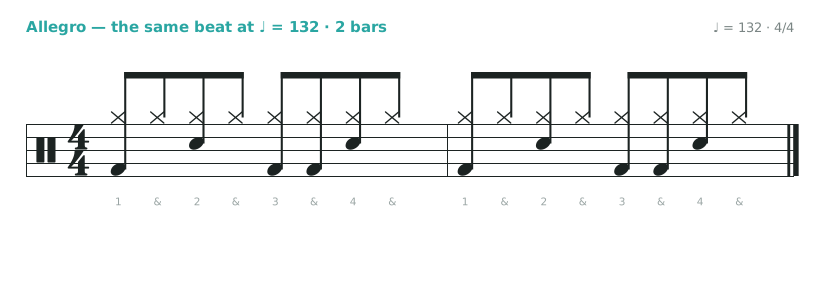
At 70 there’s plenty of room between the hi-hat 8ths, which makes it a good tempo for evening out every note. At 132 your wrists tend to tense up, so it becomes an exercise in staying relaxed. Nail the slow one first, then speed up a little at a time.
How to read the tempo mark on a chart
- ♩ = 120 — 120 quarter notes per minute. Set your metronome to 120.
- ♩. = 60 — 60 dotted quarter notes per minute. This is how compound meters like 6/8 and 12/8 are marked, counting the big beat. Counted in 8th notes, that’s 180. (How to read time signatures)
- ♩ = c. 120 — c. means circa, “about”. Roughly 120.
- M.M. ♩ = 120 — M.M. stands for Maelzel’s Metronome; it just marks a metronome number. Same meaning as ♩ = 120.
Signs that change the tempo
Tempo changes in the middle of a song are common too. Drummers usually drive the band’s tempo, so these are worth knowing well.
| Sign | Meaning | What the drummer does |
|---|---|---|
| rit. (ritardando) / rall. (rallentando) | gradually slower | Common at the end of a song. Don’t slow down on your own — watch the band and slow down together. |
| accel. (accelerando) | gradually faster | Spread it over a few bars instead of jumping all at once. |
| a tempo / Tempo I | back to the tempo / back to the first tempo | Often follows a rit. Snap back to the original tempo on the next downbeat. |
| rubato | freely stretched and pushed | Follow the singer. Drummers often lay out or play cymbals only. |
| 𝄐 (fermata) | hold the note longer | On a final chord, let the cymbal ring and cut off together on the cue. |
A tempo marking tells you the mood; a number tells you the exact speed. When you’re learning a song, checking the original recording’s actual BPM is the most accurate. See “How to find a song’s BPM” in What Does BPM Mean? and the Tap Tempo and Song Analyzer on the metronome page.
Every song in DrumMate’s library of 1,000+ songs shows its BPM, and you can practise along with the original at a slower tempo. Connect an electronic drum kit and you get timing and accuracy scores for every bar, so you can see right away whether your time holds up as you speed up.