
Two-Bar Drum Fills — 3 Ways to Build a Longer Fill Before the Last Chorus or Ending (Notation and Audio)

A two-bar fill is a long fill that runs across two bars. Because it’s longer than a one-beat or one-bar fill, it belongs where the song takes a big turn: before the last chorus, at the end of a bridge, or right before the ending. Being long makes two things harder: not losing the beat, and making the two bars sound like one idea.
Here are three ways to build a two-bar fill, with notation and audio. Each score is one bar of 8-beat → two fill bars → a crash bar, at 90 BPM.
- Save two-bar fills for big moments (last chorus, ending). In an 8-bar phrase, start on beat 1 of bar 7.
- Three ways to build one: (1) the same shape twice, splitting the ending, (2) a short fill twice, the second one bigger, (3) eighths → triplets → sixteenths.
- Long fills drift easily — quarter-note kicks under the fill (like method 3) hold the beat.
- Land on the next downbeat with crash + kick. Even if the fill slips, get that beat right.
When to use a two-bar fill
Pop and rock songs are usually built in four- and eight-bar phrases (song structure article). One-beat and one-bar fills can go every four bars, but two-bar fills get cluttered if you use them often. Use them once or twice a song, before the biggest change. At the end of an eight-bar phrase, start on beat 1 of bar 7, finish at the end of bar 8, and crash on beat 1 of bar 9.
It’s easy to miss where a two-bar fill starts. Count the bar number on each downbeat — “1, 2, 3, 4 / 2, 2, 3, 4 …” — and come in on the “7.”
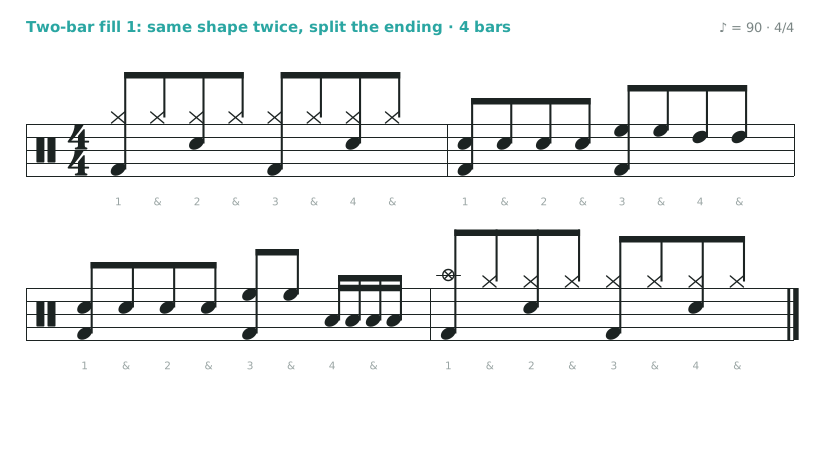
1. The same shape twice, split the ending
The easiest method. Play a one-bar fill twice, but split only the last beat of the second bar into smaller notes. Bar one: snare eighths on beats 1–2, high tom on beat 3, mid tom on beat 4 (kick on 1 and 3). Bar two: the same, except beat 4 becomes four floor tom sixteenths. Repeating the shape makes it easy to remember, and speeding up at the end says “here comes the downbeat.”
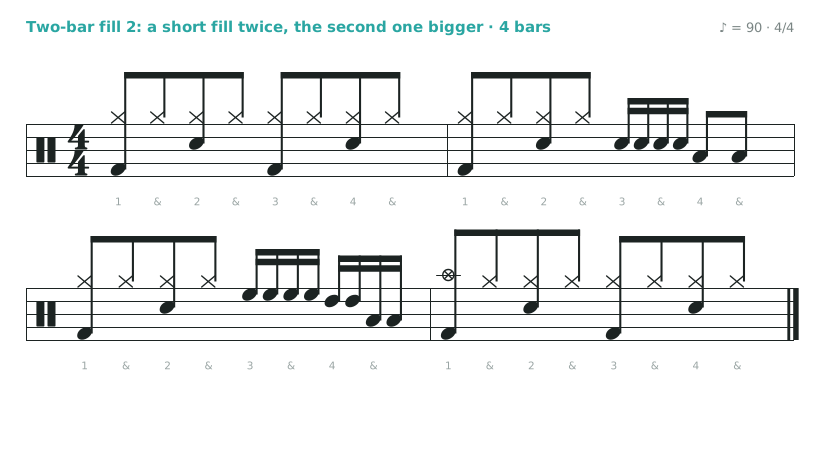
2. A short fill twice, the second one bigger
Keep the groove on beats 1–2 of both bars and put a short fill only on beats 3–4. The first is small — four snare sixteenths and two floor tom eighths. The second is bigger — four high tom sixteenths, then two on the mid tom and two on the floor tom. It works like a question and answer, so it sings, and because the groove keeps going the beat stays steadier.
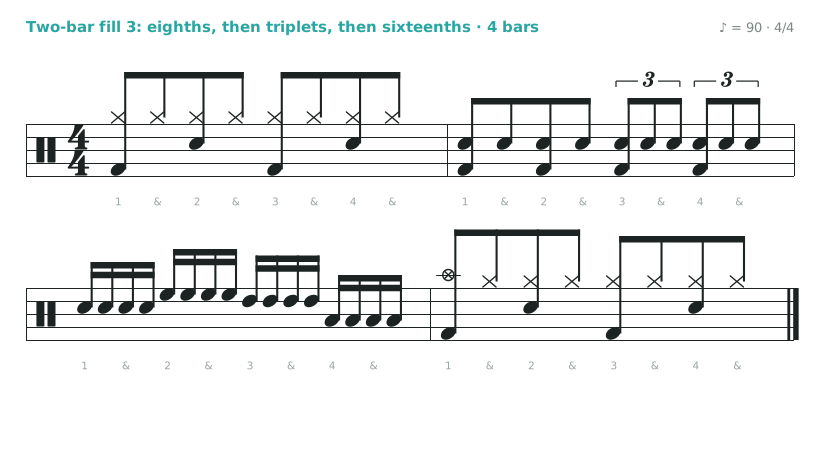
3. Eighths → triplets → sixteenths
Build tension by splitting the notes smaller and smaller. Bar one: snare eighths on beats 1–2, snare triplets on beats 3–4. Bar two: sixteenths, one beat each on snare → high tom → mid tom → floor tom. Quarter-note kicks under the first bar keep the pulse steady even as you switch to triplets. More notes fit into the same beat, so your hands speed up while the tempo stays put (how to count rhythms).
How to practice
- The two fill bars alone at 75%. Loop the two fill bars plus the crash beat with a metronome.
- Add a groove bar in front. Play it as written: 8-beat → fill → crash. The switch from groove to fill is where you’ll tend to rush.
- Stretch to eight bars. Six bars of groove + two-bar fill + crash. Count bar numbers and come in on bar 7.
- Up to tempo. When it’s clean, add 4 BPM at a time.
Most often the last notes of the fill get rushed and the crash comes early. Record the last beat and check it against the metronome. If it’s still hard, turn the last beat into eighths instead of sixteenths.
Practice with DrumMate
Fills improve fastest when you hear where they go in real songs. DrumMate lets you play along with the original recording while the notation scrolls, across a library of over 1,000 songs, and with an electronic kit connected it scores timing and accuracy bar by bar — so you can see right away whether the downbeat after the fill landed.
Keep reading
- Drum Fills for Beginners — 10 Easy Fills From One Beat to One Bar (Notation and Audio)
- Types of Drum Fills — 7 Kinds: Snare, Tom, Kick, Triplet, Linear, Roll and Space Fills (Notation and Audio)
- Drum Build-Ups — Three Ways to Raise the Energy Before a Chorus (Notation and Audio)
- Song Structure for Drummers — What to Play in the Verse, Chorus and Bridge (Notation and Audio)