
Drum Song Difficulty Levels Explained — What Changes From Level 1 to 24, Based on 440 Songs (Notation and Audio)

Every song in the DrumMate library has a level from 1 to 24. But what actually gets harder as the level goes up — tempo, or the number of notes? We counted the groove and fill notation in all 440 song posts to find out.
The short answer: level follows how finely the rhythm is divided more than how fast it is. Songs at Lv.11–15 have the slowest average tempo, 94 BPM, yet half of them put sixteenth-note kicks in the main groove.
- Song-card levels run from 1 to 24 — most songs sit at Lv.3–5 (138) and Lv.11–15 (125).
- Lv.1–2: eighth beat plus tom fills. Lv.3–5: off-beat kicks (2% → 77%) and open hi-hat appear. Lv.6–10: tempos rise (124 BPM average).
- Lv.11–15: slowest tempos, but 50% have sixteenth-note kicks and 34% sixteenth-note hi-hat. Lv.16–24: 34% use triplets.
- A 30-minute practice plan for each level range, with links to the next step.
At a glance — rhythm differences by level
Each song post shows the main groove and a fill (usually four bars each). The table gives the share of songs where a note type appears at least once. “Off-beat kick,” “16th hi-hat” and “16th kick” look at the groove only; the rest look at groove plus fill.
| Level | Songs | Avg BPM | Off-beat kick (8th) | Open hi-hat | 16th hi-hat | 16th kick | Triplets | 32nd notes |
|---|---|---|---|---|---|---|---|---|
| Lv.1–2 | 49 | 105 | 2% | 0% | 0% | 0% | 0% | 0% |
| Lv.3–5 | 138 | 103 | 77% | 28% | 3% | 1% | 2% | 0% |
| Lv.6–10 | 81 | 124 | 73% | 40% | 1% | 4% | 7% | 5% |
| Lv.11–15 | 125 | 94 | 73% | 47% | 34% | 50% | 11% | 23% |
| Lv.16–24 | 47 | 125 | 79% | 32% | 11% | 15% | 34% | 19% |
Toms show up in the fills of 80–98% of songs at almost every level. What separates levels is not whether you hit toms, but which note values you hit them with.
What’s new at each level
Lv.1–2 — Eighth beat and tom fills
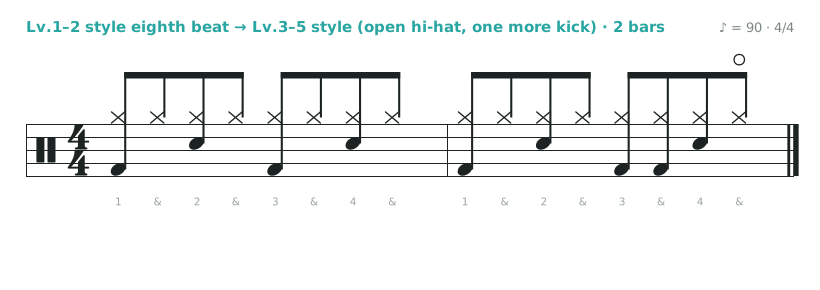
Not a single song here uses open hi-hat, sixteenths or triplets. An eighth-note beat (hi-hat eighths, snare on 2 and 4, kick on 1 and 3) plus short tom fills gets you through. Examples: Dancing Queen (Lv.2 · 99 BPM), Gangnam Style (강남스타일) (Lv.2 · 132 BPM).
Lv.3–5 — Open hi-hat and one more kick
The clearest change is the kick. Songs with a kick on an eighth-note off-beat (the “&”) in the main groove jump from 2% at Lv.1–2 to 77% at Lv.3–5. About one song in four also opens the hi-hat. This is the busiest range in the library. Examples: Eye of the Tiger (Lv.4 · 109 BPM), Uptown Funk (Lv.4 · 115 BPM).
Lv.6–10 — Faster, and longer
The grooves look much like Lv.3–5, but the average tempo climbs to 124 BPM. The job is to play the same patterns faster and hold them for a whole song. Examples: Beat It (Lv.8 · 140 BPM), Hotel California (Lv.10 · 74 BPM).
Lv.11–15 — Sixteenth notes move into the groove
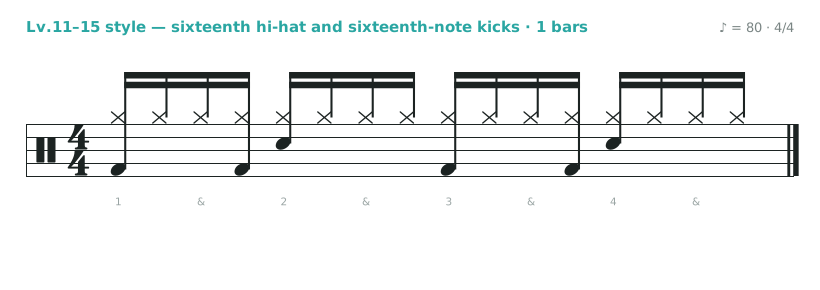
This is where the biggest change happens. The average tempo actually drops to 94 BPM, but 50% of grooves have sixteenth-note kicks, 34% have sixteenth-note hi-hat, and 23% of songs have thirty-second notes in the fill. Your hands and feet have to learn the spots between the beats. Examples: Mr. Brightside (Lv.12 · 148 BPM), Californication (Lv.14 · 97 BPM).
Lv.16–24 — Fast tempos plus triplets
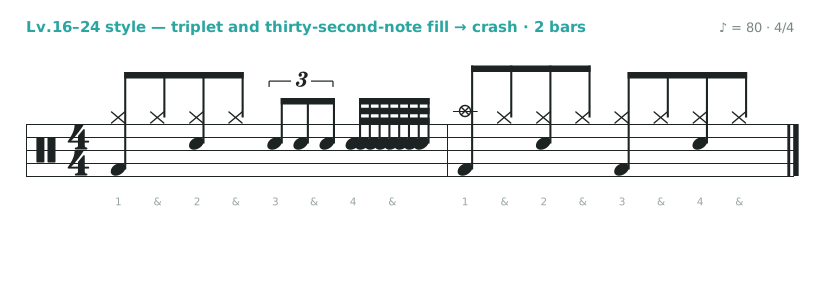
The average tempo rises again to 125 BPM, and 34% of songs use triplets. You mix fast sixteenth and triplet fills and have to last through long songs. Examples: 그대에게 (Lv.16 · 142 BPM), Bohemian Rhapsody (Lv.18 · 95 BPM), Smoke On The Water (Lv.23 · 115 BPM).
A slow song leaves more room between beats for sixteenth-note kicks and quiet snare notes. At the same BPM, switching the hi-hat from eighths to sixteenths doubles the work for your hands. Don’t pick songs by BPM alone.
How to find your level
- If your eighth-note beat stays steady to the end, start with Lv.1–2 songs.
- If you can open and close the hi-hat on the and of 4, try Lv.3–5.
- If you can hold an eighth beat at 120 BPM for three minutes, try Lv.6–10.
- If you can put a kick on the a of 1 over sixteenth-note hi-hat, try Lv.11–15.
- If you land beat one cleanly after a triplet or thirty-second-note fill, try Lv.16 and up.
When you choose a song, read the “hard parts” in its post along with the level — songs at the same level get hard in different places. See How to Choose Songs to Practice on Drums — 6 Ways to Find Songs That Fit Your Level.
A 30-minute practice plan for each level
This uses the frame from the 30-minute practice routine (warm-up 5 → technique 10 → grooves and fills 10 → song 5) and fills in what to practice at each level. The warm-up is the same for everyone.
| Level | Technique (10 min) | Grooves and fills (10 min) | Song (5 min) |
|---|---|---|---|
| Lv.1–2 | Eighth-note singles (10 exercises, #1) | Eighth beat and quarter hi-hat (10 basic beats) + one-beat fills (fill collection) | 20 beginner songs |
| Lv.3–5 | Snare eighths with kick (exercises #7–10) | Open hi-hat + tom fills | Beginner songs, Part 2 |
| Lv.6–10 | Sixteenth-note singles (exercise #2) | Sixteenth-note beat + two-beat fills (fill collection) | 20 intermediate songs |
| Lv.11–15 | Sixteenth-note kick spots, one bar at a time (count “1 e & a”) | 10 intermediate grooves + triplet fills | 20 advanced songs |
| Lv.16–24 | Drum rolls · BPM steps from playing faster | Only the fill bars from the song post, at 75% | Top 13 hardest songs |
In the DrumMate library every song shows its level and BPM, so you can pick songs at your level and practice along with the original recording. With an electronic kit connected, you get timing and accuracy scored bar by bar.