
10 Intermediate Drum Beats — Sixteenth-Note Kicks, Funk, Half-Time and Shuffle Grooves (Notation and Audio)

Once basic beats like the 8-beat and 16-beat feel natural, the next step is to move one kick, one snare or one open hi-hat. Most grooves you hear in real songs are a basic beat with just one or two notes shifted.
This is the follow-up to our 10 basic drum beats: ten intermediate drum beats with notation and audio. For each one you get the one new thing it teaches and a link to a guide that goes deeper.
- 10 intermediate grooves: three sixteenth-kick beats, three snare variations, ride/shuffle/cross-stick grooves, and one two-bar phrase.
- Each is a basic beat with only one or two notes moved — look at what changed before you play.
- Use the Listen, Repeat and Slow buttons under each score to hear it.
- Start at 75% of the listed tempo, loop four bars, and alternate with a plain 8-beat.
At a glance
| # | Groove | What moves | Tempo | Go deeper |
|---|---|---|---|---|
| 1 | 8-beat with a sixteenth kick | kick on 1, 2a, 3& | 80 | The Basic Rock Beat — Your First 8th-Note Drum Groove and Two Variations |
| 2 | 16th-note groove with syncopated kicks | kick on 1, 1a, 2&, 3&, 4e | 80 | 16th-Note Drum Grooves for Beginners — One-Hand, Two-Hand and Kick Variations |
| 3 | 16th-note groove with an open hi-hat on 4& | kick on 1, 1a, 3, 3&, open hi-hat on 4& | 80 | Open vs Closed Hi-Hat — How to Play It, How It’s Notated, and Two Exercises |
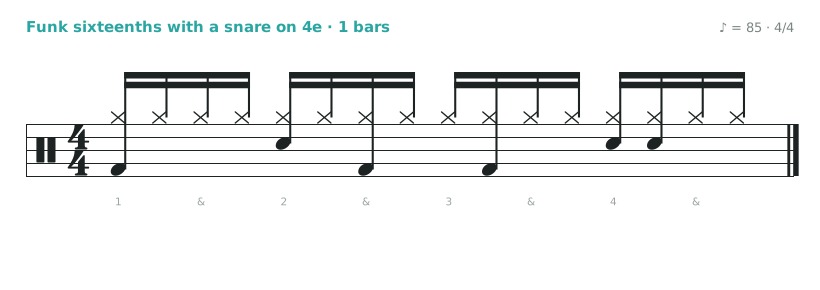
| 4 | Funk sixteenths with a snare on 4e | snare on 2, 4, 4e; kick on 1, 2&, 3e | 85 | Funk Drum Beat Basics — Make the Kick Dance Over Sixteenths (Notation and Audio) |
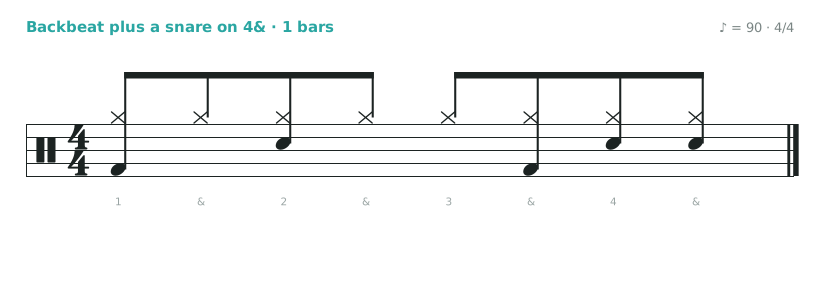
| 5 | Backbeat plus a snare on 4& | snare on 2, 4, 4&; kick on 1, 3& | 90 | What Is a Drum Fill? Meaning, Where It Goes and How Long It Lasts (Notation and Audio) |
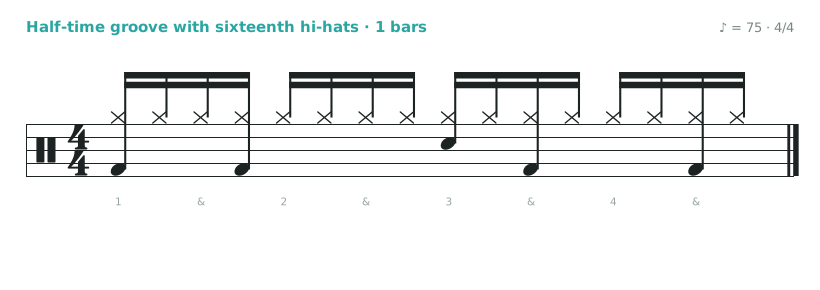
| 6 | Half-time groove with sixteenth hi-hats | snare on 3; kick on 1, 1a, 3&, 4& | 75 | What Is a Half-Time Groove? Same Tempo, Half the Feel — How to Play It (Notation and Audio) |
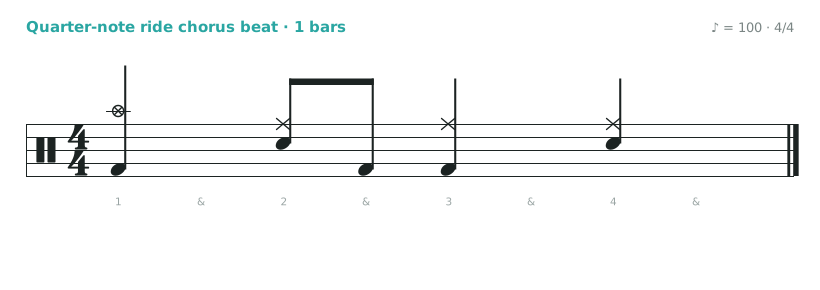
| 7 | Quarter-note ride chorus beat | crash on 1, ride on 2, 3, 4; kick on 1, 2&, 3 | 100 | How to Play the Ride Cymbal — When and How to Move Off the Hi-Hat |
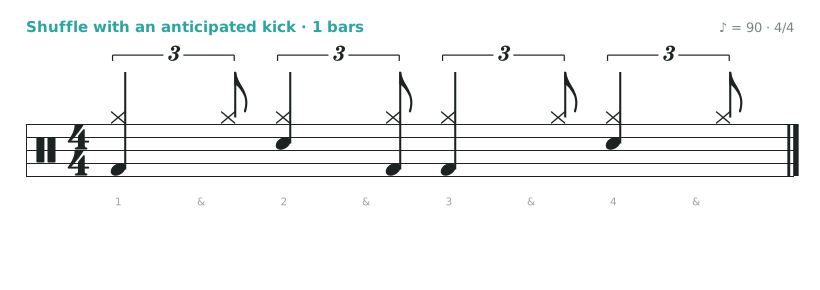
| 8 | Shuffle with an anticipated kick | kick on 1, the last triplet of 2, and 3 | 90 | Shuffle Drum Beat for Beginners — Understanding the Swing Feel Through Triplets |
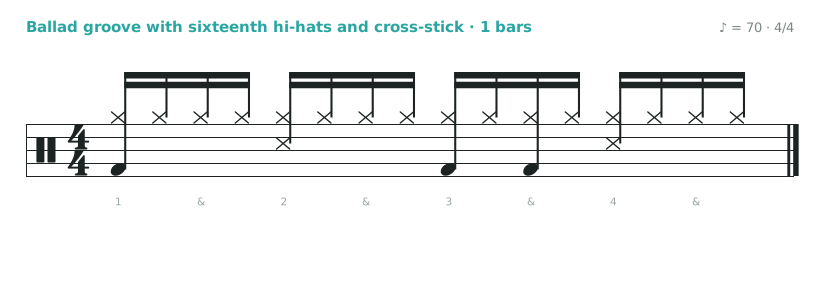
| 9 | Ballad groove with sixteenth hi-hats and cross-stick | cross-stick on 2 and 4; kick on 1, 3, 3& | 70 | How to Play Cross-Stick (Side Stick) — The Ballad “Click” Sound (Notation and Audio) |
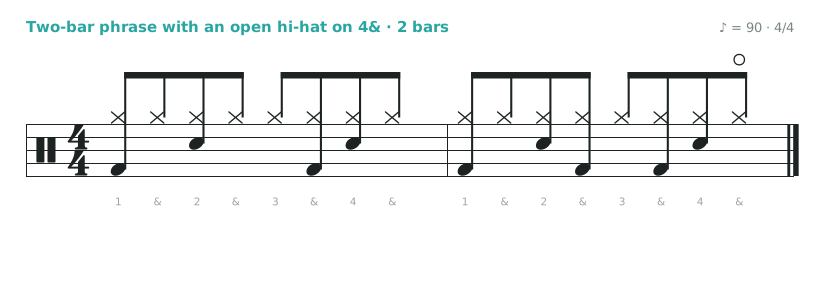
| 10 | Two-bar phrase with an open hi-hat on 4& | bar 1 kick on 1, 3&; bar 2 kick on 1, 2&, 3&, open hi-hat on 4& | 90 | Song Structure for Drummers — What to Play in the Verse, Chorus and Bridge (Notation and Audio) |
Beat names use “1 e & a” counting: 1a is the fourth sixteenth of beat 1, and 3& is the off-beat of beat 3.
Grooves where the kick moves to sixteenths
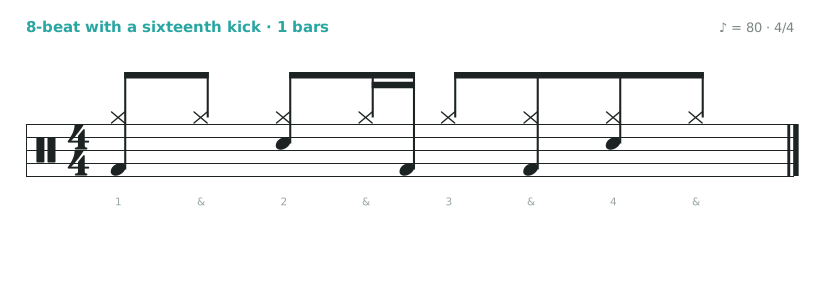
1. 8-beat with a sixteenth kick
Eighth hi-hats, with one kick on the sixteenth right after the beat-2 snare (2a). That kick falls between hi-hat notes, so for the first time your foot lands off the hand grid.
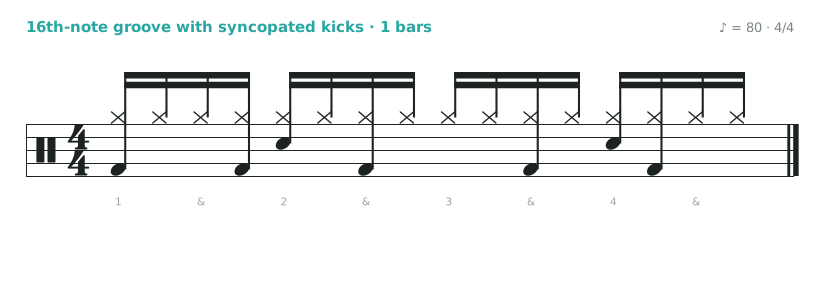
2. 16th-note groove with syncopated kicks
Sixteenth hi-hats with five kicks moving between the beats. Two kicks sit on sixteenth spots (1a and 4e), so count which hi-hat note each kick lines up with.
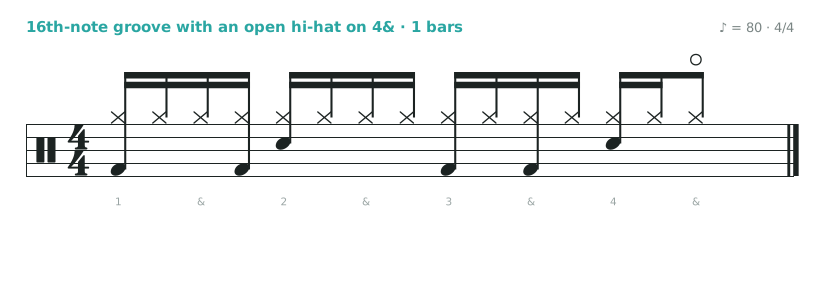
3. 16th-note groove with an open hi-hat on 4&
Sixteenth hi-hats, opening on the & of 4 and closing on the next 1. The sixteenth after the open note is left out so the open sound rings.
Grooves where the snare moves
4. Funk sixteenths with a snare on 4e
A second snare lands right after beat 4 (on 4e), and the kick is pushed to 3e. Two snares back to back while the hands keep sixteenths is what makes it funky.
5. Backbeat plus a snare on 4&
An extra snare on the & of 4 pulls the groove into the next bar. It adds motion at the end of the bar without a fill, so it works as a mini-fill.
6. Half-time groove with sixteenth hi-hats
Half-time — one snare on beat 3 — with sixteenth hi-hats and off-beat kicks. It feels twice as slow at the same tempo, and the two kicks after beat 3 lead into the next bar.
Changing the hand voice and feel
7. Quarter-note ride chorus beat
A chorus beat: quarter notes on the ride instead of the hi-hat, with a crash on 1. With slower hands, the kick on 2& stands out and the song opens up.
8. Shuffle with an anticipated kick
Shuffle hi-hats (first and third triplets) with an extra kick on the last triplet of beat 2, right before beat 3. It lines up with the hi-hat, so hands and foot move together.
9. Ballad groove with sixteenth hi-hats and cross-stick
A ballad groove with cross-stick instead of snare and sixteenth hi-hats filling the space. Keeping the sixteenths even at a slow tempo is the whole job.
Thinking in two bars
10. Two-bar phrase with an open hi-hat on 4&
Keep bar 1 simple, then add a kick and open the hi-hat on 4& in bar 2 so the two bars feel like one unit. Songs move in 2- and 4-bar phrases, so this trains you to think in phrases.
Played at one flat volume, the sixteenth hi-hat grooves (2, 3, 4, 6 and 9) sound mechanical. Play the first note of each beat a little louder and keep the rest low, and the groove comes alive. The drum dynamics guide covers this.
How to practice
- Set the metronome to 75% of the listed tempo.
- Play only the hi-hat (or ride) and kick first. Check which hi-hat note each moved kick lines up with.
- Add the snare and loop four bars.
- Alternate four bars of a plain 8-beat with four bars of the new groove. If the time doesn’t wobble at the switch, you’ve got it.
- Go up 4 BPM at a time until you reach the listed tempo.
If the basic beats aren’t solid yet, start with 10 Basic Drum Beats for Beginners — Sheet Music and Audio for Every Groove.
These grooves show up in real songs right away. In the DrumMate library you can practice 1,000+ songs along with the original recordings, and with an electronic kit connected you get timing and accuracy scored bar by bar — so you know whether that moved kick or snare is really in place.
Keep reading
- 10 Basic Drum Beats for Beginners — Sheet Music and Audio for Every Groove
- 16th-Note Drum Grooves for Beginners — One-Hand, Two-Hand and Kick Variations
- Funk Drum Beat Basics — Make the Kick Dance Over Sixteenths (Notation and Audio)
- Drum Dynamics — Dynamic Marks, Playing a Soft Verse and Loud Chorus, and 4 Exercises (Notation and Audio)