
How to Play the Amen Break on Drums — The Most Sampled Drum Break in 3 Steps (Notation and Audio)

The Amen break is a four-bar drum solo, about seven seconds long, in the middle of “Amen, Brother,” a 1969 track by the American soul group the Winstons. The drummer was Gregory “G. C.” Coleman. Wikipedia calls it one of the most sampled recordings in music history — countless hip-hop, jungle and drum and bass tracks are built on those seven seconds.
This post shows how to play those four bars on a real kit, in three notated steps: the skeleton, the full first bar, then all four bars. Every score has a listen button.
- The Amen break is a four-bar, roughly seven-second drum break in “Amen, Brother” by the Winstons, the B-side of the 1969 single “Color Him Father”
- Tempo is about 136 BPM (Wikipedia); kick and snare trade sixteenth-note spots under steady ride eighths
- Bars 1 and 2 match, bar 3 delays the last snare by half a beat, bar 4 skips the downbeat and drops an early crash
- Three steps with notation: skeleton (90) → first bar (100) → all four bars (136)
- Plus the story of the band and drummer who never got paid for it
Where the Amen break comes from
| Details (Wikipedia) | |
|---|---|
| Track | “Amen, Brother” — B-side of the 1969 single “Color Him Father” |
| Band | The Winstons, an American soul group; recorded in Atlanta in early 1969 |
| Drummer | Gregory “G. C.” Coleman |
| Length | Four bars, about seven seconds, starting around 1:26 into the track |
| Tempo | About 136 BPM |
| Where it spread | 1980s hip-hop (Salt-N-Pepa’s 1986 “I Desire” was an early example, plus N.W.A’s “Straight Outta Compton”) → early-1990s UK jungle and drum and bass → rock, ads and TV themes (Futurama) |
Its appearance on the 1986 compilation Ultimate Breaks and Beats put it in every DJ’s crate, and in early-1990s British dance music, chopped-up and processed versions of the break became the backbone of jungle and drum and bass.
What the four bars look like
The ride plays steady eighth notes while the kick and snare trade sixteenth-note spots underneath. Bars 1 and 2 are the same. Bar 3 holds the last snare back half a beat (to the “and” of 4), and bar 4 leaves the downbeat empty, plays a syncopated figure and brings in an early crash on the “and” of 3. The positions below follow the transcription that several drum lesson sources agree on (some write that last-bar “and” of 3 as an open hi-hat instead of a crash).
| Bar | Kick | Snare | Cymbal |
|---|---|---|---|
| 1–2 | 1 · 1& · 3& · 3a | 2 · 2a · 3e · 4 · 4a | Ride eighths |
| 3 | 1 · 1& · 3& | 2 · 2a · 3e · 4& | Ride eighths |
| 4 | 1& · 1a · 3& | 1e · 2 · 2a · 3e · 4& | Ride (except 3&) + crash on 3& |
Step 1 — the skeleton
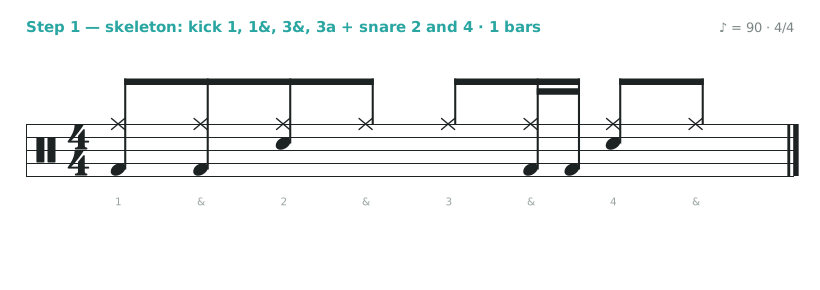
Leave out the small snares and play only the frame. The kick comes in pairs: 1 and the “and” of 1, then the “and” of 3 and the “a” of 3 — those doubled kicks are the first thing that makes it sound like the Amen. Snare on the 2 and 4 backbeat. Start at 90 BPM.
Step 2 — the full first bar
Now add three sixteenth-note snares: the “a” of 2 (right before 3), the “e” of 3 (right before the “and”-of-3 kick) and the “a” of 4 (right before the next downbeat). These little snares give the break its rolling feel. On the record they sit below the 2-and-4 backbeat; the score has no dynamics, so keep them lighter yourself.
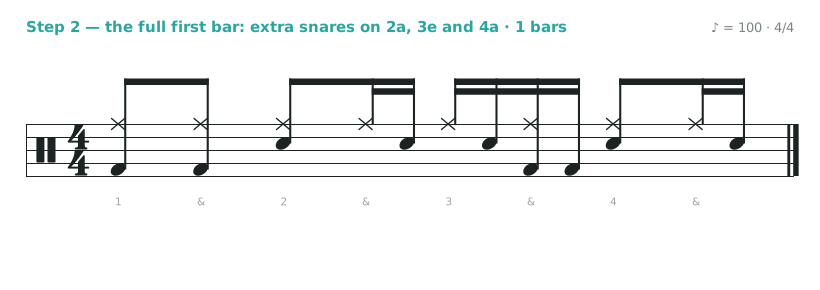
Right hand plays only the ride eighths; the left hand takes every snare. Right after the snare on the “e” of 3 come two kicks on the “and” and “a” of 3, so count it out slowly (“2 e & a 3 e & a”) and lock in left hand → foot → foot.
Step 3 — all four bars
Play the first bar twice. In bar 3, push the beat-4 snare to the “and” of 4 and play just one kick on the “and” of 3. Bar 4 drops the kick on 1, starts with a snare on the “e” of 1, puts kicks on the “and” and “a” of 1, and hits kick plus crash on the “and” of 3. The score below runs at 136 BPM, close to the original, so try the Slow 75% button first.
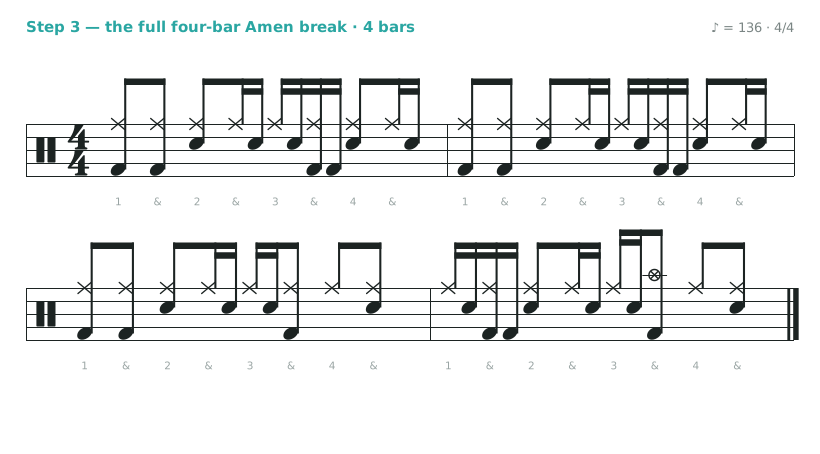
① Bar 1 alone at 90 BPM, four times in a row → ② bars 1–2 plus bar 3 with its late snare → ③ bar 4 on its own (the empty downbeat feels odd at first) → ④ all four bars at 110 → 120 → 136 BPM. The most common mistake is rushing the delayed snares in bars 3 and 4.
The royalties that never came
According to Wikipedia, the Winstons never received royalties for the sample. Bandleader Richard Lewis Spencer, who owned the copyright, only found out in 1996, by which time the three-year statute of limitations for infringement had run out. Coleman died homeless and destitute in 2006. In 2015, two British DJs set up a fundraiser for Spencer that raised more than £18,000; Spencer died in 2020. In 2026, “Amen, Brother” was selected for the US National Recording Registry.
Practice with DrumMate
Once sixteenth-note kicks and snares feel natural, take them into real songs. The DrumMate library has more than 1,000 songs, and with an electronic kit connected it scores your timing and accuracy bar by bar. The free metronome makes it easy to step the tempo up as you go.