
How to Start a Song on Drums — 4 Drum Intro Patterns and the Count-In (Notation and Audio)

A drum intro is how you open the first few bars of a song. The basic version is a count-in (four clicks at tempo) followed by a crash and kick on beat 1 of the next bar. Swap in a pickup fill, a build-in or a tom intro, and the same song starts with a completely different feel.
All four intros below lead into the same 8th-note beat, with notation and audio. Endings are covered separately in the drum endings post — learn starts and endings together and you can play a song cleanly from the first bar to the last.
- Basic: four count-in clicks → crash and kick on 1
- Pickup fill: count three, play a short fill on beat 4, crash on 1
- Build-in: hi-hat, then kick, then snare, one bar each
- Tom intro: floor-tom 8th notes for a heavy start
- With a band, agree on the count-in tempo, the number of intro bars and the beat where everyone comes in
At a glance
| Intro | How to play it | Good for | Where the band comes in |
|---|---|---|---|
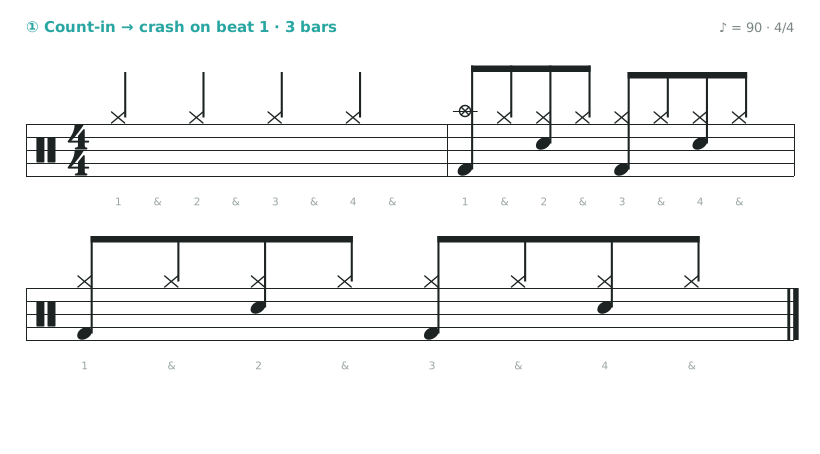
| ① Count-in → crash | Four quarter-note clicks on the hi-hat (or sticks) → crash and kick on 1 | Most songs, first rehearsals | Beat 1 of the bar after the count |
| ② Pickup fill | Rest for beats 1–3 (the count), short fill on 4 → crash on 1 | Bright, punchy openings | Beat 1 after the fill |
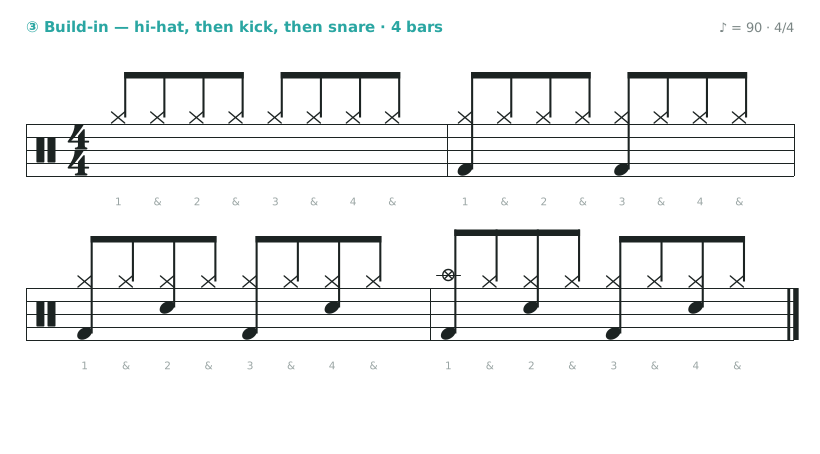
| ③ Build-in | Hi-hat alone → add kick → add snare → crash | Songs where the drums start alone, intros that grow | A bar you agree on (e.g. beat 1 of bar 4) |
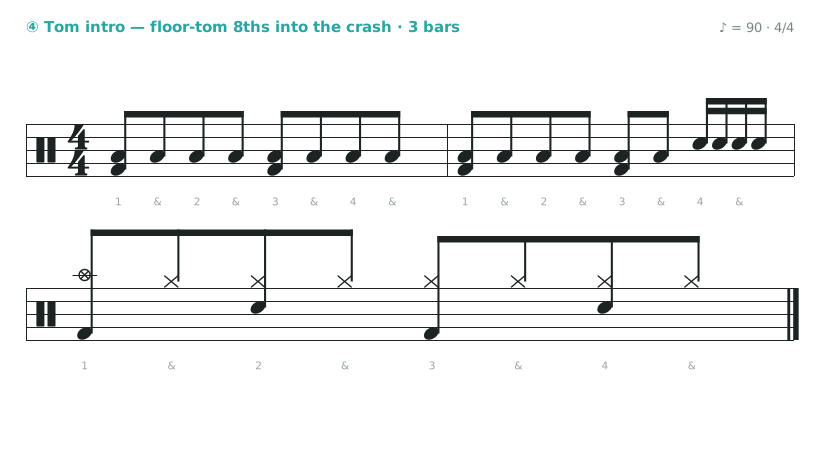
| ④ Tom intro | Floor-tom 8ths with kick on 1 and 3 → short fill → crash | Heavy, big-sounding songs | The beat 1 with the crash |
① Count-in → crash on beat 1
The most common start. Click four quarter notes on the hi-hat or your sticks at the song’s tempo so everyone hears the speed, then open the song with a crash and kick together on beat 1 of the next bar. The key is a count-in at exactly the song’s tempo — nerves make count-ins rush, so check the tempo on a metronome right before you count.
② Pickup fill — start on beat 4
Count only “one, two, three,” play a short fill on beat 4 (here, four 16th notes on the snare) and come in with the crash on beat 1 of the next bar. The song seems to jump in slightly ahead of the downbeat. The fill doesn’t need to be long — one beat is plenty.
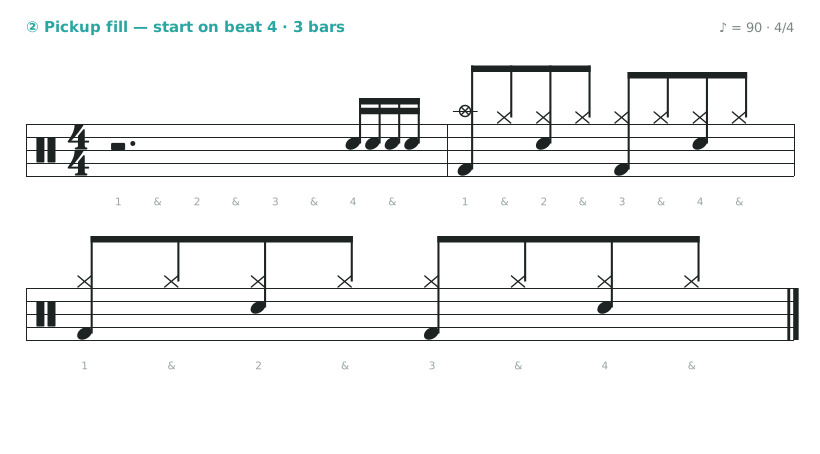
The whole band comes in on the beat 1 after the pickup fill. Landing that beat together matters more than a flashy fill. If the first beat after your fill keeps coming in late or early, shrink the fill to two 8th notes.
③ Build-in — hi-hat, then kick, then snare
A common choice when the drums start alone. One bar of hi-hat 8ths, one bar adding the kick on 1 and 3, one bar adding the snare on 2 and 4 — then the band comes in with the crash on beat 1 of bar 4. The thing to practice is keeping your hands and feet steady each time you add a part.
④ Tom intro — floor-tom 8th notes
Playing 8th notes on the floor tom instead of the hi-hat makes the very first sound heavy. On beat 4 of the second bar, four snare 16ths give the signal, and on beat 1 of bar 3 you hit the crash and switch to an 8th-note hi-hat beat. To keep the time from slipping as your hand moves to the hi-hat, practice taking your right hand straight from the crash to the hi-hat.
5 tips for starting songs with a band
- Decide who starts. For each song, agree whether everyone starts on your count, the drums start alone, or the guitar starts and the drums come in later.
- Count-in tempo = song tempo. Check the original BPM in advance and listen to it on a metronome right before you count.
- Write down the intro length. Notes like “intro 4 bars → verse” keep you from missing your entrance.
- Make the entry beat obvious. The crash and kick on the beat 1 after the intro is everyone’s cue, so play it clearly.
- Listen to the original intro. Hear how the recording starts first, then see whether you can play something close to it.
In the DrumMate library you can practice more than 1,000 songs from the very start along with the original recordings, and if you connect an electronic kit it scores your timing and accuracy bar by bar — so you can check your timing from the first bar of the song.
Keep reading
- How to End a Song on Drums — 4 Drum Ending Patterns and How to Finish With the Band (Notation and Audio)
- Your First Band Rehearsal — 7 Things Every Drummer Should Prepare
- Drum Build-Ups — Three Ways to Raise the Energy Before a Chorus (Notation and Audio)
- How to Practise with a Metronome — 4 Steps to Rock-Solid Drum Time