
How to End a Song on Drums — 4 Drum Ending Patterns and How to Finish With the Band (Notation and Audio)

The basic drum ending is one crash and kick together on beat 1 of the last bar, left to ring. Change when you hit it (beat 1 or the “and” of 4), how many times (once or three times) and what leads into it (a fill or a roll), and you can end almost any song.
Below are four common endings with notation and audio, plus tips for finishing cleanly with a band.
- Four endings: 1) fill into one final hit, 2) ending on the “and” of 4, 3) three stabs, 4) roll into a final hit.
- Decide beforehand whether the last note rings or is choked (grabbed to stop the cymbal).
- The bar before the ending matters most — a fill or roll tells everyone the song is about to stop.
- For songs that slow down (rit.) or hold a fermata, watch the band leader instead of counting.
Four Drum Endings at a Glance
| Ending | How to play it | Good for | Last note |
|---|---|---|---|
| 1. One final hit | Short fill, then crash + kick on beat 1 of the next bar | Most ballads, pop and rock | Ring or choke |
| 2. Ending on the & of 4 | Crash + kick + snare on the “and” of 4 in the last bar | Fast rock, punk, pop-punk | Usually choked |
| 3. Three stabs | Crash + snare + kick on beats 1, 2 and 3 of the last bar | Songs where the whole band hits together | Sometimes let the third ring |
| 4. Roll ending | A bar of snare roll, then crash + kick on 1 | Last song of a set, big finishes | Let it ring |
1. Fill Into One Final Hit
The most common ending. Put a short fill on beat 4 of the bar before the end (here one sixteenth each on snare, high tom, mid tom and floor tom), then hit crash and kick together on beat 1 of the last bar. After that, play nothing.
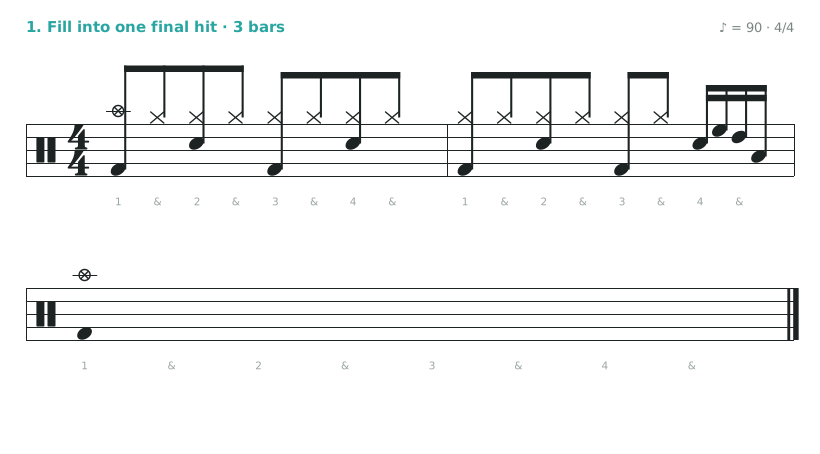
After the final hit you can let the cymbal ring, or grab it with your left hand to stop the sound (a choke) — see When to Hit the Crash Cymbal — Timing, Technique and Chokes (Notation and Audio) for how. If the band stops dead together, choke it; if the last chord rings out, let the cymbal ring too.
2. Ending on the “And” of 4
Instead of waiting for beat 1 of the next bar, play the final hit on the “and” of 4. Ending half a beat early gives a sudden, clipped finish that you hear a lot in fast rock and punk. Two sixteenth snares on beat 4 right before it make the hit easy to hear.
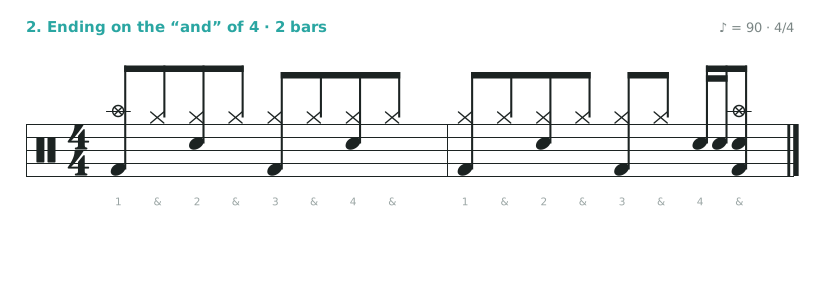
Everyone in the band has to know this one. If you don’t agree on “we end on the and of 4” before rehearsal, some players will hit on the “and” and others on the next beat 1, and the ending happens twice.
3. Three Stabs
Hit crash, snare and kick together on beats 1, 2 and 3 of the last bar and leave beat 4 empty. The whole band plays these stabs together, so the drums have to show the beats clearly. Four sixteenth snares on beat 4 of the previous bar warn everyone it’s coming.
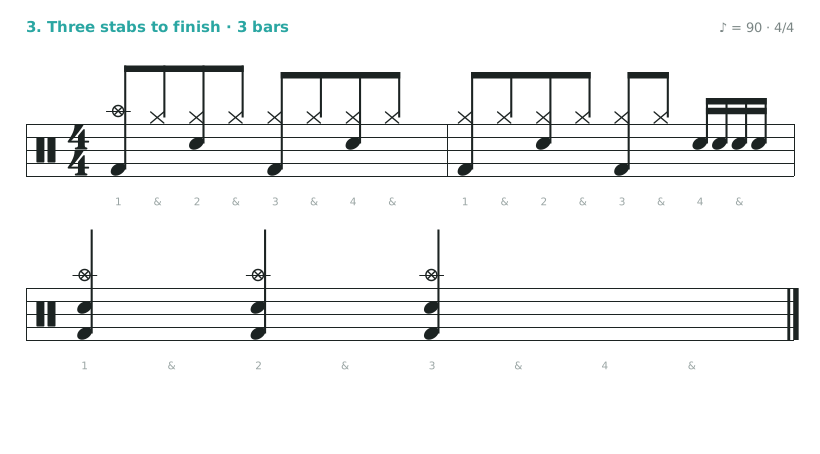
Right hand on crash, left hand on snare, right foot on kick — all at once. Keeping the three hits even is the hard part; many songs make the third one the biggest and let it ring. The notation has no accent marks, so add them to suit the song.
4. Roll Ending
Use this for a big finish, like the last song of a set. Fill the bar before the end with a snare roll that gets louder (a crescendo), then end with crash and kick on beat 1. It’s written as thirty-seconds, but in practice you play an even double-stroke or buzz roll — see How to Do a Drum Roll — Single, Double and Buzz Rolls, and How to Make Them Even (Notation and Audio).
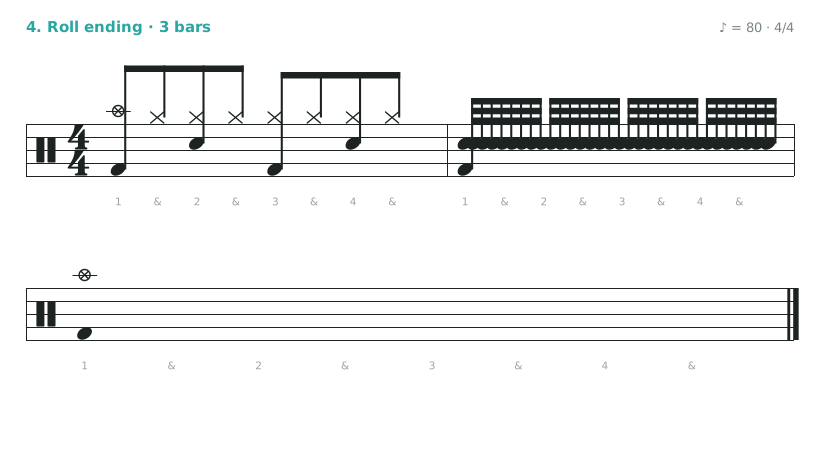
Live, drummers often hold the roll longer than one bar and hit the end when the singer or guitarist drops their hand. When that happens, watch that person rather than counting.
How to End Cleanly With a Band
- Write down where the last bar is: for example “end on bar 8 of the last chorus.” Counting song sections is covered in Song Structure for Drummers — What to Play in the Verse, Chorus and Bridge (Notation and Audio).
- Signal it a bar early: the fill in the bar before is the cue. For a bigger ending, stretch it to two bars as in Two-Bar Drum Fills — 3 Ways to Build a Longer Fill Before the Last Chorus or Ending (Notation and Audio).
- Songs that slow down (rit.): don’t count the tempo — slow down with the singer or guitarist. Marks like rit. and the fermata are explained in Tempo Markings Explained — Largo, Andante, Allegro and Presto in BPM, and How to Read ♩ = 120 (Notation and Audio) and Drum Notation Symbols Explained — Accents, Ghost Notes, Flams, Roll Slashes, Rimshots and Chokes.
- Fade-out songs: even if the record fades, live you need a real ending — usually 1 or 4 above (see “agree on the ending” in Your First Band Rehearsal — 7 Things Every Drummer Should Prepare).
- Stop after the hit: a very common mistake is one stray hi-hat or kick after the final hit. Get used to holding your sticks still for a second or two after it.
At 90 BPM on the metronome, play three bars of 8-beat and then one ending bar, over and over. Cycle through all four endings, record yourself, and check that the final hit lines up with the click and nothing else sounds after it.
In the DrumMate library you can play more than 1,000 songs from start to finish along with the original recordings, so you can check exactly how each song ends. With an electronic kit connected, you also get timing and accuracy scores for every bar.