
When the Levee Breaks Drum Beat — How to Play John Bonham’s Groove in 3 Steps (Notation and Audio)

Led Zeppelin’s “When the Levee Breaks” (1971) is one of the most famous drum sounds in rock, and it belongs to John Bonham. The pattern itself is simpler than it sounds: 8th-note hi-hat, snare on 2 and 4, and kick on 1, 2a, 3& and 3a. That one bar comes back again and again through the song.
The notation in this post follows the main groove exactly as two drum-lesson sources write it — the transcription in Roland’s “Behind the Beat” article and a 7DrumLessons transcription — and both put every note in the same place. This isn’t a full transcription of the song; it covers the main groove only, built up in three steps by adding one kick at a time.
- Main groove: 8th-note hi-hat · snare on 2 and 4 · kick on 1, 2a, 3&, 3a
- The tricky parts are the 2a kick (alone between hi-hat notes) and the 3&–3a double kick
- Practice in three steps: kick 1·3& → 1·2a·3& → 1·2a·3&·3a
- None of the 434 songs in the DrumMate library uses this kick-and-snare bar — four use it without the 3a
The story — a blues original and drums recorded in a stairwell
- The original: a country blues song written and first recorded by Kansas Joe McCoy and Memphis Minnie, cut in New York in June 1929. The lyrics are about the Great Mississippi Flood of 1927.
- Led Zeppelin’s version: the closing track of the band’s untitled fourth album (usually called “Led Zeppelin IV”), released in 1971, running 7:08. Robert Plant suggested the song, and Wikipedia notes that Bonham’s drumming is usually seen as its defining feature.
- The drum recording: Bonham played a Ludwig kit in the lobby of Headley Grange, with two microphones hung above a flight of stairs. The sound then ran through heavily set compressors and an echo (delay) unit.
- Sampling: the beat has been sampled by the Beastie Boys (on Licensed to Ill), Dr. Dre, Eminem, Beyoncé (“Don’t Hurt Yourself”), Enigma (“Return to Innocence”) and many others.
- John Bonham: born 31 May 1948 in Redditch, England, died 25 September 1980 at 32. Rolling Stone named him the greatest drummer of all time in 2016, and he entered the Rock and Roll Hall of Fame with Led Zeppelin in 1995.
The “When the Levee Breaks” drum pattern on a 16-step grid
Split one bar into sixteen 16th notes and the spots are easy to see. The “a” is the last 16th note of each beat (1 e & a).
        1 e & a 2 e & a 3 e & a 4 e & a
Hi-hat  x   x   x   x   x   x   x   x
Snare           O               O
Kick    O             O     O O
| Instrument | Where | What to watch |
|---|---|---|
| Hi-hat | Eight 8th notes | Keep your hand steady and even |
| Snare | Beats 2 and 4 | Roland’s transcription marks both with accents |
| Kick | 1, 2a, 3&, 3a | The 2a sits alone between hi-hat notes; 3& and 3a are two 16ths in a row |
Learn it in three steps (notation and audio)
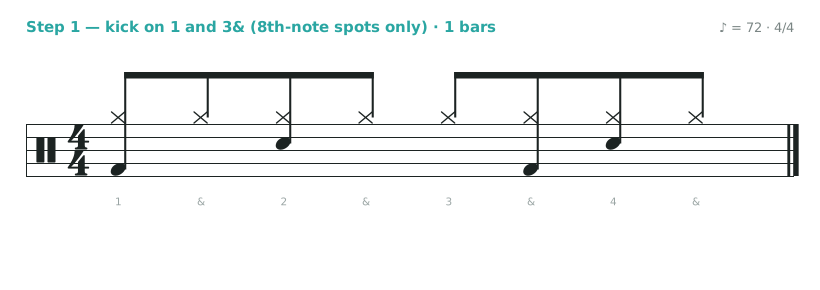
Step 1 — kick on 1 and 3&
Start with the kick on 8th-note spots only: beat 1 and the & of 3. This is the Levee groove with the 2a and 3a taken out.
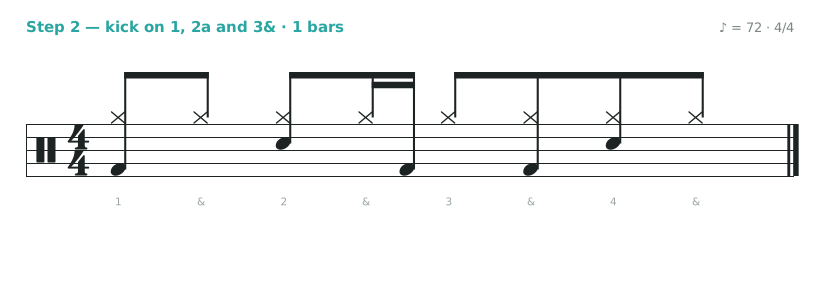
Step 2 — add the 2a kick
Right after the snare on 2, put a kick on the last 16th of beat 2 (2a). There’s no hi-hat there, so the kick sounds on its own. Don’t let your hand stall — keep the hi-hat even.
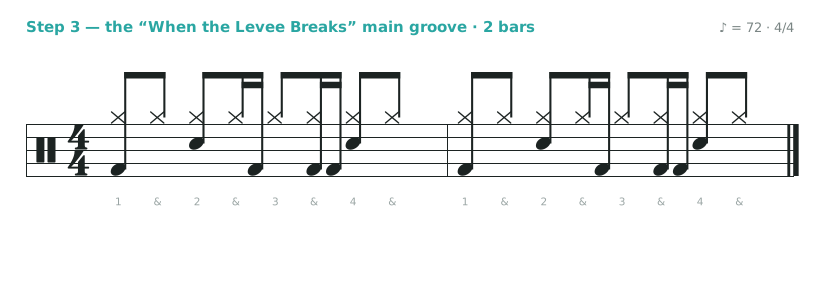
Step 3 — add the 3a kick: the main groove
Add one more kick on 3a, straight after the 3& kick, and you have the Levee groove. The 3&–3a pair is two kicks a 16th apart, so this is where your foot works hardest.
Lesson writers describe this groove with phrases like the kick “propelling” the hi-hat and the snare falling with a deliberate hesitation. The notation only shows where the notes go, so once you have the spots, listen to the record and let the snare land unhurried. A big part of the original’s huge sound comes from the room and the echo unit, so don’t expect a practice kit to sound the same.
How it compares with 434 songs in the DrumMate library
We compared the Levee groove with the real transcriptions (four bars of main beat and four bars of fill) in DrumMate’s song posts for all 434 songs in 4/4.
- Kick on 1, 2a, 3&, 3a with snare on 2 and 4: 0 songs — it doesn’t appear in any main-beat or fill bar.
- Songs with the 3&–3a double kick in the main beat: just 3 (including Smells Like Teen Spirit and Somewhere I Belong).
- Songs with a 2a kick in the main beat: 26; with a 3a kick: 12. Songs with a kick on any 16th-note “a” spot: 52 (about 12%).
The step 2 shape (kick on 1, 2a and 3& with snare on 2 and 4), however, is the main beat of four songs. All four are Level 14–15 on their song cards, so they make good practice pieces once step 2 feels easy.
| Song | Artist | Level | BPM |
|---|---|---|---|
| 사건의 지평선(Event Horizon) | YOUNHA | Level 14 | 98 |
| NO PAIN | Silica Gel | Level 15 | 94 |
| Boy | Charlie Puth | Level 15 | 93 |
| Kiss Me | Sixpence None The Richer | Level 14 | 100 |
Practice order
- Play step 1 at 72 BPM for one minute without wobbling.
- In step 2, count “1 e & a” out loud so the 2a kick never lands on a hi-hat note.
- For step 3, first play the kick part alone (1, 2a, 3&, 3a) to get the double kick, then add your hands. The heel-up/heel-down post below helps with two kicks in a row.
- When two bars loop without a gap, play along with the record. If the original tempo is too much, start a little slower with a metronome.
On DrumMate you can practice more than 1,000 library songs along with the original recordings, and if you connect an electronic kit it scores your timing and accuracy bar by bar. Use the 2a-kick songs in the table above to build the Levee footwork in real music.
Keep reading
- Heel Down vs Heel Up — How to Play the Bass Drum Pedal (Notation and Audio)
- 10 Intermediate Drum Beats — Sixteenth-Note Kicks, Funk, Half-Time and Shuffle Grooves (Notation and Audio)
- How to Play the Amen Break on Drums — The Most Sampled Drum Break in 3 Steps (Notation and Audio)
- The 10 Most Common Drum Beats — Kick and Snare Patterns Ranked From 434 Songs (Notation and Audio)